Results by title
246 books match the query 'Violence in Society' and 10 start with p
Peace and Mind
Part 3: Seriatim Symposium on Dispute, Conflict, and Enmity, Volume 8Jeffrey M. Perl, ed.
Duke University Press, 0
One contributor, a longtime president of the American Council of Learned Societies, calls for "intellectual philanthropy" and suggests that academics should transcend their ideological differences and form cooperative partnerships in the public service. A pair of essays, by key figures of the 1989 Velvet Revolution in Eastern Europe, analyze the ways that self-confidence and self-regard undercut efforts toward the resolution of complex social problems. The qualities of ideological self-subversion and even weakness, Common Knowledge maintains, are essential if the intellectual community is to become an agent for peace in a time of war.
Contributors. Wayne Andersen, Sissela Bok, Yves Bonnefoy, Caroline Walker Bynum, Clare Cavanagh, Charles-Albert Cingria, Caryl Emerson, Clifford Geertz, Stanley N. Katz, Aileen Kelly, Adam Michnik, Péter Nádas, Eugene Ostashevsky, Jeffrey M. Perl, Marjorie Perloff, Nina Pelikan Straus, Rei Terada, Gianni Vattimo, William Vesterman, Aleksandr Vvedensky, Adam Zagajewski.
Penelope’s Bones
A New History of Homer’s World through the Women Written Out of ItEmily Hauser
University of Chicago Press, 2025
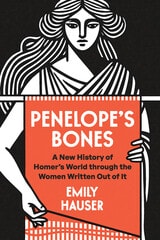
Achilles. Agamemnon. Odysseus. Hector. The lives of these and many other men in the greatest epics of ancient Greece have been pored over endlessly in the past three millennia. But these are not just tales about heroic men. There are scores of women as well—complex, fascinating women whose stories have gone unexplored for far too long.
In Penelope’s Bones, award-winning classicist and historian Emily Hauser pieces together compelling evidence from archaeological excavations and scientific discoveries to unearth the richly textured lives of women in Bronze Age Greece—the era of Homer’s heroes. Here, for the first time, we come to understand the everyday lives and experiences of the real women who stand behind the legends of Helen, Briseis, Cassandra, Aphrodite, Circe, Athena, Hera, Calypso, Penelope, and more. In this captivating journey through Homer’s world, Hauser explains era-defining discoveries, such as the excavation of Troy and the decipherment of Linear B tablets that reveal thousands of captive women and their children; more recent finds like the tomb of the Griffin Warrior at Pylos, whose tomb contents challenge traditional gender attributes; DNA evidence showing that groups of warriors buried near the Black Sea with their weapons and steeds were, in fact, Amazon-like female fighters; a prehistoric dye workshop on Crete that casts fresh light on “women’s work” of dyeing, spinning, and weaving textiles; and a superbly preserved shipwreck off the coast of Turkey whose contents tell of the economic and diplomatic networks crisscrossing the Bronze Age Mediterranean.
Essential reading for fans of Madeline Miller or Natalie Haynes, this riveting new history brings to life the women of the Bronze Age Aegean as never before, offering a groundbreaking reassessment of the ancient world.
Performances of Violence
Austin Sarat
University of Massachusetts Press, 2011

Phenomenal Justice
Violence and Morality in ArgentinaEva van Roekel
Rutgers University Press, 2020
Short-listed for the Juan E. Méndez Book Award for Human Rights in Latin America from Duke University Libraries
How do victims and perpetrators of political violence caught up in a complicated legal battle experience justice on their own terms? Phenomenal Justice is a compelling ethnography about the reopened trials for crimes against humanity committed during the brutal military dictatorship that ruled Argentina between 1976 and 1983. Grounded in phenomenological anthropology and the anthropology of emotion, this book establishes a new theoretical basis that is faithful to the uncertainties of justice and truth in the aftermath of human rights violations. The ethnographic observations and the first-person stories about torture, survival, disappearance, and death reveal the enduring trauma, heartfelt guilt, happiness, battered pride, and scratchy shame that demonstrate the unreserved complexities of truth and justice in post-conflict societies. Phenomenal Justice will be an indispensable contribution to a better understanding of the military dictatorship in Argentina and its aftermath.

Poetry and Violence
The Ballad Tradition of Mexico's Costa ChicaJohn H. McDowell
University of Illinois Press, 1999
Detailed and rife with social and cultural implications, Poetry and Violence is a compelling commentary on violence as both human experience and communicative action.
Political Power in Pre-Colonial Buganda
Economy, Society, and Warfare in the Nineteenth CenturyRichard Reid
Ohio University Press, 2002
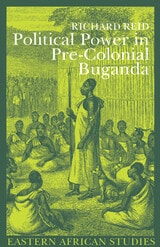
Blessed with fertile and well-watered soil, East Africa’s kingdom of Buganda supported a relatively dense population and became a major regional power by the mid-nineteenth century. This complex and fascinating state has also long been in need of a thorough study that cuts through the image of autocracy and military might.
Political Power in Pre-Colonial Buganda explores the material basis of Ganda political power, gives us a new understanding of what Ganda power meant in real terms, and relates the story of how the kingdom used the resources at its disposal to meet the challenges that confronted it. Reid further explains how these same challenges ultimately limited Buganda’s dominance of the East African great lakes region.

Post-Military Society
Militarism, Demilitarization and War at the End of the Twentieth CenturyMartin Shaw
Temple University Press, 1991
With the collapse of the Cold War following the Eastern European revolutions and the ongoing democratization of the Soviet republics, optimism about peace has transformed the international political climate. Incidents such as the Gulf War, however, have tempered this optimism and cast doubts on the prospects for demilitarization. In this book, Martin Shaw examines some of the developments that lie behind the recent momentous changes and argues that, despite the Gulf War and other regional wars, militarism is in decisive retreat.
Writing from a broadly sociological perspective, Shaw examines the roles of war and military institutions in human society and the ways in which preoccupation with war has affected domestic, regional, and international politics in the twentieth century. In doing so, he asks: When does the post-war era end? How have nuclear weapons altered the perception of war by society? What is the relationship between industrialism and militarism?
The author contends that, despite the militarism of some Third World countries, societies in the advanced industrial world (especially in Europe) have been undergoing a profound demilitarization. These societies have become politically insulated from war preparation, have recognized the effect of social movements on inter-state relations, and are experiencing a "revolution of rising expectations."
Offering evidence of "post-military citizenship," Shaw describes the increasing resistance to military conscription throughout the Western world, the replacement of blind obedience with demand for accountability in Eastern bloc countries, and the simultaneous rise of nationalism and communitarianism among common market members. And, in light of the collapse of Stalinist militarism in Europe and the USSR, Shaw suggests some of the changes that face Soviet society.

Postfeminist War
Women in the Media-Military-Industrial ComplexMary Douglas Vavrus
Rutgers University Press, 2019

Primed for Violence
Murder, Antisemitism, and Democratic Politics in Interwar PolandPaul Brykczynski
University of Wisconsin Press, 2017
As Paul Brykczynski tells this gripping story, he explores the complex role of antisemitism, nationalism, and violence in Polish politics between the two World Wars. Though focusing on Poland, the book sheds light on the rise of the antisemitic right in Europe and beyond, and on the impact of violence on political culture and discourse.

Prison and Social Death
Price, Joshua M
Rutgers University Press, 2015