Results by title
51 books match the query 'Volume' and 3 start with p
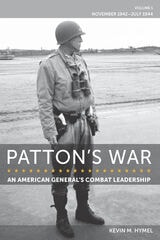
Patton's War
An American General's Combat Leadership, Volume I: November 1942–July 1944Kevin M. Hymel
University of Missouri Press, 2021
George S. Patton Jr. lived an exciting life in war and peace, but he is best remembered for his World War II battlefield exploits. Patton’s War: An American General’s Combat Leadership: November 1942–July 1944, the first of three volumes, follows the general from the beaches of Morocco to the fields of France, right before the birth of Third Army on the continent. In highly engaging fashion, Kevin Hymel uncovers new facts and challenges long-held beliefs about the mercurial Patton, not only examining his relationships with his superiors and fellow generals and colonels, but also with the soldiers of all ranks whom he led. Using new sources unavailable to previous historians and through extensive research of soldiers’ memoirs and interviews, Hymel adds a new dimension to the telling of Patton’s WWII story.
[more]
Perjury and Pardon, Volume I
Jacques Derrida
University of Chicago Press, 2022
An inquiry into the problematic of perjury, or lying, and forgiveness from one of the most influential philosophers of the twentieth century.
“One only ever asks forgiveness for what is unforgivable.” From this contradiction begins Perjury and Pardon, a two-year series of seminars given by Jacques Derrida at the École des hautes études en sciences sociales in Paris in the late 1990s. In these sessions, Derrida focuses on the philosophical, ethical, juridical, and political stakes of the concept of responsibility. His primary goal is to develop what he calls a “problematic of lying” by studying diverse forms of betrayal: infidelity, denial, false testimony, perjury, unkept promises, desecration, sacrilege, and blasphemy.
Although forgiveness is a notion inherited from multiple traditions, the process of forgiveness eludes those traditions, disturbing the categories of knowledge, sense, history, and law that attempt to circumscribe it. Derrida insists on the unconditionality of forgiveness and shows how its complex temporality destabilizes all ideas of presence and even of subjecthood. For Derrida, forgiveness cannot be reduced to repentance, punishment, retribution, or salvation, and it is inseparable from, and haunted by, the notion of perjury. Through close readings of Kant, Kierkegaard, Shakespeare, Plato, Jankélévitch, Baudelaire, and Kafka, as well as biblical texts, Derrida explores diverse notions of the “evil” or malignancy of lying while developing a complex account of forgiveness across different traditions.
[more]
Public Response to Peacetime Uses of Atomic Energy
Volume I: Community DifferencesBurton R. Fisher, Benjamin J. Darsky, and Charles A. Metzner
University of Michigan Press, 1951
This is Volume 1 of a study of people, reactions, and information, based on a sample interview survey in comparable communities with and without major atomic energy activities. The study was conducted under contract with the United States Atomic Energy Commission. This volume presents aspects of data obtained from a survey of public reactions and information dealing with peacetime uses of atomic energy. Research methods and study objectives are also discussed, and the book includes an appendix containing the questionnaire used in the study.
[more]