Results by title
53 books match the query 'Voting' and 5 start with p

POWER OF THE PEOPLE
Congressional Competition, Public Attention, and Voter RetributionSean M. Theriault
The Ohio State University Press, 2005
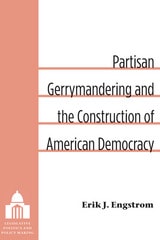
Partisan Gerrymandering and the Construction of American Democracy
Erik J. Engstrom
University of Michigan Press, 2016
Erik J. Engstrom offers a historical perspective on the effects of gerrymandering on elections and party control of the U.S. national legislature. Aside from the requirements that districts be continuous and, after 1842, that each select only one representative, there were few restrictions on congressional districting. Unrestrained, state legislators drew and redrew districts to suit their own partisan agendas. With the rise of the “one-person, one-vote” doctrine and the implementation of the Voting Rights Act of 1965, however, redistricting became subject to court oversight.
Engstrom evaluates the abundant cross-sectional and temporal variation in redistricting plans and their electoral results from all the states, from 1789 through the 1960s, to identify the causes and consequences of partisan redistricting. His analysis reveals that districting practices across states and over time systematically affected the competitiveness of congressional elections, shaped the partisan composition of congressional delegations, and, on occasion, determined party control of the House of Representatives.
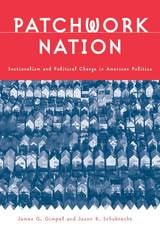
Patchwork Nation
Sectionalism and Political Change in American PoliticsJames G. Gimpel and Jason E. Schuknecht
University of Michigan Press, 2004
Political Judgment
Structure and ProcessMilton Lodge and Kathleen M. McGraw, Editors
University of Michigan Press, 1995
Positive Political Theory II
Strategy and StructureDavid Austen-Smith and Jeffrey S. Banks
University of Michigan Press, 2005
other book like it.”
—Norman Schofield, Washington University
“The authors succeed brilliantly in tackling a large
number of important questions concerning the
interaction among voters and elected representatives
in the political arena, using a common, rigorous
language.”
—Antonio Merlo, University of Pennsylvania
Positive Political Theory II: Strategy and Structure
is the second volume in Jeffrey Banks and David
Austen-Smith’s monumental study of the links
between individual preferences and collective choice.
The book focuses on representative systems, including
both elections and legislative decision-making
processes, clearly connecting individual preferences to
collective outcomes. This book is not a survey. Rather,
it is the coherent, cumulative result of the authors’
brilliant efforts to indirectly connect preferences to
collective choice through strategic behaviors such as
agenda-selection and voting.
The book will be an invaluable reference and teaching
tool for economists and political scientists, and an
essential companion to any scholar interested in the
latest theoretical advances in positive political theory.