Results by title
65 books match the query 'Water-supply' and 2 start with p
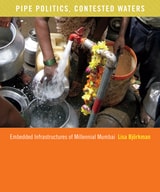
Pipe Politics, Contested Waters
Embedded Infrastructures of Millennial MumbaiLisa Bjorkman
Duke University Press, 2015
Winner, 2014 Joseph W. Elder Prize in the Indian Social Sciences
Despite Mumbai's position as India's financial, economic, and cultural capital, water is chronically unavailable for rich and poor alike. Mumbai's dry taps are puzzling, given that the city does not lack for either water or financial resources. In Pipe Politics, Contested Waters, Lisa Björkman shows how an elite dream to transform Mumbai into a "world class" business center has wreaked havoc on the city’s water pipes. In rich ethnographic detail, Pipe Politics explores how the everyday work of getting water animates and inhabits a penumbra of infrastructural activity—of business, brokerage, secondary markets, and sociopolitical networks—whose workings are reconfiguring and rescaling political authority in the city. Mumbai’s increasingly illegible and volatile hydrologies, Björkman argues, are lending infrastructures increasing political salience just as actual control over pipes and flows becomes contingent on dispersed and intimate assemblages of knowledge, power, and material authority. These new arenas of contestation reveal the illusory and precarious nature of the project to remake Mumbai in the image of Shanghai or Singapore and gesture instead toward the highly contested futures and democratic possibilities of the actually existing city.
Despite Mumbai's position as India's financial, economic, and cultural capital, water is chronically unavailable for rich and poor alike. Mumbai's dry taps are puzzling, given that the city does not lack for either water or financial resources. In Pipe Politics, Contested Waters, Lisa Björkman shows how an elite dream to transform Mumbai into a "world class" business center has wreaked havoc on the city’s water pipes. In rich ethnographic detail, Pipe Politics explores how the everyday work of getting water animates and inhabits a penumbra of infrastructural activity—of business, brokerage, secondary markets, and sociopolitical networks—whose workings are reconfiguring and rescaling political authority in the city. Mumbai’s increasingly illegible and volatile hydrologies, Björkman argues, are lending infrastructures increasing political salience just as actual control over pipes and flows becomes contingent on dispersed and intimate assemblages of knowledge, power, and material authority. These new arenas of contestation reveal the illusory and precarious nature of the project to remake Mumbai in the image of Shanghai or Singapore and gesture instead toward the highly contested futures and democratic possibilities of the actually existing city.
[more]
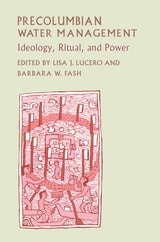
Precolumbian Water Management
Ideology, Ritual, and PowerEdited by Lisa J. Lucero and Barbara W. Fash
University of Arizona Press, 2006
Among ancient Mesoamerican and Southwestern peoples, water was as essential as maize for sustenance and was a driving force in the development of complex society. Control of water shaped the political, economic, and religious landscape of the ancient Americas, yet it is often overlooked in Precolumbian studies. Now one volume offers the latest thinking on water systems and their place within the ancient physical and mental language of the region.
Precolumbian Water Management examines water management from both economic and symbolic perspectives. Water management facilities, settlement patterns, shrines, and water-related imagery associated with civic-ceremonial and residential architecture provide evidence that water systems pervade all aspects of ancient society. Through analysis of such data, the contributors seek to combine an understanding of imagery and the religious aspects of water with its functional components, thereby presenting a unified perspective of how water was conceived, used, and represented in ancient greater Mesoamerica. The collection boasts broad chronological and geographical coverage—from the irrigation networks of Teotihuacan to the use of ritual water technology at Casas Grandes—that shows how procurement and storage systems were adapted to local conditions.
The articles consider the mechanisms that were used to build upon the sacredness of water to enhance political authority through time and space and show that water was not merely an essential natural resource but an important spiritual one as well, and that its manipulation was socially far more complex than might appear at first glance. As these papers reveal, an understanding of materials associated with water can contribute much to the ways that archaeologists study ancient cultural systems. Precolumbian Water Management underscores the importance of water management research and the need to include it in archaeological projects of all types.
[more]