Results by title
301 books match the query 'West (U.S.)' and 11 start with p
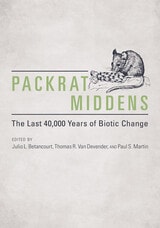
Packrat Middens
The Last 40,000 Years of Biotic ChangeEdited by Julio L. Betancourt, Thomas R. Van Devender, and Paul S. Martin
University of Arizona Press, 1990
This book brings together the findings and views of many of the researchers investigating fossil middens in the United States, Mexico, Africa, the Middle East, and Australia. The contributions serve to open a forum for methodological concerns, update the fossil record of various geographic regions, introduce new applications, and display the vast potential for fossil midden analysis in arid regions worldwide. The findings presented here will serve to foster regional research and to promote general studies devoted to global climate change. Included in the text are more than two hundred charts, photographs, and maps.
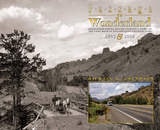
Passage to Wonderland
Rephotographing Joseph Stimson's Views of the Cody Road to Yellowstone National Park, 1903 and 2008Michael A. Amundson
University Press of Colorado, 2012
Amundson examines the physical changes along "the most scenic fifty miles in America" and explores the cultural and natural history behind them. This careful analysis of the paired images make Passage to Wonderland more than a "then and now" photography book--it is a unique exploration of the interconnectedness between the Old West and the New West. It will be a wonderful companion for those touring the Cody Road as well as those armchair tourists who can follow the road on Google Earth using the provided GPS coordinates.
The University Press of Colorado gratefully acknowledges the generous support of the Charles Redd Center for Western Studies at Brigham Young University toward the publication of this book.
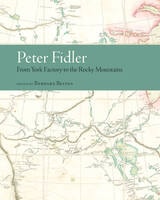
Peter Fidler
From York Factory to the Rocky MountainsBarbara Belyea
University Press of Colorado, 2026
The two journals—“From York Factory to Buckingham House” and “From Buckingham House to the Rocky Mountains”—detail Fidler’s travels over a period of nine months. They include remarks on fur trade history, organization of the inland brigade, three distinct geographical regions, and the daily life of a Plains nation. Belyea’s introduction and ample notes provide insight into the way geographic, specifically cartographic, information was noted in the journals, with additional information on industry trading techniques, traders’ economic decisions, broad changes in regional social and economic conditions, and interactions with indigenous peoples.
Fidler’s journals are an exceptional record of the fur trade’s western expansion and the daily life of a Plains nation at the height of its power and prosperity. With its rich analysis of primary source documents and painstaking reproduction of historical trade routes, Peter Fidler: From York Factory to the Rocky Mountains will be of great value to students and scholars in the fields of fur trade studies, cartography, travel literature, and Canadian history, as well as general readers interested in westward expansion, exploration, commerce, and indigenous-colonial relations.

Photographed All the Best Scenery
Don Fowler
University of Utah Press, 1972

Platte River Road Narratives
A Descriptive Bibliography of Travel Over the Great Central Overland Route to Oregon, California, Utah, Colorado, Montana, and Other Western States and Territories, 1812-1866Merrill J. Mattes
University of Illinois Press, 1988
This massive annotated bibliography of all known significant eyewitness accounts of nineteenth-century central overland travel fills a conspicuous gap in historical literature, and will greatly accelerate research, writing, and collecting.
Platte River Road Narratives includes not only all identifiable overland accounts, but also a number of those identifiable in manuscript form only. Over 2,000 entries identify the author, the form of the passage, overland trip, and give Matte's authoritative commentary and evaluation, as well as identification of the repository of the source material.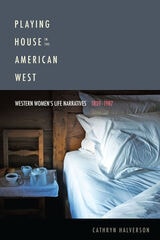
Playing House in the American West
Western Women's Life Narratives, 1839–1987Cathryn Halverson
University of Alabama Press, 2013
How domestic life shaped identity, gender, and power in the American West
The controlling metaphor Cathryn Halverson uses in her engrossing study is “playing house.” From Caroline Kirkland and Laura Ingalls Wilder to Willa Cather and Marilynne Robinson, from the mid-nineteenth to the late-twentieth centuries, western authors have persistently embraced wayward or eccentric housekeeping to prove a woman’s difference from western neighbors and eastern readers alike.
The readings in Playing House investigate the surprising textual ends to which westerners turn the familiar terrain of the home: evaluating community; arguing for different conceptions of race and class; and perhaps most especially, resisting traditional gender roles. Western women writers, Halverson argues, render the home as a stage for autonomy, resistance, and imagination rather than as a site of sacrifice and obligation.
The western women examined in Playing House in the American West are promoted and read as representatives of a region, as insiders offering views of distant and intriguing ways of life, even as they conceive of themselves as outsiders. By playing with domestic conventions, they recast the region they describe, portraying the West as a place that fosters female agency, individuality, and subjectivity.
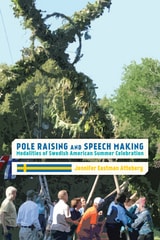
Pole Raising and Speech Making
Modalities of Swedish American Summer CelebrationJennifer Eastman Attebery
Utah State University Press, 2015
In Pole Raising and Speech Making, author Jennifer Eastman Attebery focuses on the beginnings of the traditional Scandinavian Midsummer celebration and the surrounding spring-to-summer seasonal festivities in the Rocky Mountain West during the height of Swedish immigration to the area—1880–1917.
Combining research in folkloristics and history, Attebery explores various ways that immigrants blended traditional Swedish Midsummer-related celebrations with local civic celebrations of American Independence Day on July 4 and the Mormons’ Pioneer Day on July 24. Functioning as multimodal observances with multiple meanings, these holidays represent and reconsider ethnicity and panethnicity, sacred and secular relationships, and the rural and the urban, demonstrating how flexible and complex traditional celebrations can be.
Providing a wealth of detail and information surrounding little-studied celebrations and valuable archival and published primary sources—diaries, letters, speeches, newspaper reports, and images—Pole Raising and Speech Making is proof that non-English immigrant culture must be included when discussing “American” culture. It will be of interest to scholars and graduate students in ethnic studies, folklore, ritual and festival studies, and Scandinavian American cultural history.
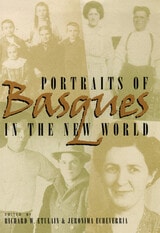
Portraits of Basques in the New World
Richard W. Etulain
University of Nevada Press, 1999
A collection of new essays on notable historic and contemporary Basques of America's Far West that offers a perceptive and lively examination of the lives of one of the West's most resilient and successful ethnic minorities. It is essential reading for anyone interested in the Basque people or those interested in the process of immigration and assimilation: these profiles illustrate how America's Basque immigrants have achieved success in mainstream society while retaining strong ties to their ancient Old World culture.
Pottery of the Great Basin and Adjacent Areas
UUAP 111Suzanne Griset
University of Utah Press, 1986
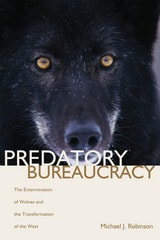
Predatory Bureaucracy
The Extermination of Wolves and the Transformation of the WestMichael Robinson
University Press of Colorado, 2005
Robinson follows wolves' successful adaptation to the arrival of explorers, mountain men, and bounty hunters, through their disastrous century-long entanglement with the federal government. He shares the parallel story of the Biological Survey's rise, detailing the personal, social, geographic, and political forces that allowed it to thrive despite opposition from hunters, animal lovers, scientists, environmentalists, and presidents.
Federal predator control nearly eliminated wolves throughout the United States and Mexico and radically changed American lands and wildlife populations. It undercut the livelihoods of countless homestead families in order to benefit an emerging western elite of livestock owners. The extermination of predators led to problems associated with prey overpopulation, but, as Robinson reveals, extermination and control programs still continue. Predatory Bureaucracy will fascinate readers interested in wildlife, ecosystems, agriculture, and environmental politics.
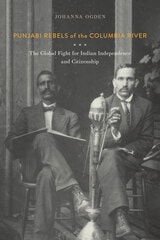
Punjabi Rebels of the Columbia River
The Global Fight for Indian Independence and CitizenshipJohanna Ogden
Oregon State University Press, 2024
Oregon is commonly perceived to have little, let alone notable, South Asian history. Yet in the early 1900s Oregon was at the center of two entwined quests for Indian independence and civic belonging that rocked the world.
Punjabi Rebels of the Columbia River traces the stories of the radical Indian independence organization known as Ghadar and Bhagat Singh Thind’s era-defining US Supreme Court citizenship case. Ghadar sought the overthrow of India’s British colonizers while Thind utilized sanctioned legal channels to do so. Despite widely differing strategies, both the movement and the man were targeted, often in coordination, by the highest levels of the US and British governments. The empires’ united message: India would not be an independent country and Indians could not be citizens. In the decades that followed, it was a verdict Indians refused to abide.
Johanna Ogden’s detailed history of migrants’ experience expands the time frame, geographic boundaries, and knowledge of the conditions and contributions of Indians in North America. It is the story of a people’s awakening amid a rich community of international workers in an age of nationalist uprisings. To understand why one of the smallest western Indian settlements became a resistance center, Punjabi Rebels mines the colonial underpinnings of labor, race, and place-making and their regional and global connections, rendering a history of whiteness and labor as much as of Indian-ness and migration. The first work to rejoin the lived experience of Thind and Ghadar activists, Punjabi Rebels complicates our understanding not just of the global fight for Indian political rights but of multi-racial democracy.