106 books match the query 'Western' and 4 start with p
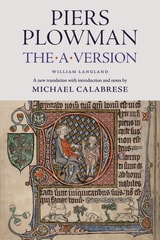
cover of Piers Plowman: The A Version

Piers Plowman

The A Version

William Langland

Catholic University of America Press, 2020
Passionate about trying to create social justice in a time of crisis after the Black Plague, William Langland spent his entire life working on Piers Plowman, an epic study of the human quest for truth, justice, and community. The “A Version,” the first and shortest of the three versions he crafted, is wonderfully relatable and completely teachable to a modern student audience. Piers Plowman is becoming ever more relevant to students and scholars in English studies. Perhaps because the poem involves culture, religion, community, and work and engages explicitly with the histories of government and popular revolt, this allegorical tale of a wandering Christian named “Will,” searching for truth with the aid of a humble plowman named Piers, has found new critical and pedagogic life in the last 20 years. Currently there are no translations of the A-version of Piers Plowman in print, so readers, scholars and teachers have been longing for an affordable, student-centered translation. The apparatus includes a 30-page historical and critical introduction, footnotes, a bibliography, a note on translation theory and practice, and samplings of the original text in Middle English, with a guide to pronunciation of that language. Piers Plowman is an extraordinary important document about the issues dramatically relevant to this day. It confronts poverty and inequity in 14th-century England and explores the need for virtue and social justice, encouraging its readers to create equality with open access for people of all classes and abilities. Though a Christian poem, Piers addresses issues of inclusivity, social responsibility and communal duty, as the poem’s protagonist wanders about the world, facing injustice and persecution as he looks for truth and salvation. Michael Calabrese, author of An Introduction to Piers Plowman and director of the Chaucer Studio’s Middle English recording of the poem, brings Piers Plowman to life for 21st-century students and for all readers interested in the history of society, virtue, faith and salvation.
[more]
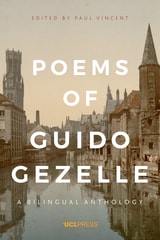
cover of Poems of Guido Gezelle: A Bilingual Anthology

Poems of Guido Gezelle

A Bilingual Anthology

Edited by Paul Vincent

University College London, 2016
The Bruges-born poet-priest Guido Gezelle(1830–1899) is generally considered one of the masters of 19th-century European lyric poetry. At the end of his life and in the first two decades of the 20th century, Gezellewas hailed by the avant-garde as the founder of modern Flemish poetry. His unique voice was belatedly recognised in the Netherlands and often compared with his English contemporary Gerard Manley Hopkins (1844–1889). In this bilingual anthology, award-winning translator Paul Vincent selects a representative picture of Gezelle’soutput, from devotional through narrative, to celebratory and expressionistic. Gezelle’sfavourite themes are childhood, the Flemish landscape, friendship, nature, religion and the Flemish vernacular, and his apparently simple poems conceal a sophisticated prosody and a dialogue with spiritual and literary tradition. However, an important barrier to wider international recognition of his lyric genius up to now has been the absence of translations that do justice to the vigour and musicality of Gezelle’sWest Flemish idiom. Two of the translations included go some way to redressing the balance: ‘TheWatter-Scriever’ by Scotland’s national poet Edwin Morgan and ‘A Little Leaf . . .’ by Francis Jones. Both translators make brilliant use of their own vernaculars (Glaswegian and North Yorkshire respectively) to bring Gezelleto life for the non-Dutch-speaking reader.
[more]
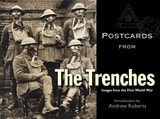
cover of Postcards from the Trenches: Images from the First World War

Postcards from the Trenches

Images from the First World War

Edited by the Bodleian Library

Bodleian Library Publishing, 2008

World War I has come down to us in indelible images—those of airplane bombers, bleak-eyed soldiers, stern-faced commanders, and the ruins of countless villages. But soldiers themselves also took photographs on the battlefield, and many of their striking images were transformed into postcards that were sent home to family and friends or collected as war mementos. Postcards from the Trenches gathers a number of these postcards to create a striking visual history of World War I.

The cards in this compelling volume were created not only by soldiers, but also by embedded journalists from France, Belgium, Austria, Germany, and Britain. The images capture scenes both humorous and poignant, including soldiers having a mock party with little food to eat, wounded soldiers smiling for the camera, a makeshift trench hospital, the bloody aftermath of a battle, and a huddle of men taking what they know could be their last communion before marching onto the battlefield. Other cards document the mundane duties that dominated wartime life, including men digging trenches, troops marching to new trenches and battlefields, and or soldiers nearly comatose with boredom while waiting for the fight to begin. This stunning visual narrative opens a new window into one of the most analyzed events in history, as the postcards’ images testify to the resilience and bravery of soldiers in the most trying circumstances.

            A fascinating and unprecedented historical document, Postcards from the Trenches draws back the curtain to unflinchingly show the daily horror and humanity that define life in war.
 
[more]
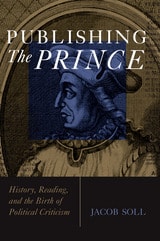
cover of Publishing The Prince: History, Reading, and the Birth of Political Criticism

Publishing The Prince

History, Reading, and the Birth of Political Criticism

Jacob Soll

University of Michigan Press, 2010

As new ideas arose during the Enlightenment, many political thinkers published their own versions of popular early modern "absolutist" texts and transformed them into manuals of political resistance. As a result, these works never achieved a fixed and stable edition. Publishing The Prince illustrates how Abraham-Nicolas Amelot de La Houssaye created the most popular late seventeenth- and eighteenth-century version of Machiavelli's masterpiece. In the process of translating, Amelot also transformed the work, altering its form and meaning, and his ideas spread through later editions.

Revising the orthodox schema of the public sphere in which political authority shifted away from the crown with the rise of bourgeois civil society in the eighteenth century, Soll uses the example of Amelot to show for the first time how the public sphere in fact grew out of the learned and even royal libraries of erudite scholars and the bookshops of subversive, not-so-polite publicists of the republic of letters.

Jacob Soll is Associate Professor of History at Rutgers University.

Cover art courtesy of Annenberg Rare Book Room and Manuscript Library, University of Pennsylvania
Jacket Design: Stephanie Milanowski

"Jacob Soll traces the origins of Enlightenment criticism to the practices of learned humanists and hard-pressed literary entrepreneurs. This learned and lively book is also a tour de force of historical research and interpretation."
---Anthony Grafton, author of Cardano's Cosmos and Bring Out Your Dead

"Brilliant. How the printed page changed political philosophy into investigative reporting, and reason of state into the unmasking of power."
---J. G. A. Pocock, author of The Machiavellian Moment

"Soll's path-breaking study is a 'must read' for all those interested in the history of political thought and early modern intellectual history."
---Barbara Shapiro, University of California Berkeley

"Soll has done [Amelot] and his context justice, writing as he does with a clear, singular, and welcome voice."
---Margaret C. Jacobs, American Historical Review

[more]