Results by title
453 books match the query 'Wisconsin' and 14 start with p

Patrick J. Lucey
A Lasting LegacyDennis L. Dresang
Wisconsin Historical Society Press, 2020
Preceding his service as governor, Lucey played a key role in rebuilding the Democratic Party in Wisconsin, returning a state that had been dominated by Republicans to a more moderate two-party system. As party chairman, he built coalitions between World War II veterans, remnants of the defunct Progressive Party, urban socialists, and activists in rural communities throughout the state.
Through exclusive interviews and unprecedented access to archival materials, Dennis L. Dresang shares the story of this pivotal figure in Wisconsin history, from his small-town rural roots to his wide-ranging influence.

Paying the Price
College Costs, Financial Aid, and the Betrayal of the American DreamSara Goldrick-Rab
University of Chicago Press, 2016
Not necessarily, says Sara Goldrick-Rab, and with Paying the Price, she shows in damning detail exactly why. Quite simply, college is far too expensive for many people today, and the confusing mix of federal, state, institutional, and private financial aid leaves countless students without the resources they need to pay for it.
Drawing on an unprecedented study of 3,000 young adults who entered public colleges and universities in Wisconsin in 2008 with the support of federal aid and Pell Grants, Goldrick-Rab reveals the devastating effect of these shortfalls. Half the students in the study left college without a degree, while less than 20 percent finished within five years. The cause of their problems, time and again, was lack of money. Unable to afford tuition, books, and living expenses, they worked too many hours at outside jobs, dropped classes, took time off to save money, and even went without adequate food or housing. In many heartbreaking cases, they simply left school—not with a degree, but with crippling debt. Goldrick-Rab combines that shocking data with devastating stories of six individual students, whose struggles make clear the horrifying human and financial costs of our convoluted financial aid policies.
America can fix this problem. In the final section of the book, Goldrick-Rab offers a range of possible solutions, from technical improvements to the financial aid application process, to a bold, public sector–focused “first degree free” program. What’s not an option, this powerful book shows, is doing nothing, and continuing to crush the college dreams of a generation of young people.

Penny Loafers & Bobby Pins
Tales and Tips from Growing Up in the ’50s and ’60sSusan Sanvidge
Wisconsin Historical Society Press, 2010
“In the fifties, sleek Mixmasters were replacing rusty eggbeaters, and new pressure-cookers blew their tops in kitchens all over town. There were kids everywhere, and new ‘ranch-style’ houses filled vacant lots. . . . Turquoise Studebakers and dusty-rose Chevy BelAirs with flamboyant fins and lots of chrome replaced dark pre-war cars. Cameras took color snapshots instead of black-and-white. We wore red canvas tennis shoes and lemon yellow shorts, and bright blue popsicles melted down our chins.” —from the Introduction
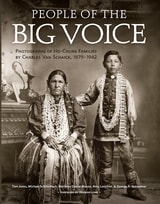
People of the Big Voice
Photographs of Ho-Chunk Families by Charles Van Schaick, 1879-1942Tom Jones
Wisconsin Historical Society Press, 2027
A stunning photographic portrayal of the Ho-Chunk people during a challenging period that presents the resilience of a community whose story continues to this day.
People of the Big Voice tells the visual history of Ho-Chunk families at the turn of the twentieth century and beyond as depicted through the lens of Black River Falls studio photographer Charles Van Schaick. The family relationships among those who sat for the photographer are clearly visible in these images. Sisters, friends, families, and young couples appear and reappear, fleshing out a narrative of the period, from 1879 to 1942, referred to as "the dark ages” in First Nations tribal history.
Following introductory essays from three of the authors are more than three hundred beautifully detailed photographs. Unique to the project are captions that identify over ninety percent of the individuals pictured—made possible by the continuing efforts of tribal members and genealogists—and include both English and Ho-Chunk names.
Also featured are candid shots of Ho-Chunk people on the streets of Black River Falls, outside family dwellings, and at powwows. As author and Ho-Chunk tribal member Amy Lonetree writes, "A significant number of the images were taken just a few short years after the darkest, most devastating period for the Ho-Chunk. Invasion, diseases, warfare, forced assimilation, loss of land, and repeated forced removals from our beloved homelands left the Ho-Chunk people in a fight for their culture and their lives."
A significant contribution to the history of Native peoples, People of the Big Voice is a breathtaking portrayal of a resilient community whose story continues today.
People of the Sturgeon
Wisconsin's Love Affair with an Ancient FishKathleen Schmitt Kline
Wisconsin Historical Society Press, 2012
Perspectives on Milwaukee's Past
Edited by Margo Anderson and Victor Greene
University of Illinois Press, 2008
In this volume, a diverse group of scholars explores key themes in the distinctive history of Milwaukee, from settlement to the present, both in terms of the area's internal development and its comparative standing with other Great Lakes cities. Contributors discuss the importance of socialism and labor in local politics; Milwaukee's ethnic diversity, including long-standing African American, Latino, and Asian communities as well as an unusually large and significant German American population; the function and origins of the city's residential architecture; and the role of religious and ethnic culture in forming the city's identity. Rich in detail, the essays also challenge readers and researchers to pursue additional research on the city and the region by identifying critical areas and methods for future investigations into Milwaukee's past.
Contributors are Margo Anderson, Steven M. Avella, John D. Buenker, Jack Dougherty, Eric Fure-Slocum, Victor Greene, Thomas C. Hubka, Judith T. Kenny, Genevieve G. McBride, Aims McGuinness, Anke Ortlepp, Joseph A. Rodriguez, and N. Mark Shelley.
Picturing Indians
Photographic Encounters and Tourist Fantasies in H. H. Bennett's Wisconsin DellsSteven D. Hoelscher
University of Wisconsin Press, 2008
Winner, Book Award of Merit, Wisconsin Historical Society, Best Books for General Audiences, selected by the American Association of School Librarians, and Best Books for Regional Interests, selected by the Public Library Association
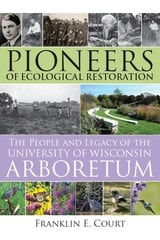
Pioneers of Ecological Restoration
The People and Legacy of the University of Wisconsin ArboretumFranklin E. Court
University of Wisconsin Press, 2012
Internationally renowned for its pioneering role in the ecological restoration of tallgrass prairies, savannas, forests, and wetlands, the University of Wisconsin Arboretum contains the world’s oldest and most diverse restored ecological communities. A site for land restoration research, public environmental education, and enjoyment by nature lovers, the arboretum remains a vibrant treasure in the heart of Madison’s urban environment.
Pioneers of Ecological Restoration chronicles the history of the arboretum and the people who created, shaped, and sustained it up to the present. Although the arboretum was established by the University of Wisconsin in 1932, author Franklin E. Court begins his history in 1910 with John Nolen, the famous landscape architect who was invited to create plans for the city of Madison, the university campus, and Wisconsin state parks. Drawing extensive details from archives and interviews, Court follows decades of collaborative work related to the arboretum’s lands, including the early efforts of Madison philanthropists and businessmen Michael Olbrich, Paul E. Stark, and Joseph W. “Bud” Jackson.
With labor from the Civilian Conservation Corps during the 1930s Depression, University of Wisconsin scientists began establishing both a traditional horticultural collection of trees and plants and a completely new, visionary approach to recreate native ecosystems. Hundreds of dedicated scientists and staff have carried forward the arboretum’s mission in the decades since, among them G. William Longenecker, Aldo Leopold, John T. Curtis, Rosemary Fleming, Virginia Kline, and William R. Jordan III.
This archival record of the arboretum’s history provides rare insights into how the mission of healing and restoring the land gradually shaped the arboretum’s future and its global reputation; how philosophical conflicts, campus politics, changing priorities, and the encroaching city have affected the arboretum over the decades; and how early aspirations (some still unrealized) have continued to motivate the work of this extraordinary institution.
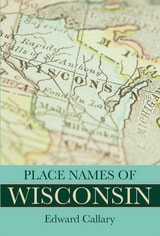
Place Names of Wisconsin
Edward Callary
University of Wisconsin Press, 2016
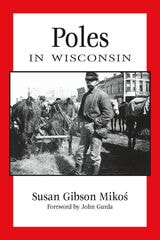
Poles in Wisconsin
Susan Gibson Mikos
Wisconsin Historical Society Press, 2012
In this all-new addition to the People of Wisconsin series, author Susan Mikos traces the history of Polish immigrants as they settled in America’s northern heartland. The second largest immigrant population after Germans, Poles put down roots in all corners of the state, from the industrial center of Milwaukee to the farmland around Stevens Point, in the Cutover, and beyond. In each locale, they brought with them a hunger to own land, a willingness to work hard, and a passion for building churches.
Included is a first person memoir from Polish immigrant Maciej Wojda, translated for the first time into English, and historical photographs of Polish settlements around our state.

Portraits of Justice
The Wisconsin Supreme Court's First 150 YearsTrina E. Gray
Wisconsin Historical Society Press, 2003
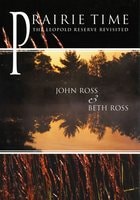
Prairie Time
The Leopold Reserve RevisitedJohn Ross and Beth Ross
University of Wisconsin Press, 1998
In the rush of modern life, we measure our lives by the clock, the calendar, the timetable. But there are older rhythms in nature: the call of chickadees before the first hint of spring, the golden face of a compass plant in July, the first snowfall. These signs mark the passage of time in a world that Aldo Leopold knew well and eloquently described.
With notebook and camera in hand, John and Beth Ross revisit the Aldo Leopold Memorial Reserve in south-central Wisconsin fifty years after Leopold’s death. Thanks to the efforts of Leopold, his family, and the Leopold Foundation, this once-ruined farmland is now largely restored to a natural state. The Rosses explore the terrain of this sandy land, encounter its natural citizens, and relate life here to its physical underpinnings. Following Leopold’s own practice of phenology, they note the seasonal changes: arrivals and departures of wild geese, the blossoming of the pasque flower at the edge of melting snow, the appearance of monarch butterflies on the milkweed. And further, they seek to find in this landscape an underlying morality, a communion of understanding, a sense of place in the cosmos.
Beautifully illustrated with color photographs, the book also includes notes on the behavior, habitat, and human interactions with ninety-four species of plants, birds, and other animals found in the reserve. An extensive glossary explains terms from geology, ecology, meteorology, and related life and earth sciences.
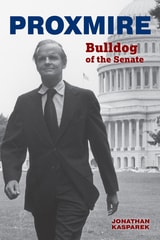
Proxmire
Bulldog of the SenateJonathan Kasparek
Wisconsin Historical Society Press, 2019
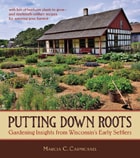
Putting Down Roots
Gardening Insights from Wisconsin’s Early SettlersMarcia C. Carmichael
Wisconsin Historical Society Press, 2013