Results by title
441 books match the query 'Women and literature' and 11 start with p

Pacific Northwest Women, 1815-1925
Lives, Memories, and WritingsJean M. Ward
Oregon State University Press, 1995
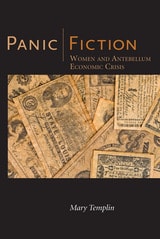
Panic Fiction
Women and Antebellum Economic CrisisMary Templin
University of Alabama Press, 2014
Between the mid-1830s and the late 1850s, authors such as Hannah Lee, Catharine Sedgwick, Eliza Follen, Maria McIntosh, and Maria Cummins wrote dozens of novels and stories depicting the effects of financial panic on the home and proposing solutions to economic instability. This unique body of antebellum American women’s writing, which integrated economic discourse with the language and conventions of domestic fiction, is what critic Mary Templin terms “panic fiction.”
In Panic Fiction: Antebellum Women Writers and Economic Crisis, Templin draws in part from the methods of New Historicism and cultural studies, situating these authors and their texts within the historical and cultural contexts of their time. She explores events surrounding the panics of 1837 and 1857, prevalent attitudes toward speculation and failure as seen in newspapers and other contemporaneous texts, women’s relationships to the marketplace, and the connections between domestic ideology and middle-class formation.
Although largely unknown today, the phenomena of “panic fiction” was extremely popular in its time and had an enormous influence on nineteenth-century popular conceptions of speculation, failure, and the need for marketplace reform, providing a distinct counterpoint to the analysis of panic found in newspapers, public speeches, and male-authored literary texts of the time.
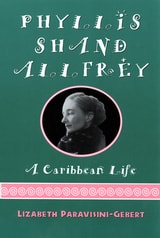
Phyllis Shand Allfrey
A Caribbean LifeParavisini-Gebert, Lizabeth
Rutgers University Press, 1996
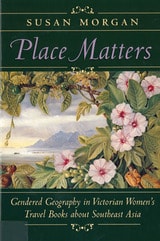
Place Matters
Morgan, Susan
Rutgers University Press, 1996
"Morgan has written an important and original work that presents a well-substantiated challenge to many recent studies of 'colonial discourse'."--Nancy L. Paxton,
Susan Morgan's study of materials and regions, previously neglected in contemporary postcolonial studies, begins with the transforming premise that "place matters." Concepts derived from writings about one area of the world cannot simply be transposed to another area, in some sort of global theoretical move. Moreover, place in the discourse of Victorian imperialism is a matter of gendered as well as geographic terms. Taking up works by Anna Forbes and Marianne North on the Malay Archipelago, by Margaret Brooke and Harriette McDougall on Sarawak, by Isabella Bird and Emily Innes on British Malaya, by Anna Leonowens on Siam, Morgan also makes extensive use of theorists whose work on imperialism in Southeast Asia is unfamiliar to most American academics.
This vivid examination of a different region and different writings emphasizes that in Victorian literature there was no monolithic imperialist location, authorial or geographic. The very notion of a ‘colony’ or an ‘imperial presence’ in Southeast Asia is problematic. Morgan is concerned with marking the intersections of particular Victorian imperial histories and constructions of subjectivity. She argues that specific places in Southeast Asia have distinctive, and differing, masculine imperial rhetorics. It is within these specific rhetorical contexts that women’s writings, including their moments of critique, can be read.
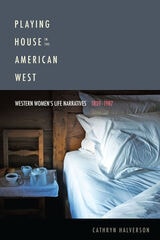
Playing House in the American West
Western Women's Life Narratives, 1839–1987Cathryn Halverson
University of Alabama Press, 2013
How domestic life shaped identity, gender, and power in the American West
The controlling metaphor Cathryn Halverson uses in her engrossing study is “playing house.” From Caroline Kirkland and Laura Ingalls Wilder to Willa Cather and Marilynne Robinson, from the mid-nineteenth to the late-twentieth centuries, western authors have persistently embraced wayward or eccentric housekeeping to prove a woman’s difference from western neighbors and eastern readers alike.
The readings in Playing House investigate the surprising textual ends to which westerners turn the familiar terrain of the home: evaluating community; arguing for different conceptions of race and class; and perhaps most especially, resisting traditional gender roles. Western women writers, Halverson argues, render the home as a stage for autonomy, resistance, and imagination rather than as a site of sacrifice and obligation.
The western women examined in Playing House in the American West are promoted and read as representatives of a region, as insiders offering views of distant and intriguing ways of life, even as they conceive of themselves as outsiders. By playing with domestic conventions, they recast the region they describe, portraying the West as a place that fosters female agency, individuality, and subjectivity.
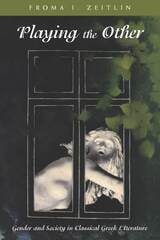
Playing the Other
Gender and Society in Classical Greek LiteratureFroma I. Zeitlin
University of Chicago Press, 1995
Zeitlin demonstrates the indispensable workings of gender as a major factor in Greek social, religious, and cultural practices and in more abstract ideas about nature and culture, public and private, citizen and outsider, self and other, and mortal and immortal. Focusing on the prominence of female figures in these male authored texts, she enlarges our perspective on critical components of political order and civic identity by including issues of sexuality, the body, modes of male and female maturation, and speculations about parentage, kinship, and reproductive strategies. Along with considerations of genre, poetics, and theatrical mimesis, she points to the powerful mythmaking capacities of Greek culture for creating memorable paradigms and dramatic scenarios that far exceed simple notions of male and female opposition and predictable enforcement of social norms. Consisting of both new and revised essays, Playing the Other is a wide-ranging account of a central category of Greek literature by a scholar who pioneered an approach to classics through the perspective of gender.
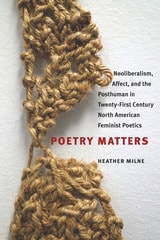
Poetry Matters
Neoliberalism, Affect, and the Posthuman in Twenty-First Century North American Feminist PoeticsHeather Milne
University of Iowa Press, 2018
Poetry Matters explores poetry written by women from the United States and Canada, which documents the social and political turmoil of the early twenty-first century and places this poetry in dialogue with recent currents of feminist theory including new materialism, affect theory, posthumanism, and feminist engagements with neoliberalism and capitalism. Central to this project is the conviction that a poetics that explores the political dimensions of affect; demonstrates an understanding of subjectivity as posthuman and transcorporeal; critically reflects on the impact of capitalism on queer, racialized, and female bodies; and develops an ethical vocabulary for reimagining the nation state and critically engaging with issues of democracy and citizenship is now more urgent than ever before.
Milne focuses on poetry published after 2001 by writers who mostly began writing after the feminist writing movements of the 1980s, but who have inherited and built upon their political and aesthetic legacies. The poets discussed in this book—including Jennifer Scappettone, Margaret Christakos, Larissa Lai, Rita Wong, Nikki Reimer, Rachel Zolf, Yedda Morrison, Marcella Durand, Evelyn Reilly, Juliana Spahr, Claudia Rankine, Dionne Brand, Jena Osman, and Jen Benka—bring a sense of political agency to poetry. These voices seek new vocabularies and dissenting critical and aesthetic frameworks for thinking across issues of gender, materiality, capitalism, the toxic convergences of nationalism and racism, and the decline of democratic institutions. This is poetry that matters—both in its political urgency and in its attentiveness to the world as “matter”—as a material entity under siege. It could not be more timely or more relevant.

Politicizing Gender
Narrative Strategies in the Aftermath of the French RevolutionKadish, Doris Y
Rutgers University Press, 1991
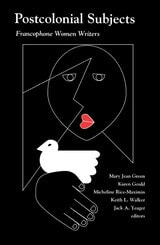
Postcolonial Subjects
Francophone Women WritersMary Green
University of Minnesota Press, 1996
Explores French-language writing by women outside France.
This groundbreaking volume highlights the work of contemporary women writing in French whose cultural links, ethnic identities, and historical roots lie outside France. The writings of these women emanate from the cultures of Africa and the Indian Ocean, the Middle East, the Caribbean, Southeast Asia, and Quebec and other French-speaking regions of Canada.
By writing in French, the writers discussed in Postcolonial Subjects both acknowledge and write against the cultural heritage of France. In doing so, they participate in the subversion of European literary traditions and take part in various forms of cultural and linguistic blending, generating new artistic currents. Each of these essays articulates contemporary debates about the politics and cultural effects of sexism, homophobia, racism, and essentialism, as well as pointing out connections and points of resistance among such diverse strains as feminism, nationalism, and ethnicity. Contributors: Eloise A. Brière, U of Albany; Miriam Cooke, Duke U; Irène Assiba d’Almeida, U of Arizona; Joan Dayan, U of Arizona; John D. Erickson, U of Kentucky; Françoise Lionnet, Northwestern U; Christiane Makward, Pennsylvania State U; Kitzie McKinney, Bentley College; Christopher L. Miller, Yale U; Mary-Kay Miller, Vanderbilt U; Jane Moss, Colby College; Elisabeth Mudimbe-Boyi, Stanford U; Lori Saint-Martin, U du Québec à Montréal; Ronnie Scharfman, Purchase College, SUNY.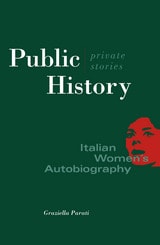
Public History, Private Stories
Italian Women’s AutobiographyGraziella Parati
University of Minnesota Press, 1996
Explores the way Italian women writers craft identities through writing.
In this important volume, Graziella Parati examines the ways in which Italian women writers articulate their identities through autobiography—a public act that is also the creation of a private life. Considering autobiographical writings by five women writers from the seventeenth century to the present, Parati draws important connections between self-writing and the debate over women’s roles, both traditional and transgressive.
Parati considers the first prose autobiography written by an Italian woman -Camilla Faà Gonzaga’s 1622 memoir—as her beginning point, citing it as a central “pre-text.” In her memoir, Gonzaga makes explicit her conflict over the public silence imposed on her, yet succeeds in writing herself into history through self-narrative. Parati then examines Enif Robert’s autobiography, in which Robert strives to enter the public sphere of the post-World War I futurist movement by writing about her fight to overcome cancer of the uterus. Next, Parati considers Fausta Cialente’s life story, an account of her family's life in Trieste from World War I through the fascist era, as well as the narrative in which Rita Levi Montalcini describes her life as a woman, a Nobel-Prize winning scientist, and a Jew who lived under fascism in the thirties and forties. Finally, Parati analyzes Luisa Passerini's look back on her involvement with the student movement of 1968. Through her discussion of these women’s writings, Parati demonstrates the complex negotiations over identity contained within them, negotiations that challenge dichotomies between male and female, maternal and paternal, and private and public. Public History, Private Stories is a compelling exploration of the disparate identities created by these women through the act of writing autobiography.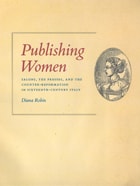
Publishing Women
Salons, the Presses, and the Counter-Reformation in Sixteenth-Century ItalyDiana Robin
University of Chicago Press, 2007
Even the most comprehensive Renaissance histories have neglected the vibrant groups of women writers that emerged in cities across Italy during the mid-1500s—and the thriving network of printers, publishers, and agents that specialized in producing and selling their books. In Publishing Women, Diana Robin finally brings to life this story of women’s cultural and intellectual leadership in early modern Italy, illuminating the factors behind—and the significance of—their sudden dominance.
Focusing on the collective publication process, Robin portrays communities in Naples, Venice, Rome, Siena, and Florence, where women engaged in activities that ranged from establishing literary salons to promoting religious reform. Her innovative cultural history considers the significant roles these women played in tandem with men, rather than separated from them. In doing so, it collapses the borders between women’s history, Renaissance and Reformation studies, and book history to evoke a historical moment that catapulted women’s writings and women-sponsored books into the public sphere for the first time anywhere in Europe.