295 books match the query 'Zoology' and 27 start with p
cover of Packrat Middens: The Last 40,000 Years of Biotic Change

Packrat Middens

The Last 40,000 Years of Biotic Change

Edited by Julio L. Betancourt, Thomas R. Van Devender, and Paul S. Martin

University of Arizona Press, 1990

Over the past thirty years, late Quaternary environments in the arid interior of western North America have been revealed by a unique source of fossils: well-preserved fragments of plants and animals accumulated locally by packrats and quite often encased, amberlike, in large masses of crystallized urine. These packrat middens are ubiquitous in caves and rock crevices throughout the arid West, where they can lie preserved for tens of thousands of years. More than a thousand of these deposits have been dated and analyzed, and middens have supplanted pollen records as a touchstone for studying vegetation dynamics and climatic change in radiocarbon time (the last 40,000 years). Now, similar deposits made by other mammals like hyraxes are being reported from other parts of the world.

This book brings together the findings and views of many of the researchers investigating fossil middens in the United States, Mexico, Africa, the Middle East, and Australia. The contributions serve to open a forum for methodological concerns, update the fossil record of various geographic regions, introduce new applications, and display the vast potential for fossil midden analysis in arid regions worldwide. The findings presented here will serve to foster regional research and to promote general studies devoted to global climate change. Included in the text are more than two hundred charts, photographs, and maps.
[more]
cover of Patterns of Behavior: Konrad Lorenz, Niko Tinbergen, and the Founding of Ethology

Patterns of Behavior

Konrad Lorenz, Niko Tinbergen, and the Founding of Ethology

Richard W. Burkhardt, Jr.

University of Chicago Press, 2005

It is hard to imagine, by their very name, the life sciences not involving the study of living things, but until the twentieth century much of what was known in the field was based primarily on specimens that had long before taken their last breaths. Only in the last century has ethology—the study of animal behavior—emerged as a major field of the life sciences.

In Patterns of Behavior, Richard W. Burkhardt Jr. traces the scientific theories, practices, subjects, and settings integral to the construction of a discipline pivotal to our understanding of the diversity of life. Central to this tale are Konrad Lorenz and Niko Tinbergen, 1973 Nobel laureates whose research helped legitimize the field of ethology and bring international attention to the culture of behavioral research. Demonstrating how matters of practice, politics, and place all shaped "ethology's ecologies," Burkhardt's book offers a sensitive reading of the complex interplay of the field's celebrated pioneers and a richly textured reconstruction of ethology's transformation from a quiet backwater of natural history to the forefront of the biological sciences.
 
Winner of the 2006 Pfizer Awad from the History of Science Society
[more]
cover of Penguins in the Desert

Penguins in the Desert

Eric Wagner

Oregon State University Press, 2018

Most of us wouldn’t think to look for penguins in a hot desert, but every year along a windswept edge of coastal Patagonia, hundreds of thousands of Magellanic penguins gather to rear their young at Punta Tombo, Argentina. It is the largest penguin colony in the world outside of Antarctica, and for the past three decades, biologist Dee Boersma has followed them there.

Eric Wagner joined her team for six months in 2008, and in Penguins in the Desert, he chronicles that season in the remarkable lives of both the Magellanic penguins of Punta Tombo and the scientists who track their every move. For Boersma, the penguins are ecosystem sentinels. At the colony’s peak, more than a million birds bred there, but now less than half as many do. In confronting this fact, Boersma tackles some of the most urgent issues facing penguins and people today. What is the best way to manage our growing appetite for fish? How do we stop catastrophic oil spills from coating birds? How will we address the looming effects of climate change?

As Wagner spends more and more time with the penguins and the scientists in the field, other equally pressing questions come to mind. What is it like to be beaten by a penguin? Or bitten by one? How can a person be so dirty for so many months on end? In a tale that is as much about life in the field as it is about one of the most charismatic creatures on earth, Wagner brings humor, warmth, and hard-won insight as he tries to find the answer to what turns out to be the most pressing question of all: What does it mean to know an animal and to grapple with the consequences of that knowing?
[more]
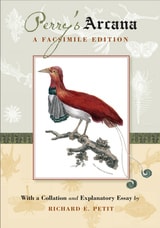
cover of Perry's Arcana: A Facsimile Edition

Perry's Arcana

A Facsimile Edition

Richard E. Petit

Temple University Press, 2009

From 1810 to 1811, the English stonemason and amateur naturalist George Perry published a lavishly illustrated magazine on natural history. The Arcana or Museum of Nature ran to 22 monthly parts, with 84 extraordinary hand-colored plates and over 300 text pages describing mammals, birds, reptiles, fish, mollusks, echinoderms, insects, trilobites and plants, alongside travelogues from far-off lands. It presented the first published illustration of the koala and many new genera and species, but astonishingly was then largely forgotten for nearly two hundred years. Perry’s work was deliberately ignored by his contemporaries in England, as he was a supporter of Lamarck rather than of Linnaeus, and the Arcana’s rarity—only thirteen complete copies are known to have survived—has helped maintain its shroud of mystery.

Now at last this neglected gem has been revived for scientists, students, and aficionados of natural history. New scholarship is combined with modern digital reproduction techniques to do full justice to the beautiful plates. An up-to-date account of all the species is given, along with a full collation and extensive notes, by the eminent natural historian Richard E. Petit.

The Arcana is technically interesting too, as its glowing plates were printed with variously colored inks to suppress their outlines. Its appeal will extend not only to academic libraries and scholars specializing in various branches of natural history and the history of science, but also to collectors of beautiful natural history books and enthusiasts of Regency Britain.

[more]
cover of Phantoms of the Prairie: The Return of Cougars to the Midwest

Phantoms of the Prairie

The Return of Cougars to the Midwest

John W. Laundré

University of Wisconsin Press, 2012

Last seen in the 1880s, cougars (also known as pumas or mountain lions) are making a return to the plains regions of the Midwest. Their comeback, heralded by wildlife enthusiasts, has brought concern and questions to many. Will the people of the region make room for cougars? Can they survive the highly altered landscape of the Midwest? Is there a future for these intrepid pioneers if they head even farther east?
    Using GIS technology, and historical data, among many other methods, Phantoms of the Prairie takes readers on a virtual journey, showing how the cougar might move over the landscape with minimal human contact. Drawing on his years of research on cougars, John W. Laundré offers an overview of what has been, what is, and what might be regarding the return of cougars to their ancestral prairie homeland.

[more]
cover of Phoenix Zones: Where Strength Is Born and Resilience Lives

Phoenix Zones

Where Strength Is Born and Resilience Lives

Hope Ferdowsian, MD

University of Chicago Press, 2018

Few things get our compassion flowing like the sight of suffering. But our response is often shaped by our ability to empathize with others. Some people respond to the suffering of only humans or to one person’s plight more than another’s. Others react more strongly to the suffering of an animal. These divergent realities can be troubling—but they are also a reminder that trauma and suffering are endured by all beings, and we can learn lessons about their aftermath, even across species.
 
With Phoenix Zones, Dr. Hope Ferdowsian shows us how. Ferdowsian has spent years traveling the world to work with people and animals who have endured trauma—war, abuse, displacement. Here, she combines compelling stories of survivors with the latest science on resilience to help us understand the link between violence against people and animals and the biological foundations of recovery, peace, and hope. Taking us to the sanctuaries that give the book its title, she reveals how the injured can heal and thrive if we attend to key principles: respect for liberty and sovereignty, a commitment to love and tolerance, the promotion of justice, and a fundamental belief that each individual possesses dignity. Courageous tales show us how: stories of combat veterans and wolves recovering together at a California refuge, Congolese women thriving in one of the most dangerous places on earth, abused chimpanzees finding peace in a Washington sanctuary, and refugees seeking care at Ferdowsian’s own medical clinic.
 
These are not easy stories. Suffering is real, and recovery is hard. But resilience is real, too, and Phoenix Zones shows how we can foster it. It reveals how both people and animals deserve a chance to live up to their full potential—and how such a view could inspire solutions to some of the greatest challenges of our time.
[more]
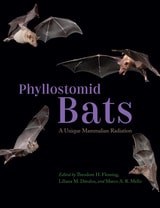
cover of Phyllostomid Bats: A Unique Mammalian Radiation

Phyllostomid Bats

A Unique Mammalian Radiation

Edited by Theodore H. Fleming, Liliana M. Dávalos, and Marco A. R. Mello

University of Chicago Press, 2020

With more than two hundred species distributed from California through Texas and across most of mainland Mexico, Central and South America, and islands in the Caribbean Sea, the Phyllostomidae bat family (American leaf-nosed bats) is one of the world’s most diverse mammalian families. From an insectivorous ancestor, species living today, over about 30 million years, have evolved a hyper-diverse range of diets, from blood or small vertebrates, to consuming nectar, pollen, and fruit. Phyllostomid plant-visiting species are responsible for pollinating more than five hundred species of neotropical shrubs, trees, vines, and epiphytes—many of which are economically and ecologically important—and they also disperse the seeds of at least another five hundred plant species. Fruit-eating and seed-dispersing members of this family thus play a crucial role in the regeneration of neotropical forests, and the fruit eaters are among the most abundant mammals in these habitats.

Coauthored by leading experts in the field and synthesizing the latest advances in molecular biology and ecological methods, Phyllostomid Bats is the first overview in more than forty years of the evolution of the many morphological, behavioral, physiological, and ecological adaptations in this family. Featuring abundant illustrations as well as details on the current conservation status of phyllostomid species, it is both a comprehensive reference for these ecologically vital creatures and a fascinating exploration of the evolutionary process of adaptive radiation.
[more]
cover of Physiological and Biochemical Zoology, volume 95 number 4 (July/August 2022)

Physiological and Biochemical Zoology, volume 95 number 4 (July/August 2022)

The University of Chicago Press

University of Chicago Press Journals, 2022

[more]
cover of Physiological and Biochemical Zoology, volume 95 number 5 (September/October 2022)

Physiological and Biochemical Zoology, volume 95 number 5 (September/October 2022)

The University of Chicago Press

University of Chicago Press Journals, 2022
[more]
cover of Physiological and Biochemical Zoology, volume 95 number 6 (November/December 2022)

Physiological and Biochemical Zoology, volume 95 number 6 (November/December 2022)

The University of Chicago Press

University of Chicago Press Journals, 2022
This is volume 95 issue 6 of Physiological and Biochemical Zoology. Physiological and Biochemical Zoology: Ecological and Evolutionary Approaches primarily publishes original research in physiological ecology, ecophysiology, comparative physiology, and evolutionary physiology. Studies at all levels of biological organization from the molecular to the whole organism are welcome, and work that integrates across levels of organization is particularly encouraged. Studies that focus on behavior or morphology are welcome, so long as they include ties to physiology or biochemistry, in addition to having an ecological or evolutionary context. Subdisciplines of interest include nutrition and digestion, salt and water balance, epithelial and membrane transport, gas exchange and transport, acid-base balance, temperature adaptation, energetics, structure and function of macromolecules, chemical coordination and signal transduction, nitrogen metabolism and excretion, locomotion and muscle function, biomechanics, circulation, behavioral, comparative and mechanistic endocrinology, sensory physiology, neural coordination, and ecotoxicology ecoimmunology.
[more]
cover of Physiological and Biochemical Zoology, volume 96 number 1 (January/February 2023)

Physiological and Biochemical Zoology, volume 96 number 1 (January/February 2023)

The University of Chicago Press

University of Chicago Press Journals, 2023
This is volume 96 issue 1 of Physiological and Biochemical Zoology. Physiological and Biochemical Zoology: Ecological and Evolutionary Approaches primarily publishes original research in physiological ecology, ecophysiology, comparative physiology, and evolutionary physiology. Studies at all levels of biological organization from the molecular to the whole organism are welcome, and work that integrates across levels of organization is particularly encouraged. Studies that focus on behavior or morphology are welcome, so long as they include ties to physiology or biochemistry, in addition to having an ecological or evolutionary context. Subdisciplines of interest include nutrition and digestion, salt and water balance, epithelial and membrane transport, gas exchange and transport, acid-base balance, temperature adaptation, energetics, structure and function of macromolecules, chemical coordination and signal transduction, nitrogen metabolism and excretion, locomotion and muscle function, biomechanics, circulation, behavioral, comparative and mechanistic endocrinology, sensory physiology, neural coordination, and ecotoxicology ecoimmunology.
[more]
cover of Physiological and Biochemical Zoology, volume 96 number 2 (March/April 2023)

Physiological and Biochemical Zoology, volume 96 number 2 (March/April 2023)

The University of Chicago Press

University of Chicago Press Journals, 2023
This is volume 96 issue 2 of Physiological and Biochemical Zoology. Physiological and Biochemical Zoology: Ecological and Evolutionary Approaches primarily publishes original research in physiological ecology, ecophysiology, comparative physiology, and evolutionary physiology. Studies at all levels of biological organization from the molecular to the whole organism are welcome, and work that integrates across levels of organization is particularly encouraged. Studies that focus on behavior or morphology are welcome, so long as they include ties to physiology or biochemistry, in addition to having an ecological or evolutionary context. Subdisciplines of interest include nutrition and digestion, salt and water balance, epithelial and membrane transport, gas exchange and transport, acid-base balance, temperature adaptation, energetics, structure and function of macromolecules, chemical coordination and signal transduction, nitrogen metabolism and excretion, locomotion and muscle function, biomechanics, circulation, behavioral, comparative and mechanistic endocrinology, sensory physiology, neural coordination, and ecotoxicology ecoimmunology.
[more]
cover of Physiological and Biochemical Zoology, volume 96 number 3 (May/June 2023)

Physiological and Biochemical Zoology, volume 96 number 3 (May/June 2023)

The University of Chicago Press

University of Chicago Press Journals, 2023
This is volume 96 issue 3 of Physiological and Biochemical Zoology. Physiological and Biochemical Zoology: Ecological and Evolutionary Approaches primarily publishes original research in physiological ecology, ecophysiology, comparative physiology, and evolutionary physiology. Studies at all levels of biological organization from the molecular to the whole organism are welcome, and work that integrates across levels of organization is particularly encouraged. Studies that focus on behavior or morphology are welcome, so long as they include ties to physiology or biochemistry, in addition to having an ecological or evolutionary context. Subdisciplines of interest include nutrition and digestion, salt and water balance, epithelial and membrane transport, gas exchange and transport, acid-base balance, temperature adaptation, energetics, structure and function of macromolecules, chemical coordination and signal transduction, nitrogen metabolism and excretion, locomotion and muscle function, biomechanics, circulation, behavioral, comparative and mechanistic endocrinology, sensory physiology, neural coordination, and ecotoxicology ecoimmunology.
[more]
cover of Physiological and Biochemical Zoology, volume 96 number 4 (July/August 2023)

Physiological and Biochemical Zoology, volume 96 number 4 (July/August 2023)

The University of Chicago Press

University of Chicago Press Journals, 2023
This is volume 96 issue 4 of Physiological and Biochemical Zoology. Physiological and Biochemical Zoology: Ecological and Evolutionary Approaches primarily publishes original research in physiological ecology, ecophysiology, comparative physiology, and evolutionary physiology. Studies at all levels of biological organization from the molecular to the whole organism are welcome, and work that integrates across levels of organization is particularly encouraged. Studies that focus on behavior or morphology are welcome, so long as they include ties to physiology or biochemistry, in addition to having an ecological or evolutionary context. Subdisciplines of interest include nutrition and digestion, salt and water balance, epithelial and membrane transport, gas exchange and transport, acid-base balance, temperature adaptation, energetics, structure and function of macromolecules, chemical coordination and signal transduction, nitrogen metabolism and excretion, locomotion and muscle function, biomechanics, circulation, behavioral, comparative and mechanistic endocrinology, sensory physiology, neural coordination, and ecotoxicology ecoimmunology.
[more]
cover of Physiological and Biochemical Zoology, volume 96 number 5 (September/October 2023)

Physiological and Biochemical Zoology, volume 96 number 5 (September/October 2023)

The University of Chicago Press

University of Chicago Press Journals, 2023
This is volume 96 issue 5 of Physiological and Biochemical Zoology. Physiological and Biochemical Zoology: Ecological and Evolutionary Approaches primarily publishes original research in physiological ecology, ecophysiology, comparative physiology, and evolutionary physiology. Studies at all levels of biological organization from the molecular to the whole organism are welcome, and work that integrates across levels of organization is particularly encouraged. Studies that focus on behavior or morphology are welcome, so long as they include ties to physiology or biochemistry, in addition to having an ecological or evolutionary context. Subdisciplines of interest include nutrition and digestion, salt and water balance, epithelial and membrane transport, gas exchange and transport, acid-base balance, temperature adaptation, energetics, structure and function of macromolecules, chemical coordination and signal transduction, nitrogen metabolism and excretion, locomotion and muscle function, biomechanics, circulation, behavioral, comparative and mechanistic endocrinology, sensory physiology, neural coordination, and ecotoxicology ecoimmunology.
[more]
cover of Physiological and Biochemical Zoology, volume 96 number 6 (November/December 2023)

Physiological and Biochemical Zoology, volume 96 number 6 (November/December 2023)

The University of Chicago Press

University of Chicago Press Journals, 2023
This is volume 96 issue 6 of Physiological and Biochemical Zoology. Physiological and Biochemical Zoology: Ecological and Evolutionary Approaches primarily publishes original research in physiological ecology, ecophysiology, comparative physiology, and evolutionary physiology. Studies at all levels of biological organization from the molecular to the whole organism are welcome, and work that integrates across levels of organization is particularly encouraged. Studies that focus on behavior or morphology are welcome, so long as they include ties to physiology or biochemistry, in addition to having an ecological or evolutionary context. Subdisciplines of interest include nutrition and digestion, salt and water balance, epithelial and membrane transport, gas exchange and transport, acid-base balance, temperature adaptation, energetics, structure and function of macromolecules, chemical coordination and signal transduction, nitrogen metabolism and excretion, locomotion and muscle function, biomechanics, circulation, behavioral, comparative and mechanistic endocrinology, sensory physiology, neural coordination, and ecotoxicology ecoimmunology.
[more]
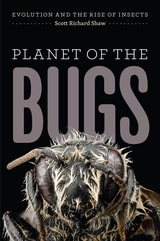
cover of Planet of the Bugs: Evolution and the Rise of Insects

Planet of the Bugs

Evolution and the Rise of Insects

Scott Richard Shaw

University of Chicago Press, 2014

Dinosaurs, however toothy, did not rule the earth—and neither do humans. But what were and are the true potentates of our planet? Insects, says Scott Richard Shaw—millions and millions of insect species. Starting in the shallow oceans of ancient Earth and ending in the far reaches of outer space—where, Shaw proposes, insect-like aliens may have achieved similar preeminence—Planet of the Bugs spins a sweeping account of insects’ evolution from humble arthropod ancestors into the bugs we know and love (or fear and hate) today.

Leaving no stone unturned, Shaw explores how evolutionary innovations such as small body size, wings, metamorphosis, and parasitic behavior have enabled insects to disperse widely, occupy increasingly narrow niches, and survive global catastrophes in their rise to dominance. Through buggy tales by turns bizarre and comical—from caddisflies that construct portable houses or weave silken aquatic nets to trap floating debris, to parasitic wasp larvae that develop in the blood of host insects and, by storing waste products in their rear ends, are able to postpone defecation until after they emerge—he not only unearths how changes in our planet’s geology, flora, and fauna contributed to insects’ success, but also how, in return, insects came to shape terrestrial ecosystems and amplify biodiversity. Indeed, in his visits to hyperdiverse rain forests to highlight the current insect extinction crisis, Shaw reaffirms just how crucial these tiny beings are to planetary health and human survival.

In this age of honeybee die-offs and bedbugs hitching rides in the spines of library books, Planet of the Bugs charms with humor, affection, and insight into the world’s six-legged creatures, revealing an essential importance that resonates across time and space.
 
[more]
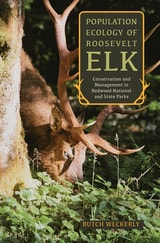
cover of Population Ecology of Roosevelt Elk: Conservation and Management in Redwood National and State Parks

Population Ecology of Roosevelt Elk

Conservation and Management in Redwood National and State Parks

Butch Weckerly

University of Nevada Press, 2017

The Roosevelt elk populate the parks along California’s north coast and comprise the largest land mammals in the parks, some weighing up to 1,200 pounds. They are a stable terrestrial land mammal population, a fixture in the parks, but still require ongoing stewardship and management.
 
In a study spanning more than twenty years, Weckerly made key observations and conducted various investigations under a multitude of ecological conditions. Few authors have dedicated this much time and effort into a single research area. It is a testament to perseverance that his groundbreaking study of the Roosevelt elk was so successful. He was able to document the independent dynamics of several herds of female elk, experience the extinction of one of their subpopulations, and record scientific conclusions in the context of resiliency and redundancy of the elk population.
 
This book will be of considerable interest to those who investigate the ecology of big game animals, including naturalists, hunters, and individuals with particular interest in Redwood State and National Parks. It is an important book that contributes substantially to the persistence and viability of Roosevelt elk in the parks and the surrounding area.
[more]
cover of Population Fluctuations in Rodents

Population Fluctuations in Rodents

Charles J. Krebs

University of Chicago Press, 2013
How did rodent outbreaks in Germany help to end World War I? What caused the destructive outbreak of rodents in Oregon and California in the late 1950s, the large population outbreak of lemmings in Scandinavia in 2010, and the great abundance of field mice in Scotland in the spring of 2011? Population fluctuations, or outbreaks, of rodents constitute one of the classic problems of animal ecology, and in Population Fluctuations in Rodents, Charles J. Krebs sifts through the last eighty years of research to draw out exactly what we know about rodent outbreaks and what should be the agenda for future research.
           
Krebs has synthesized the research in this area, focusing mainly on the voles and lemmings of the Northern Hemisphere—his primary area of expertise—but also referring to the literature on rats and mice. He covers the patterns of changes in reproduction and mortality and the mechanisms that cause these changes—including predation, disease, food shortage, and social behavior—and discusses how landscapes can affect population changes, methodically presenting the hypotheses related to each topic before determining whether or not the data supports them. He ends on an expansive note, by turning his gaze outward and discussing how the research on rodent populations can apply to other terrestrial mammals. Geared toward advanced undergraduate students, graduate students, and practicing ecologists interested in rodent population studies, this book will also appeal to researchers seeking to manage rodent populations and to understand outbreaks in both natural and urban settings—or, conversely, to protect endangered species.
[more]
cover of Power in the Wild: The Subtle and Not-So-Subtle Ways Animals Strive for Control over Others

Power in the Wild

The Subtle and Not-So-Subtle Ways Animals Strive for Control over Others

Lee Alan Dugatkin

University of Chicago Press, 2022

From the shell wars of hermit crabs to little blue penguins spying on potential rivals, power struggles in the animal kingdom are as diverse as they are fascinating, and this book illuminates their surprising range and connections.
 
The quest for power in animals is so much richer, so much more nuanced than who wins what knock-down, drag-out fight. Indeed, power struggles among animals often look more like an opera than a boxing match. Tracing the path to power for over thirty different species on six continents, writer and behavioral ecologist Lee Alan Dugatkin takes us on a journey around the globe, shepherded by leading researchers who have discovered that in everything from hyenas to dolphins, bonobos to field mice, cichlid fish to cuttlefish, copperhead snakes to ravens, and meerkats to mongooses, power revolves around spying, deception, manipulation, forming and breaking up alliances, complex assessments of potential opponents, building social networks, and more. Power pervades every aspect of the social life of animals: what they eat, where they eat, where they live, whom they mate with, how many offspring they produce, whom they join forces with, and whom they work to depose. In some species, power can even change an animal’s sex. Nor are humans invulnerable to this magnificently intricate melodrama: Dugatkin’s tales of the researchers studying power in animals are full of unexpected pitfalls, twists and turns, serendipity, and the pure joy of scientific discovery.
[more]
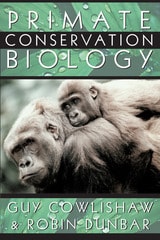
cover of Primate Conservation Biology

Primate Conservation Biology

Guy Cowlishaw and Robin I. M. Dunbar

University of Chicago Press, 2000

From the snub-nosed monkeys of China to the mountain gorillas of central Africa, our closest nonhuman relatives are in critical danger worldwide. A recent report, for example, warns that nearly 20 percent of the world's primates may go extinct within the next ten or twenty years. In this book Guy Cowlishaw and Robin Dunbar integrate cutting-edge theoretical advances with practical management priorities to give scientists and policymakers the tools they need to help keep these species from disappearing forever.

Primate Conservation Biology begins with detailed overviews of the diversity, life history, ecology, and behavior of primates and the ways these factors influence primate abundance and distribution. Cowlishaw and Dunbar then discuss the factors that put primates at the greatest risk of extinction, especially habitat disturbance and hunting. The remaining chapters present a comprehensive review of conservation strategies and management practices, highlighting the key issues that must be addressed to protect primates for the future.
[more]
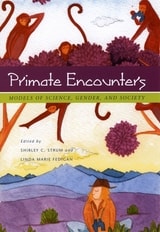
cover of Primate Encounters: Models of Science, Gender, and Society

Primate Encounters

Models of Science, Gender, and Society

Edited by Shirley C. Strum and Linda Marie Fedigan

University of Chicago Press, 2000

A provocative collective reflection on primatology and its relations to broader cultural, historical, and social issues, Primate Encounters brings together both scientists and those who study them to investigate precisely what kind of science primatology is.

"[A] fascinating study . . . on how and why ideas about primate society have changed. The volume consists of dialogues among scientists from different disciplines, national traditions, scientific culture, generations, standpoints, and genders. . . . A wonderful reflection on the discipline of primatology and on science in general."—Science Books and Films

"Primate Encounters should be required reading for anyone about to embark on a career in the field. But it equally valuable for its miscellany of opinions, recollections and off-the-cuff remarks, as well as for its thoughtful observations, 'outrageous ravings' and humour (from the elders in the field). It gives us a glimpse of how scientists work together to understand their place in the world."—Deborah L. Mazolillo, Times Literary Supplement
[more]
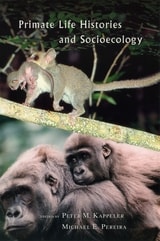
cover of Primate Life Histories and Socioecology

Primate Life Histories and Socioecology

Edited by Peter M. Kappeler and Michael E. Pereira

University of Chicago Press, 2003

We know a great deal about roles the environment plays in shaping survival, reproductive success, and even social systems among primates. But how do primate life histories affect social systems and vice versa? Do baboons' patterns of growth, for example, help to structure their societies? Does fission-fusion sociality interact with predator pressure to influence the timing of maturation in chimpanzees?

Exploring these issues and many others, the contributors to Primate Life Histories and Socioecology provide the first systematic attempt to understand relationships among primate life histories, ecology, and social behavior conjointly. Topics covered include how primate life histories interact with rates of evolution, predator pressure, and diverse social structures; how the slow maturation of primates affects the behavior of both young and adult caregivers; and reciprocal relationships between large brains and increased social and behavioral complexity. The first collection of its kind, this book will interest a wide range of researchers, from anthropologists and evolutionary biologists to psychologists and ecologists.

Contributors:
Paul-Michael Agapow, Susan C. Alberts, Jeanne Altmann, Robert A. Barton, Nicholas G. Blurton Jones, Robert O. Deaner, Robin I. M. Dunbar, Jörg U. Ganzhorn, Laurie R. Godfrey, Kristen Hawkes, Nick J. B. Isaac, Charles H. Janson, Kate E. Jones, William L. Jungers, Peter M. Kappeler, Susanne Klaus, Phyllis C. Lee, Steven R. Leigh, Robert D. Martin, James F. O'Connell, Sylvia Ortmann, Michael E. Pereira, Andy Purvis, Caroline Ross, Karen E. Samonds, Jutta Schmid, Stephen C. Stearns, Michael R. Sutherland, Carel P. van Schaik, and Andrea J. Webster.
[more]
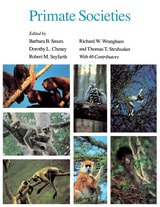
cover of Primate Societies

Primate Societies

Edited by Barbara B. Smuts, Dorothy L. Cheney, Robert M. Seyfarth, Richard W. Wr

University of Chicago Press, 1986

Primate Societies is a synthesis of the most current
information on primate socioecology and its theoretical and
empirical significance, spanning the disciplines of behavioral
biology, ecology, anthropology, and psychology. It is a very rich
source of ideas about other taxa.

"A superb synthesis of knowledge about the social lives of
non-human primates."—Alan Dixson, Nature
[more]
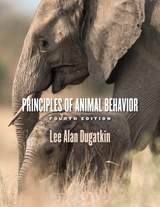
cover of Principles of Animal Behavior, 4th Edition

Principles of Animal Behavior, 4th Edition

Lee Alan Dugatkin

University of Chicago Press, 2020

Since the last edition of this definitive textbook was published in 2013, much has happened in the field of animal behavior. In this fourth edition, Lee Alan Dugatkin draws on cutting-edge new work not only to update and expand on the studies presented, but also to reinforce the previous editions’ focus on ultimate and proximate causation, as well as the book’s unique emphasis on natural selection, learning, and cultural transmission. The result is a state-of-the-art textbook on animal behavior that explains underlying concepts in a way that is both scientifically rigorous and accessible to students. Each chapter in the book provides a sound theoretical and conceptual basis upon which the empirical studies rest. A completely new feature in this edition are the Cognitive Connection boxes in Chapters 2–17, designed to dig deep into the importance of the cognitive underpinnings to many types of behaviors. Each box focuses on a specific issue related to cognition and the particular topic covered in that chapter.

As Principles of Animal Behavior makes clear, the tapestry of animal behavior is created from weaving all of these components into a beautiful whole. With Dugatkin’s exquisitely illustrated, comprehensive, and up-to-date fourth edition, we are able to admire that beauty anew.
[more]
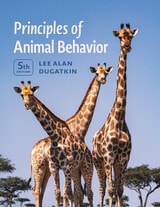
cover of Principles of Animal Behavior, 5th Edition

Principles of Animal Behavior, 5th Edition

Lee Alan Dugatkin

University of Chicago Press, 2025

Incorporating essential revisions to reflect the latest scientific advancements, a celebrated author and scientist offers a leading textbook on animal behavior.
 
So much has happened in the field of animal behavior since the last edition of this definitive textbook was published in 2020. In this fifth edition, Lee Alan Dugatkin continues to draw on cutting-edge new research not only to update and expand on the studies presented but also to reinforce the previous editions’ focus on ultimate and proximate causation as well as the book’s unique emphasis on natural selection, learning, and cultural transmission in nonhuman animals. The result is an essential update to the leading textbook on animal behavior that explains underlying concepts accessibly and with scientific rigor.
 
Completely new features include:
  • Anthropogenic Connection Boxes. Humans are changing the planet. We are clearing forests, polluting the oceans, irrigating deserts, poisoning the soils, and driving a dramatic increase in global temperatures. All of these changes alter both the habitats where animals live and the species themselves as they evolve in response to our impact on their surroundings. Students will dig deep into how anthropogenic evolution affects animal behavior.
  • Social Network Connection Boxes. Researchers have discovered that social networks play a critical role in almost every aspect of animal life: what they eat, how they protect themselves, who they mate with, the dynamics of parent-offspring relations, aggression, navigation, communication, play, cooperation, culture, and more. Students will discover how social network studies enrich our understanding of the wondrous complexity of animal behavior.
As Principles of Animal Behavior makes clear, the tapestry of animal behavior is created by weaving all of these components into a beautiful whole. In this lavishly illustrated, comprehensive, and up-to-date edition, we can admire that beauty anew.
[more]
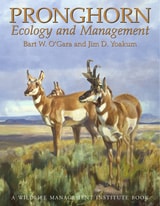
cover of Pronghorn: Ecology & Mangemt: Ecology and Management

Pronghorn

Ecology & Mangemt: Ecology and Management

Bart W. O'Gara

University Press of Colorado, 2004

One of the fastest land animals on Earth (second only to the cheetah), the pronghorn can reach speeds of more than 50 miles per hour. It also is one of the most fascinating of all animals. For many people, the pronghorn was nearly as much a symbol of the American West as was the bison; for some, it still is. Eliminated from much of its historic range by the early 1900s, this unique North American big game species has experienced a remarkable recovery and now is found throughout the western United States, Canada, and northern Mexico. Thirty years in the making, Pronghorn: Ecology and Management contains the most comprehensive information on the behavior, physiology, migration, taxonomy, and management of this extraordinary animal.

Full chapters are devoted to distribution, nutrition and food, diseases and parasites, ecosystem management, hunting, and much more. The principal authors—the world’s preeminent pronghorn biologists, Bart W. O’Gara and Jim D. Yoakum—conclude with a thorough discussion of the future of pronghorn and their management. With 23 chapters that include contributions by 10 other wildlife professionals and more than 850 illustrations, including original artwork by Edson Fichter and Daniel P. Metz, Pronghorn: Ecology and Management is the definitive work on the species.

A Wildlife Management Institute Book
[more]