Results by title
1210 books match the query 'Mexico' and 65 start with p
Power and Identity in Archaeological Theory and Practice
Case Studies from Ancient MesoamericaEleanor Harrison-Buck
University of Utah Press, 2012
The contributions to this volume represent a diverse array of Mesoamerican archaeological studies that are all theo-retically rooted to larger, global debates concerning issues of power and identity—two logically paired concepts. While social identity has been the focus of more critical analysis in recent years, the concept of power has received far less attention. Most studies focus on large-scale, institutional forms of power and the ruling body. Here, the focus is on relations of power, addressing broader segments of society outside the dominant group, that often are ignored in traditional reconstructions of past societies.
Harrison-Buck has compiled works that address a common criticism of social theory in the field of anthropological archaeology—the lack of strong case studies and corroborating facts supporting the abstract and often complex social theoretical concepts presented by scholars. Each contributor offers innovative method and theory and provides alternative and varied approaches to understanding power and identity in the archaeological record. They draw from a wide range of related disciplines and theoretical frameworks, including feminism, queer theory, cognitive studies, and postcolonial theory. The provocative case studies and exciting theoretical applications presented here will stimulate lively debate among scholars working both in and outside of Mesoamerica.

Power, Community and the State
The Political Anthropology of Organisation in MexicoMonique Nuijten
Pluto Press, 2003
Pre-Hispanic Occupance in the Valley of Sonora, Mexico
Archaeological Confirmations of Early Spanish ReportsWilliam E. Doolittle
University of Arizona Press, 1988
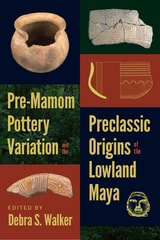
Pre-Mamom Pottery Variation and the Preclassic Origins of the Lowland Maya
Debra S. Walker
University Press of Colorado, 2022
Analyzing ceramics found at sites in Belize, Petén (Guatemala), and Mexico, the contributors provide evidence that the pre-Mamom expansion of pottery resulted from increased dependence on maize agriculture, exploitation of limestone caprock, and greater reliance on a preexisting system of long-distance exchange. The chapters describe the individual experiences of new potting communities at various sites across the region. They are supplemented by appendixes presenting key chronological data as well as the principal types and varieties of pre-Mamom ceramic complexes across the various spheres: Xe, Eb, Swasey, Cunil, and Ek.
A significant amount of new material has been excavated in the last decade, changing what is known about the early Middle Preclassic period and making Pre-Mamom Pottery Variation and the Preclassic Origins of the Lowland Maya a first read of the early ceramic prehistory of the Maya lowlands. It will be a valuable resource for students and scholars interested in the archaeology of the Maya lowlands, Mesoamerican social complexity, and ceramic technology.
Contributors: E. Wyllys Andrews V, Jaime Awe, George J. Bey III, Ronald L. Bishop, Michael G. Callaghan, Ryan H. Collins, Kaitlin Crow, Sara Dzul Góngora, Jerald Ek, Tomás Gallareta Negrón, Bernard Hermes, Takeshi Inomata, Betsy M. Kohut, Laura J. Kosakowsky, Wieslaw Koszkul, Jon Lohse, Michael Love, Nina Neivens, Terry Powis, Duncan C. Pring, Kathryn Reese-Taylor, Prudence M. Rice, Robert M. Rosenswig, Kerry L. Sagebiel, Donald A. Slater, Katherine E. South, Lauren A. Sullivan, Travis Stanton, Juan Luis Velásquez Muñoz, Debra S. Walker, Michal Wasilewski, Jaroslaw Źrałka
Prehispanic Settlement Patterns in the Northwestern Valley of Mexico
The Zumpango RegionJeffrey R. Parsons with contributions by Larry J. Gorenflo, Mary H. Parsons, and David J. Wilson
University of Michigan Press, 2008
Prehispanic Settlement Patterns in the Southern Valley of Mexico
The Chalco-Xochimilco RegionJeffrey R. Parsons, Elizabeth Brumfiel, Mary H. Parsons, and David J. Wilson
University of Michigan Press, 1982
Prehistoric Settlement Patterns in the Texcoco Region, Mexico
Jeffrey R. Parsons
University of Michigan Press, 1971
Prehistoric Social, Political, and Economic Development in the Area of the Tehuacan Valley
Some Results of the Palo Blanco ProjectEdited by Robert D. Drennan
University of Michigan Press, 1979

Private Women, Public Lives
Gender and the Missions of the CaliforniasBy Bárbara O. Reyes
University of Texas Press, 2009
Through the lives and works of three women in colonial California, Bárbara O. Reyes examines frontier mission social spaces and their relationship to the creation of gendered colonial relations in the Californias. She explores the function of missions and missionaries in establishing hierarchies of power and in defining gendered spaces and roles, and looks at the ways that women challenged, and attempted to modify, the construction of those hierarchies, roles, and spaces.
Reyes studies the criminal inquiry and depositions of Barbara Gandiaga, an Indian woman charged with conspiracy to murder two priests at her mission; the divorce petition of Eulalia Callis, the first lady of colonial California who petitioned for divorce from her adulterous governor-husband; and the testimonio of Eulalia Pérez, the head housekeeper at Mission San Gabriel who acquired a position of significant authority and responsibility but whose work has not been properly recognized. These three women's voices seem to reach across time and place, calling for additional, more complex analysis and questions: Could women have agency in the colonial Californias? Did the social structures or colonial processes in place in the frontier setting of New Spain confine or limit them in particular gendered ways? And, were gender dynamics in colonial California explicitly rigid as a result of the imperatives of the goals of colonization?
Profile of Man and Culture in Mexico
By Samuel Ramos
University of Texas Press, 1962
Profile of Man and Culture in Mexico, originally written in 1934, is addressed to the author’s compatriots, but it speaks to people, wherever they are, who are interested in enriching their own lives and in elevating the cultural level of their countries. And it speaks with a peculiar timeliness to citizens of the United States who would understand their neighbors to the south.
Samuel Ramos’s avowed purpose is to assist in the spiritual reform of Mexico by developing a theory that might explain the real character of Mexican culture. His approach is not flattering to his fellow citizens. After an analysis of the historical forces that have molded the national psychology, Ramos concludes that the Mexican sense of inferiority is the basis for most of the Mexican’s spiritual troubles and for the shortcomings of the Mexican culture.
Ramos subscribes to neither of the two major opposing schools of thought as to what norms should direct the development of Mexican culture. He agrees neither with the nationalists, who urge a deliberate search for originality and isolation from universal culture, nor with the “Europeanizers,” who advocate abandonment of the life around them and a withdrawal into the modes of foreign cultures. Ramos thinks that Mexico’s hope lies in a respect for the good in native elements and a careful selection of those foreign elements that are appropriate to Mexican life. Such a sensible choice of foreign elements will result not in imitation, but in assimilation. Combined with the nurturing of desirable native elements, it will result in an independent cultural unit, “a new branch grafted onto world culture.”
Ramos finds in Mexico no lack of intelligence or vitality: “It needs only to learn.” And he believes that the future is Mexico’s, that favorable destinies await a Mexico striving for the elevation of humanity, for the betterment of life, for the development of all the national capacities.
Promiscuous Power
An Unorthodox History of New SpainBy Martin Austin Nesvig
University of Texas Press, 2018
Honorable Mention, Bandelier/Lavrin Book Award in Colonial Latin America, Rocky Mountain Council on Latin American Studies (RMCLAS), 2019
Honorable Mention, The Alfred B. Thomas Book Award, Southeastern Council of Latin American Studies (SECOLAS), 2019
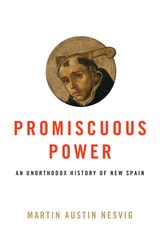
Scholars have written reams on the conquest of Mexico, from the grand designs of kings, viceroys, conquistadors, and inquisitors to the myriad ways that indigenous peoples contested imperial authority. But the actual work of establishing the Spanish empire in Mexico fell to a host of local agents—magistrates, bureaucrats, parish priests, ranchers, miners, sugar producers, and many others—who knew little and cared less about the goals of their superiors in Mexico City and Madrid. Through a case study of the province of Michoacán in western Mexico, Promiscuous Power focuses on the prosaic agents of colonialism to offer a paradigm-shifting view of the complexities of making empire at the ground level.
Presenting rowdy, raunchy, and violent life histories from the archives, Martin Austin Nesvig reveals that the local colonizers of Michoacán were primarily motivated by personal gain, emboldened by the lack of oversight from the upper echelons of power, and thoroughly committed to their own corporate memberships. His findings challenge some of the most deeply held views of the Spanish colonization of Mexico, including the Black Legend, which asserts that the royal state and the institutional church colluded to produce a powerful Catholicism that crushed heterodoxy, punished cultural difference, and ruined indigenous worlds. Instead, Nesvig finds that Michoacán—typical of many frontier provinces of the empire—became a region of refuge from imperial and juridical control and formal Catholicism, where the ordinary rules of law, jurisprudence, and royal oversight collapsed in the entropy of decentralized rule.
Prospero's Daughter
The Prose of Rosario CastellanosBy Joanna O'Connell
University of Texas Press, 1995
A member of Mexico's privileged upper class, yet still subordinated because of her gender, Rosario Castellanos became one of Latin America's most influential feminist social critics. Joanna O'Connell here offers the first book-length study of all Castellanos' prose writings, focusing specifically on how Castellanos' experiences as a Mexican woman led her to an ethic of solidarity with the oppressed peoples of her home state of Chiapas.
O'Connell provides an original and detailed analysis of Castellanos' first venture into feminist cultural analysis in her essay Sobre cultura feminina (1950) and traces her moral and intellectual trajectory as feminist and social critic. An overview of Mexican indigenismo establishes the context for individual chapters on Castellanos' narratives of ethnic conflict (the novels Balún Canán and Oficio de tinieblas and the short stories of Ciudad Real). In further chapters O'Connell reads Los convidados de agosto,Album de familia, and Castellanos' four collections of essays as developments of her feminist social analysis.

Psychiatric Encounters
Madness and Modernity in Yucatan, MexicoReyes-Foster, Beatriz M.
Rutgers University Press, 2019
Public Spectacles of Violence
Sensational Cinema and Journalism in Early Twentieth-Century Mexico and BrazilRielle Navitski
Duke University Press, 2017
Pueblos within Pueblos
Tlaxilacalli Communities in Acolhuacan, Mexico, ca. 1272-1692Benjamin Johnson
University Press of Colorado, 2017
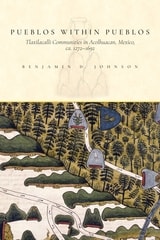
Focusing on the specific case of Acolhuacan in the eastern Basin of Mexico, Pueblos within Pueblos is the first book to systematically analyze tlaxilacalli history over nearly four centuries, beginning with their rise at the dawn of the Aztec empire through their transformation into the “pueblos” of mid-colonial New Spain. Even before the rise of the Aztecs, commoners in pre-Hispanic central Mexico set the groundwork for a new style of imperial expansion. Breaking free of earlier centralizing patterns of settlement, they spread out across onetime hinterlands and founded new and surprisingly autonomous local communities called, almost interchangeably, tlaxilacalli or calpolli.
Tlaxilacalli were commoner-administered communities that coevolved with the Acolhua empire and structured its articulation and basic functioning. They later formed the administrative backbone of both the Aztec and Spanish empires in northern Mesoamerica and often grew into full and functioning existence before their affiliated altepetl, or sovereign local polities. Tlaxilacalli resembled other central Mexican communities but expressed a local Acolhua administrative culture in their exacting patterns of hierarchy. As semiautonomous units, they could rearrange according to geopolitical shifts and even catalyze changes, as during the rapid additive growth of both the Aztec Triple Alliance and Hispanic New Spain. They were more successful than almost any other central Mexican institution in metabolizing external disruptions (new gods, new economies, demographic emergencies), and they fostered a surprising level of local allegiance, despite their structural inequality. Indeed, by 1692 they were declaring their local administrative independence from the once-sovereign altepetl. Administration through community, and community through administration—this was the primal two-step of the long-lived Acolhua tlaxilacalli, at once colonial and colonialist.
Pueblos within Pueblos examines a woefully neglected aspect of pre-Hispanic and early colonial Mexican historiography and is the first book to fully demonstrate the structuring role tlaxilacalli played in regional and imperial politics in central Mexico. It will be of interest to students and scholars of Latin American ethnohistory, history, and anthropology.