Results by title
970 books match the query 'Movements' and 68 start with p
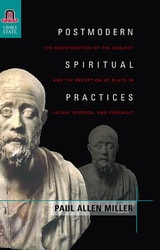
Postmodern Spiritual Practices
The Construction of the Subject and the Reception of Plato in Lacan, Derrida, and FoucaultPaul Allen Miller
The Ohio State University Press, 2007
On the other hand, blindness to the merits of postmodern thought is also due to Anglo-American philology’s own parochial instincts. Ensconced within a nineteenth-century model of Alterumswissenschaft, only a minority of classicists have made forays into philosophical, psychoanalytic, and other speculative modes of inquiry. The result has been that postmodern French thought has largely been the province of scholars of modern languages.
A situation thus emerges in which most classicists do not know theory, and so cannot appreciate the scope of these thinkers’ contribution to our understanding of the genealogy of Western thought, while most theorists do not know the Platonic texts and their contexts that ground them. This book bridges this gap, offering detailed and theoretically informed readings of French postmodernism’s chief thinkers’ debts to Plato and the ancient world.
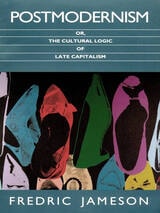
Postmodernism, or, The Cultural Logic of Late Capitalism
Fredric Jameson
Duke University Press, 1992
Postphenomenology
Essays in the Postmodern ContextDon Ihde
Northwestern University Press, 1995

Poststructuralism and Critical Theory's Second Generation
Edited by Alan D. Schrift
University of Chicago Press, 2010
From Kant to Kierkegaard, from Hegel to Heidegger, continental philosophers have indelibly shaped the trajectory of Western thought since the eighteenth century. Although much has been written about these monumental thinkers, students and scholars lack a definitive guide to the entire scope of the continental tradition. The most comprehensive reference work to date, this eight-volume History of Continental Philosophy will both encapsulate the subject and reorient our understanding of it. Beginning with an overview of Kant’s philosophy and its initial reception, the History traces the evolution of continental philosophy through major figures as well as movements such as existentialism, phenomenology, hermeneutics, and poststructuralism. The final volume outlines the current state of the field, bringing the work of both historical and modern thinkers to bear on such contemporary topics as feminism, globalization, and the environment. Throughout, the volumes examine important philosophical figures and developments in their historical, political, and cultural contexts.
The first reference of its kind, A History of Continental Philosophy has been written and edited by internationally recognized experts with a commitment to explaining complex thinkers, texts, and movements in rigorous yet jargon-free essays suitable for both undergraduates and seasoned specialists. These volumes also elucidate ongoing debates about the nature of continental and analytic philosophy, surveying the distinctive, sometimes overlapping characteristics and approaches of each tradition. Featuring helpful overviews of major topics and plotting road maps to their underlying contexts, A History of Continental Philosophy is destined to be the resource of first and last resort for students and scholars alike.
Poverty and Antitheatricality
Form and Formlessness in Latin American Literature, Art, and TheoryStephen Buttes
Rutgers University Press, 2025
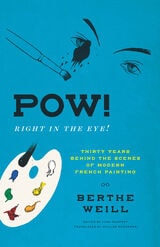
Pow! Right in the Eye!
Thirty Years behind the Scenes of Modern French PaintingBerthe Weill
University of Chicago Press, 2022
Berthe Weill, a formidable Parisian dealer, was born into a Jewish family of very modest means. One of the first female gallerists in the business, she first opened the Galerie B. Weill in the heart of Paris’s art gallery district in 1901, holding innumerable exhibitions over nearly forty years. Written out of art history for decades, Weill has only recently regained the recognition she deserves.
Under five feet tall and bespectacled, Weill was beloved by the artists she supported, and she rejected the exploitative business practices common among art dealers. Despite being a self-proclaimed “terrible businesswoman,” Weill kept her gallery open for four decades, defying the rising tide of antisemitism before Germany’s occupation of France. By the time of her death in 1951, Weill had promoted more than three hundred artists—including Henri Matisse, Pablo Picasso, Amedeo Modigliani, Diego Rivera, and Suzanne Valadon—many of whom were women and nearly all young and unknown when she first exhibited them.
Pow! Right in the Eye! makes Weill’s provocative 1933 memoir finally available to English readers, offering rare insights into the Parisian avant-garde and a lively inside account of the development of the modern art market.

Practice, Power, and Forms of Life
Sartre’s Appropriation of Hegel and MarxTerry Pinkard
University of Chicago Press, 2022
Jean-Paul Sartre’s Critique of Dialectical Reason, released to great fanfare in 1960, has since then receded in philosophical visibility. As Sartre’s reputation is now making a comeback, it is time for a reappraisal of his later work. In Practice, Power, and Forms of Life, philosopher Terry Pinkard interprets Sartre’s late work as a fundamental reworking of his earlier ideas, especially in terms of his understanding of the possibility of communal action as genuinely free, which the French philosopher had previously argued was impossible.
Pinkard reveals how Sartre was drawn back to Hegel, a move that was itself incited by Sartre’s newfound interest in Marxism. Pinkard argues that Sartre constructed a novel position on freedom that has yet to be adequately taken up and analyzed within philosophy and political theory. Through Sartre, Pinkard advances an argument that contributes to the history of philosophy as well as key debates on action and freedom.
Pragmatic Naturalism
An IntroductionS. Morris Eames
Southern Illinois University Press, 1977
It is said that America came of age intellectually with the appearance of the pragmatic movement in philosophy. Pragmatic Naturalism presents a selective and interpretative overview of this philosophy as developed in the writings of its intellectual founders and chief exponents—Charles Sanders Peirce, William James, George Herbert Mead, and John Dewey. Mr. Eames groups the leading ideas of these pragmatic naturalists around the general fields of “Nature and Human Life,” “Knowledge,” “Value,” and “Education,” treating the primary concerns and special emphasis of each philosopher to these issues.
Philosophy students, teachers of philosophy, and general readers will find this book a comprehensive overview of American philosophy.
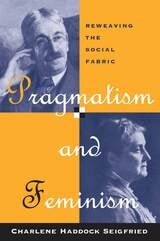
Pragmatism and Feminism
Reweaving the Social FabricCharlene Haddock Seigfried
University of Chicago Press, 1996
With careful attention to their interwoven histories and contemporary concerns, Pragmatism and Feminism effectively invigorates both traditions, opening them to new interpretations and appropriations and asserting their timely philosophical relevance. This foundational work in feminist theory simultaneously invites and guides future scholarship in an area of rapidly emerging significance.
Pragmatism and Political Theory
From Dewey to RortyMatthew Festenstein
University of Chicago Press, 1997
The book's second part traces how Dewey's approach has been differently developed, especially in the work of three contemporary pragmatic thinkers: Richard Rorty, Jurgen Habermas, and Hilary Putnam. This first full-length critical study of the relationship between the pragmatist tradition and political philosophy fills a significant gap in contemporary thought.
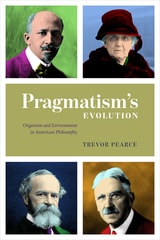
Pragmatism's Evolution
Organism and Environment in American PhilosophyTrevor Pearce
University of Chicago Press, 2020
Although the various thinkers associated with pragmatism—from Charles Sanders Peirce to Jane Addams and beyond—were towering figures in American intellectual life, few realize the full extent of their engagement with the life sciences. In his analysis, Pearce focuses on a series of debates in biology from 1860 to 1910—from the instincts of honeybees to the inheritance of acquired characteristics—in which the pragmatists were active participants. If we want to understand the pragmatists and their influence, Pearce argues, we need to understand the relationship between pragmatism and biology.
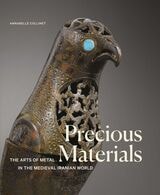
Precious Materials
The Arts of Metal in the Medieval Iranian WorldAnnabelle Collinet
Gingko, 2024
Medieval metalwork is one of the artistic highlights of the Iranian world, as well as of the Département des Arts de l’Islam at the Louvre in Paris, which holds more than one hundred and fifty objects from this period. A new approach to the study of a historic collection, Precious Material: The Arts of Metal in the Medieval Iranian World is a comprehensive overview of the production of metal in medieval Iran. Although this is one of the most important collections in the world, the objects, some well-known but many more unpublished, have never been studied or published as an ensemble. This volume includes a presentation of the collection through the lens of its centers of manufacture, a full technical analysis, as well as the functions and contexts in which the pieces were used. Each object is fully described and illustrated in color with close-up or X-ray images, and many inscriptions have been translated and are included in the catalog entries.
Prehistoric Future
Max Ernst and the Return of Painting between the WarsRalph Ubl
University of Chicago Press, 2013
Presence and Absence
A Philosophical Investigation of Language and BeingRobert Sokolowski
Catholic University of America Press, 2017
“A splendid, provocative and profound work, this book explores the manifold ways in which the contrast of presence and absence operate to establish the possibility of human discourse and truthfulness…belongs in every philosophy collection.” – Choice
“Quite simply a superb book, which deserves more than one careful reading. A fresh, unified treatment of a grand philosophical theme, the theme of the connections between thought, truth, and being.” – Man and World
“A thoughtful book about thoughtfulness and truthfulness and their ontological conditions. Simply put, this is a book that will reward its careful reader a hundredfold, for Sokolowski is a speaker who says things in ways that are provocative, exciting, and invariably insightful.” – Journal of the British Society for Phenomenology
“Has few peers in phenomenological literature.” – International Philosophical Quarterly
“[Sokolowski is] an original thinker of the first rank, who has significantly furthered the path of phenomenological philosophy. As well as being an exciting synthesis, a thinking of the previously unthought in predecessors, and a ground-breaking movement, this work is written with a sensitivity to language and its graceful use that one would hope for from one exploring its richness and power.” – Human Studies
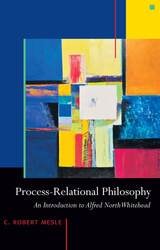
Process-Relational Philosophy
An Introduction to Alfred North WhiteheadC. Robert Mesle
Templeton Press, 2008
Process thought is the foundation for studies in many areas of contemporary philosophy, theology, political theory, educational theory, and the religion-science dialogue. It is derived from Alfred North Whitehead's philosophy, known as process theology, which lays a groundwork for integrating evolutionary biology, physics, philosophy of mind, theology, environmental ethics, religious pluralism, education, economics, and more.
In Process-Relational Philosophy, C. Robert Mesle breaks down Whitehead's complex writings, providing a simple but accurate introduction to the vision that underlies much of contemporary process philosophy and theology. In doing so, he points to a "way beyond both reductive materialism and the traps of Cartesian dualism by showing reality as a relational process in which minds arise from bodies, in which freedom and creativity are foundational to process, in which the relational power of persuasion is more basic than the unilateral power of coercion."
Because process-relational philosophy addresses the deep intuitions of a relational world basic to environmental and global thinking, it is being incorporated into undergraduate and graduate courses in philosophy, educational theory and practice, environmental ethics, and science and values, among others. Process-Relational Philosophy: A Basic Introduction makes Whitehead's creative vision accessible to all students and general readers.
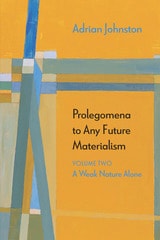
Prolegomena to Any Future Materialism
A Weak Nature AloneAdrian Johnston
Northwestern University Press, 2019
Adrian Johnston’s trilogy Prolegomena to Any Future Materialism aims to forge a thoroughly materialist yet antireductive theory of subjectivity. In this second volume, A Weak Nature Alone, Johnston focuses on the philosophy of nature required for such a theory. This volume is guided by a fundamental question: How must nature be rethought so that human minds and freedom do not appear to be either impossible or inexplicable within it? Asked differently: How must the natural world itself be structured such that sapient subjects in all their distinctive peculiarities emerged from and continue to exist within this world?
In A Weak Nature Alone, Johnston develops his transcendental materialist account of nature through engaging with and weaving together five main sources of inspiration: Hegelian philosophy, Marxist materialism, Freudian-Lacanian metapsychology, Anglo-American analytic neo-Hegelianism, and evolutionary theory and neurobiology. Johnston argues that these seemingly (but not really) strange bedfellows should be brought together so as to construct a contemporary ontology of nature. Through this ontology, nonnatural human subjects can be seen to arise in an immanent, bottom-up fashion from nature itself.
Prophetic Politics
Emmanuel Levinas and the Sanctification of SufferingPhilip J. Harold
Ohio University Press, 2009
In Prophetic Politics, Philip J. Harold offers an original interpretation of the political dimension of Emmanuel Levinas’s thought. Harold argues that Levinas’s mature position in Otherwise Than Being breaks radically with the dialogical inclinations of his earlier Totality and Infinity and that transformation manifests itself most clearly in the peculiar nature of Levinas’s relationship to politics.
Levinas’s philosophy is concerned not with the ethical per se, in either its applied or its transcendent forms, but with the source of ethics. Once this source is revealed to be an anarchic interruption of our efforts to think the ethical, Levinas’s political claims cannot be read as straightforward ideological positions or principles for political action. They are instead to be understood “prophetically,” a position that Harold finds comparable to the communitarian critique of liberalism offered by such writers as Alasdair MacIntyre and Charles Taylor. In developing this interpretation, which runs counter to formative influences from the phenomenological tradition, Harold traces Levinas’s debt to phenomenological descriptions of such experiences as empathy and playfulness.
Prophetic Politics will highlight the relevance of the phenomenological tradition to contemporary ethical and political thought—a long-standing goal of the series—while also making a significant and original contribution to Levinas scholarship.
Propositional Attitudes
The Role of Content in Logic, Language, and MindEdited by C. Anthony Anderson and Joseph Owens
CSLI, 1990