Results by title
572 books match the query 'Photography' and 64 start with p
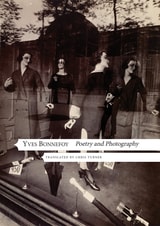
Poetry and Photography
Yves Bonnefoy
Seagull Books, 2017
Bonnefoy's compact essay focuses on one of the disturbing effects of the earliest photographs: their introduction of a notion of non-being—if not, indeed, nothingness—into the world of images. But it also foregrounds a tale which seems to have picked up figuratively on this effect and examined its dangers with a sense of horror: Guy de Maupassant’s extraordinary short story “The Night,” one of the nightmarish works of his last period of conscious creation.
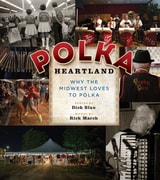
Polka Heartland
Why the Midwest Loves to PolkaRick March
Wisconsin Historical Society Press, 2015
"Polka Heartland" captures the beat that pulses in the heart of Midwestern culture--the polka--and offers up the fascinating history of how "oompah-pah" came to be the sound of middle America. From the crowded dance tent at Pulaski Polka Days to an off-the-grid Mexican polka dance in small-town Wisconsin, "Polka Heartland" explores the people, places, and history behind the Midwest's favorite music.
From polka's surprising origin story as a cutting-edge European fad to an exploration of the modern-day polka scene, author Rick March and photographer Dick Blau take readers on a joyful romp through this beloved, unique, and richly storied genre. "Polka Heartland" describes the artists, venues, instruments, and music-makers who have been pivotal to polka's popularity across the Midwest and offers six full-color photo galleries to immerse readers in today's vibrant polka scene.
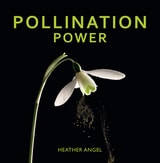
Pollination Power
Heather Angel
University of Chicago Press, 2016
In stunning full-color images, employing the latest photographic techniques, esteemed photographer Heather Angel has captures the intimate interactions of plants with their floral pollinators. The plants come not only from Angel’s Surrey backyard and the Royal Botanic Garden at Kew, but from twenty countries where Angel has travelled—from the rich floral kingdoms of the Cape of South Africa to the diversity of China and the Americas. The photos illustrate the varied techniques that flowers use to communicate with their pollinators. Some, for example, change color when the flower no longer has rewards to offer. Others control precisely when pollinators enter or leave by timing when they open and close their petals or when they emit a scent. This fascinating array of pollination repertoires crossfertilizes Angel’s photos with a descriptive text.
Featuring both common and exotic plants and temperate and tropical floral, Pollination Power will entice anyone with a passion for botanicals, from gardeners to botanists alike.
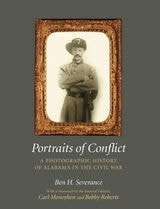
Portraits of Conflict
A Photographic History of Alabama in the Civil WarBen H. Severance
University of Arkansas Press, 2012

Portraits of Conflict
A Photographic History of Louisiana in the Civil WarCarl H. Moneyhon
University of Arkansas Press, 1990
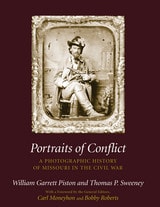
Portraits of Conflict
A Photographic History of Missouri in the Civil WarWilliam Garrett Piston
University of Arkansas Press, 2009
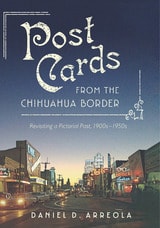
Postcards from the Chihuahua Border
Revisiting a Pictorial Past, 1900s–1950sDaniel D. Arreola
University of Arizona Press, 2019
In Postcards from the Chihuahua Border Daniel D. Arreola captures the exhilaration of places in time, taking us back to Mexico’s northern border towns of Cuidad Juárez, Ojinaga, and Palomas in the early twentieth century. Drawing on more than three decades of archival work, Arreola uses postcards and maps to unveil the history of these towns along west Texas’s and New Mexico’s southern borders.
Postcards offer a special kind of visual evidence. Arreola’s collection of imagery and commentary about them shows us singular places, enriching our understandings of history and the history of change in Chihuahua. No one postcard tells the entire story. But image after image offers a collected view and insight into changing perceptions. Arreola’s geography of place looks both inward and outward. We see what tourists see, while at the same time gaining insight about what postcard photographers and postcard publishers wanted to be seen and perceived about these border communities.
Postcards from the Chihuahua Border is a colorful and dynamic visual history. It invites the reader to time travel, to revisit another era—the first half of the last century—when these border towns were framed and made popular through picture postcards.

Postcards from the Road
Robert Frank’s ‘The Americans’Jonathan Day
Intellect Books, 2014
Taking Frank’s iconic images as his point of reference, Day shot new photographs that commented on the road and contemporary America. Here, these images are paired with critical commentary that details the aspects of the work that are visually expounded and explained in Day’s complementary images. A visual entryway to the photographs and themes of this iconic book in the history of photography, Postcards from the Road represents an innovative, carefully considered departure from standard photographic textbooks.
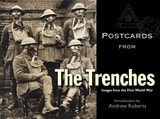
Postcards from the Trenches
Images from the First World WarEdited by the Bodleian Library
Bodleian Library Publishing, 2008
The cards in this compelling volume were created not only by soldiers, but also by embedded journalists from France, Belgium, Austria, Germany, and Britain. The images capture scenes both humorous and poignant, including soldiers having a mock party with little food to eat, wounded soldiers smiling for the camera, a makeshift trench hospital, the bloody aftermath of a battle, and a huddle of men taking what they know could be their last communion before marching onto the battlefield. Other cards document the mundane duties that dominated wartime life, including men digging trenches, troops marching to new trenches and battlefields, and or soldiers nearly comatose with boredom while waiting for the fight to begin. This stunning visual narrative opens a new window into one of the most analyzed events in history, as the postcards’ images testify to the resilience and bravery of soldiers in the most trying circumstances.
A fascinating and unprecedented historical document, Postcards from the Trenches draws back the curtain to unflinchingly show the daily horror and humanity that define life in war.
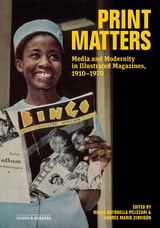
Print Matters
Media and Modernity in Illustrated Magazines, 1910–1970Maria Antonella Pelizzari
J. Paul Getty Trust, The, 2025
In the early to mid-twentieth century, the vast majority of printed photographs appeared in the pages of illustrated magazines. Publications such as Life, China Pictorial, Drum, Picture Post, and Ebony did more than showcase photographs; they crafted visual narratives by combining images, text, and graphics into influential cultural artifacts. These periodicals shaped public perception and mass media consensus like the Internet does today, bringing a shared visual experience to homes and newsstands around the world.
The essays in this volume delve into the technologies and visual strategies behind these publications, showing how their layouts were affected by political, commercial, editorial, and artistic factors leading up to World War II. The commentaries also explore how democracy, dictatorships, colonization, and modernity at large gave rise to experimental magazine designs, turning avant-garde art and lifestyle reporting into popular formats. Featuring over 150 images, Print Matters traces how illustrated magazines evolved across countries and continents, offering new insights into their history and enduring impact on culture and society.
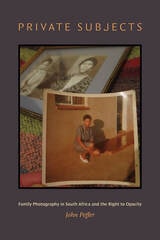
Private Subjects
Family Photography in South Africa and the Right to OpacityJohn Peffer
Duke University Press, 2026
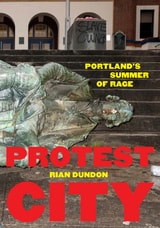
Protest City
Portland's Summer of RageRian Dundon
Oregon State University Press, 2023
In the months leading up to the 2020 presidential election, Portland made national news with nightly social justice protests, often met with violent response by counter protestors and law enforcement. Though frequently regarded as a progressive hub, Portland has a long history of racial inequality and oppression, and the city’s entrenched divisions gained new attention during the Trump years. The photos in Protest City present a visceral visual record of this significant moment in Portland’s history.
Rian Dundon, who has been photographing the rise of extreme politics on the West Coast since 2016, lived only a short walk from the protests that erupted after the murder of George Floyd. For one hundred days, Dundon enmeshed himself in the demonstrations with an unobtrusive point-and-shoot camera. The result is a graphic portrayal of how social movements become politicized, how spectacle serves as a subtext to change in the digital age, and how modern protests blur distinctions among performance, ritual, and surveillance. As he follows the progress of Portland’s conflicts, Dundon draws connections to Oregon’s legacy as a stronghold of white supremacist extremism and interrogates the role of whiteness in racial justice movements.
Most of the photographs in the book were taken between May and October 2020, but the collection also includes photos from protests in late 2020 and 2021 around various related issues, including the Red House eviction blockade, rightwing demonstrations on January 6 and 17, and the one-year anniversary of George Floyd’s murder. Dundon’s striking photos recreate the immediacy and impact of the protests, while essays by historian Carmen Thompson and journalist Donnell Alexander contextualize the uprising’s sociopolitical background. A chronology and author’s note are also featured.
The publisher and author would like to thank the Magnum Foundation, Documentary Arts, and the Economic Hardship Reporting Project for their generous support of this publication. Additional funding has been provided by Furthermore: a program of the J. M. Kaplan Fund.
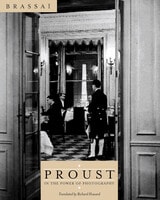
Proust in the Power of Photography
Brassaï
University of Chicago Press, 2001
Drawing on his own experience as a photographer and author, Brassaï discovers a neglected aspect of Proust's interests, offering us a fascinating study of the role of photography both in Proust's oeuvre and in early-twentieth-century culture. Brassaï shows us how Proust was excessively interested in possessing portraits of his acquaintances and how the process by which he remembered and wrote was quite similar to the ways in which photographs register and reveal life's images. This book-beautifully translated by Richard Howard-features previously obscure photographs from Brassaï's High Society series and offers a rare glimpse into two of France's most fascinating artistic minds.
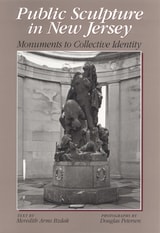
Public Sculpture in New Jersey
Monuments to Collective IdentityBzdak, Meredith Arms
Rutgers University Press, 1999
New Jersey boasts more than 700 public sculptures. When viewed as a group, these works give us great insights about who helped to shape New Jersey, what events we considered significant, and how we hope we will be remembered. Public Sculpture in New Jersey examines 150 years of past and current patterns in the commissioning and placement of outdoor art in the Garden State.
The book contains essays that profile the state’s 100 most significant works as well as the artists who created them, and features nearly 100 magnificent photographs that document these works, capturing the effects of time and the environment on each sculpture. Bzdak and Petersen selected these works for the variety of stories they tell and for their range of artistic expression, from traditional to contemporary, rather than focusing only on the best known or most visible works of public sculpture. By telling the stories behind the sculptures, the book captures New Jersey’s history, especially history that may not be well known but that conveys significant information about how our predecessors lived and the official images they sought to leave behind.