Results by title
1214 books match the query 'Subjects & Themes' and 71 start with p
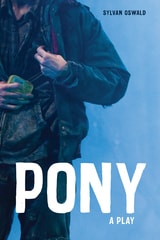
Pony
A PlaySylvan Oswald
Northwestern University Press, 2025
When Pony, a formerly incarcerated trans guy, moves to a small rural town to start a new life, he quickly becomes entangled with its isolated community. He starts to fall for a waitress who is obsessed with a local murder; he must comply with a butch social worker who doesn’t understand him; and he is pursued by a young trans man who thinks Pony could be the father he always wanted. Amid this whirlwind of fear and desire, Pony must find the strength to confront the stories he's been told about masculinity, violence, and self-worth. With a new preface by the author on searching for queer and trans community in the theater, and an afterword by critic Miriam Felton-Dansky contextualizing its place in contemporary theater, Pony is a seminal work of trans theater exploring questions of generational difference, class, and gender on an epic scale.
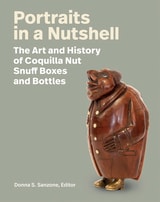
Portraits in a Nutshell
The Art and History of Coquilla Nut Snuff Boxes and BottlesDonna S. Sanzone
Brandeis University Press, 2025
Portraits in a Nutshell showcases intricately carved snuff boxes and bottles sculpted from the Brazilian coquilla nut between the seventeenth and mid-nineteenth centuries. Both utilitarian and decorative, these bottles and boxes were produced and used by diverse people of wide-ranging geographic origin, racial background, and social standing. As a result, coquilla nut snuff boxes present a rich material archive of the Atlantic world and the central role of Indigenous and Black histories within it.
Despite being just three or four inches long, these coquilla nut snuff boxes encapsulate an early modern history of transoceanic movement and creativity. The carvings depict animals and fantastical creatures, scenes of religious and courtly life, portraits of political and military leaders, abolitionists and activists, and people at the margins of colonial society. These images are available to the public and to scholars for the first time in this book and will be of interest to antique collectors, art historians, social historians, and anyone interested in the unusual and the curious.
Over 250 detailed photographs of snuff bottles and boxes from the unique and wide-ranging collection of David Badger not only illustrate the exceptional skill of their creators but also tell the story of millions of Africans transported to Brazil during centuries of the transatlantic slave trade. The text demonstrates the interconnectedness of the Atlantic world, the movements of peoples and ideas, and the commercial exchange of goods and cultural and material objects in Africa, Brazil, the Caribbean, and North America. In this beautiful book, these objects reveal a story never before told.
With a preface by Matthew Francis Rarey, associate professor of African and Black Atlantic art history at Oberlin College, and an introduction by Gwendolyn DuBois Shaw, professor of art history at the University of Pennsylvania and director of the Arthur Ross Gallery.
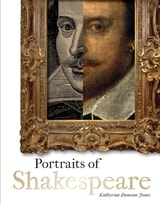
Portraits of Shakespeare
Katherine Duncan-Jones
Bodleian Library Publishing, 2015
With Portraits of Shakespeare, Katherine Duncan-Jones poses a series of questions about the mysterious physical appearance of the brilliant writer of plays, poems, and sonnets: Why is it so difficult to find images of Shakespeare that were made during his lifetime? Which images are most likely to have been made by those close to the writer? And why do newly discovered images emerge with such startling regularity? With an eye toward answering these questions, the book begins with a broad analysis of the tradition of the “author portrait” before, during, and after Shakespeare’s lifetime. Duncan-Jones provides a detailed critique of three of the most widely accepted portraits: the engraving facing the First Folio’s title page; the sculptured stone bust that adorns Shakespeare’s funerary monument at Holy Trinity Church, Stratford-upon-Avon; and the “Chandos portrait,” an early seventeenth-century painting on canvas which is widely recognized as the best image. Through a painstaking historical analysis of the painting’s early history and provenance, Duncan-Jones arrives at a plausible new identification of both the artist and the artist’s personal connections with Shakespeare. Finally, taking the book into the present, she considers the afterlife of all three images in memorials, advertising, and in graphic art—all evidence of a continuing desire to put a face to one of literature’s most famous names.

Portraits of Violence
War and the Aesthetics of DisfigurementSuzannah Biernoff
University of Michigan Press, 2017
Suzannah Biernoff draws on a wide variety of sources mainly from WWI but also contemporary photography and computer games. Each chapter revolves around particular images: Marine Wedding is discussed alongside Stuart Griffiths’ portraits of British veterans; Henry Tonks’ drawings of WWI facial casualties are compared to the medical photographs in the Gillies Archives; the production of portrait masks for the severely disfigured is approached through the lens of documentary film and photography; and finally the haunting image of one of Tonks’s patients reappears in BioShock, a highly successful computer game. The book simultaneously addresses a neglected area in disability studies; puts disfigurement on the agenda for art history and visual studies; and makes a timely and provocative contribution to the literature on the First World War.
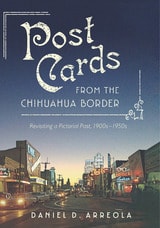
Postcards from the Chihuahua Border
Revisiting a Pictorial Past, 1900s–1950sDaniel D. Arreola
University of Arizona Press, 2019
In Postcards from the Chihuahua Border Daniel D. Arreola captures the exhilaration of places in time, taking us back to Mexico’s northern border towns of Cuidad Juárez, Ojinaga, and Palomas in the early twentieth century. Drawing on more than three decades of archival work, Arreola uses postcards and maps to unveil the history of these towns along west Texas’s and New Mexico’s southern borders.
Postcards offer a special kind of visual evidence. Arreola’s collection of imagery and commentary about them shows us singular places, enriching our understandings of history and the history of change in Chihuahua. No one postcard tells the entire story. But image after image offers a collected view and insight into changing perceptions. Arreola’s geography of place looks both inward and outward. We see what tourists see, while at the same time gaining insight about what postcard photographers and postcard publishers wanted to be seen and perceived about these border communities.
Postcards from the Chihuahua Border is a colorful and dynamic visual history. It invites the reader to time travel, to revisit another era—the first half of the last century—when these border towns were framed and made popular through picture postcards.
Postcolonial Disaster
Narrating Catastrophe in the Twenty-First CenturyPallavi Rastogi
Northwestern University Press, 2020
Rastogi creates a narratology for postcolonial disaster fiction and brings concepts from Disaster Studies into the realm of literary analysis.
Pragmatics of Democracy
A Political Theory of African American Literature Before EmancipationDouglas A. Jones
University of Chicago Press, 2025
Douglas A. Jones’s Pragmatics of Democracy reads African American literature, from its beginnings through the mid-nineteenth century, to theorize how we have come to regard democracy as the most excellent form of political life. Jones notes that the aims of democracy, especially consent of the governed and equality under the law, can seem like tenets of governance that humans desire instinctively. But human nature does not correlate absolutely to politics. Jones argues that political selfhood is formed by “bodily events.” He proposes a typology of such experiences that dispose persons toward democratic subjectivity: ecstasy, impersonality, violence, respectability, and care.
African American literature before Emancipation reveals the democratic features of these categories that conventional political philosophy ignores or obscures. Given their lives as enslaved persons or the descendants of enslaved persons, early black writers crafted narratives about achieving democratic subjectivity that were missing in other Anglo-American canons. Pragmatics of Democracy discusses the works of well-known figures such as Phillis Wheatley, Harriet E. Wilson, and Frederick Douglass as well as those of more neglected writers such as Richard Allen, Peter Paul Simmons, James McCune Smith, and Frank J. Webb.
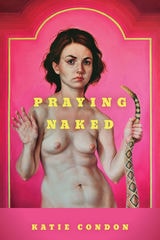
Praying Naked
Katie Condon
The Ohio State University Press, 2020
Pregnancy in the Victorian Novel
Livia Arndal Woods
The Ohio State University Press, 2023
In Pregnancy in the Victorian Novel—the first book-length study of the topic—Livia Arndal Woods traces the connections between literary treatments of pregnancy and the medicalization of pregnancy and childbirth occurring over the long nineteenth century. Woods uses the problem of pregnancy in the Victorian novel (in which pregnancy is treated modestly as a rule and only rarely as an embodied experience) to advocate for “somatic reading,” a practice attuned to impressions of the body on the page and in our own messy lived experiences.
Examining works by Emily Brontë, Charlotte Mary Yonge, Anthony Trollope, George Eliot, Thomas Hardy and others, Woods considers instances of pregnancy that are tied to representations of immodesty, poverty, and medical diagnosis. These representations, Woods argues, should be understood in the arc of Anglo-American modernity and its aftershocks, connecting backward to early modern witch trials and forward to the criminalization of women for pregnancy outcomes in twenty-first-century America. Ultimately, she makes the case that by clearing space for the personal and anecdotal in scholarship, somatic reading helps us analyze with uncertainty rather than against it and allows for richer and more relevant textual interpretation.
Previously Owned
Nathan McClain
Four Way Books, 2022
Primer of the Obsolete
Diane Glancy
University of Massachusetts Press, 2004
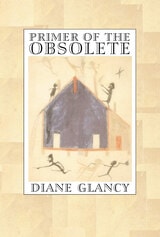
The poems have roots in history, religion, and illiteracy. They are inspired by folk artists who use materials and textures at hand—enamel and cornmeal on plywood, house paint on tar and tin, model airplane paint on corrugated scrap metal. The resulting lyrics walk the boundary between worlds, weaving remnants of the old way of viewing the world with pieces of the new world, such as a clapper that turns lights on and off. The experimental text revisits the gap between past and present. The past is just beneath a newly painted surface. The newly painted surface is not quite dry.
Print Passages
Colonial Book Culture in the Dutch East IndiesLisa Kuitert
National University of Singapore Press, 2026
Although printed material has become intertwined with everyday life in the twenty-first century, book culture has not always been ubiquitous. Print Passages researches the history of the arrival of the printed book in Indonesia, and the consequences this new technology brought with it. The introduction of the printing press during the Dutch occupation of the archipelago (then the Dutch East Indies) laid the foundation for a flourishing cultural and intellectual life centered on books and printed materials, especially after 1816. Though printed matter was used to colonize and control the land, it also gave the resistance a voice.
Through an exploration of selected themes, author Lisa Kuitert answers practical questions such as how Dutch language researchers and printers found their way to and within Indonesia, while also diving into the parallel printing culture that was entirely run by Indonesians, often with a Chinese background.
Printer's Fist
PoemsMelissa Range
Vanderbilt University Press, 2026
Melissa Range’s Printer’s Fist, awarded the 2025 Vanderbilt University Literary Prize, is a collection that tells the story of a political movement—its strides and setbacks, its unity and fractures—with a particular emphasis on print culture. Drawing upon more than a decade’s worth of archival research into nineteenth-century antislavery newspapers, pamphlets, broadsides, and more, Range highlights the expansiveness of the movement by focusing not on one, but a chorus of abolitionist voices. Her investment in celebrating Black and women’s histories, in particular, offers an inclusive account of American history, informed not only by thorough research but through a formal, poetic engagement with the past. In exploring how enslaved people’s self-emancipation was a form of resistance that preceded, operated alongside, and intertwined with organized networks of antislavery activists, Printer’s Fist will help facilitate discussions surrounding race, gender, and activism that are grounded in historical fact and emotional truth.
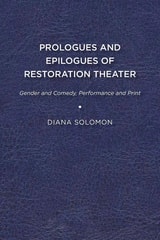
Prologues and Epilogues of Restoration Theater
Gender and Comedy, Performance and PrintDiana Solomon
University of Delaware Press, 2013
Published by University of Delaware Press. Distributed worldwide by Rutgers University Press.
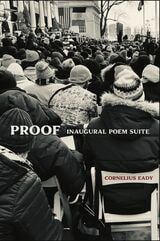
Proof
Inaugural Poem SuiteCornelius Eady
Tupelo Press, 2026
Cornelius Eady turns the inaugural poem into an instrument of reckoning.
First delivered to mark the historic inauguration of New York City’s mayor Zohran Mamdani on January 1, 2026, the title poem is not ceremony—it is summons. “You have to imagine it,” Eady insists, and from that insistence rises a chorus: those called too dark, too queer, too poor, too loud; those renamed invisible; those told “not now.” What if joy could wear down the rock of no? What if imagination were not escape, but evidence?
Moving from Robert Frost squinting into winter glare, to Elizabeth Alexander straightening her back before history, to Aretha Franklin beneath her church-crown hat, Eady braids civic pageantry with private memory. He summons the Colored Conventions of 1830, the 911 call that ricocheted through racial panic, the mock rifles on a Brooklyn rooftop, the “knife in sheep’s clothes.” Each poem widens the frame. Each poem refuses to look away.
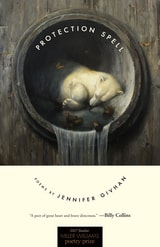
Protection Spell
PoemsJennifer Givhan
University of Arkansas Press, 2017
Finalist, 2017 Miller Williams Poetry Prize, edited by Billy Collins
“A poet of great heart and brave directness.”
—Billy Collins
In Protection Spell Jennifer Givhan explores the guilt, sadness, and freedom of relationships: the sticky love that keeps us hanging on for no reason other than love, the inky place that asks us to continue revising and reimagining, tying ourselves to this life and to each other despite the pain (or perhaps because of it). These poems reassemble safe spaces from the fissures cleaving the speaker’s own biracial home and act as witnesses speaking to the racial iniquity of our broader social landscape as well as to the precarious standpoint of a mother-woman of color whose body lies vulnerable to trauma and abuse. From insistent moments of bravery, a collection of poems arises that asks the impossible, like the childhood chant that palliates suffering by demanding nothing less than magical healing: sana sana colita de rana, si no sanas hoy, sanas mañana (the frog who loses his tail is commanded to grow another). In the end, Givhan’s verse offers a place where healing may begin.
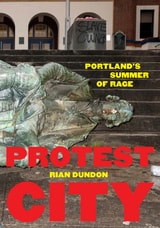
Protest City
Portland's Summer of RageRian Dundon
Oregon State University Press, 2023
In the months leading up to the 2020 presidential election, Portland made national news with nightly social justice protests, often met with violent response by counter protestors and law enforcement. Though frequently regarded as a progressive hub, Portland has a long history of racial inequality and oppression, and the city’s entrenched divisions gained new attention during the Trump years. The photos in Protest City present a visceral visual record of this significant moment in Portland’s history.
Rian Dundon, who has been photographing the rise of extreme politics on the West Coast since 2016, lived only a short walk from the protests that erupted after the murder of George Floyd. For one hundred days, Dundon enmeshed himself in the demonstrations with an unobtrusive point-and-shoot camera. The result is a graphic portrayal of how social movements become politicized, how spectacle serves as a subtext to change in the digital age, and how modern protests blur distinctions among performance, ritual, and surveillance. As he follows the progress of Portland’s conflicts, Dundon draws connections to Oregon’s legacy as a stronghold of white supremacist extremism and interrogates the role of whiteness in racial justice movements.
Most of the photographs in the book were taken between May and October 2020, but the collection also includes photos from protests in late 2020 and 2021 around various related issues, including the Red House eviction blockade, rightwing demonstrations on January 6 and 17, and the one-year anniversary of George Floyd’s murder. Dundon’s striking photos recreate the immediacy and impact of the protests, while essays by historian Carmen Thompson and journalist Donnell Alexander contextualize the uprising’s sociopolitical background. A chronology and author’s note are also featured.
The publisher and author would like to thank the Magnum Foundation, Documentary Arts, and the Economic Hardship Reporting Project for their generous support of this publication. Additional funding has been provided by Furthermore: a program of the J. M. Kaplan Fund.
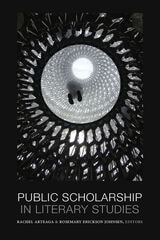
Public Scholarship in Literary Studies
Rachel Arteaga
Amherst College Press, 2021
"There are books of literary criticism that attempt to reach crossover audiences but none that take this particular public-humanities-focused-on-literary criticism perspective."—Kathryn Temple, Georgetown University
Contributions by Rachel Arteaga, Christine Chaney, Jim Cocola, Daniel Coleman, Christopher Douglas, Gary Handwerk, Cynthia L. Haven, Rosemary Erickson Johnsen, Anu Taranath, Carmaletta M. Williams, and Lorraine York.
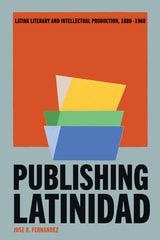
Publishing Latinidad
Latinx Literary and Intellectual Production, 1880–1960Jose O. Fernandez
University of Arizona Press, 2025
Publishing Latinidad brings to light the overlooked contributions of early Latinx writers and intellectuals, offering a fresh perspective on their roles in shaping American literary and cultural landscapes.
Jose O. Fernandez meticulously examines the works of notable figures like José Martí, Arturo Schomburg, Jesús Colón, José de la Luz Sáenz, Adela Sloss-Vento, and Américo Paredes, illuminating their innovative approaches to circumventing exclusionary practices in the publishing world. He demonstrates how these writers and intellectuals entered literary, cultural, and intellectual discourses through alternative modes of literary production: crónicas, translations, paratexts, bibliographies, archival practices, sketches, diaries, biographies, unpublished fiction, and scholarly monographs. Through these examples, Fernandez situates Latinx literary production in this time period within the broader context of racial and ethnic solidarity movements in the United States.
Publishing Latinidad is essential reading for anyone interested in the social and cultural underpinnings of Latinx literature and intellectual thought. It challenges traditional narratives and enriches our appreciation of the diverse voices that have long been instrumental in the fight for justice.
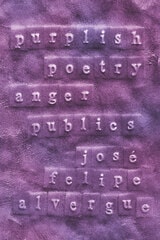
purplish
poetry anger publicsJosé Felipe Alvergue
University of Iowa Press, 2025
purplish challenges the idea of an objective or unbiased cultural rationale to purple regions in America by historicizing how anger has been systemically cleansed from the collective sentiments regarding nation-building throughout key moments of our national heritage.