Results by title
3703 books match the query '19th century' and 148 start with p

Power at Sea, Volume 1
The Age of Navalism, 1890-1918Lisle A. Rose
University of Missouri Press, 2006
Power in Concert
The Nineteenth-Century Origins of Global GovernanceJennifer Mitzen
University of Chicago Press, 2013

Pragmatic Naturalism
An IntroductionS. Morris Eames
Southern Illinois University Press, 1977
It is said that America came of age intellectually with the appearance of the pragmatic movement in philosophy. Pragmatic Naturalism presents a selective and interpretative overview of this philosophy as developed in the writings of its intellectual founders and chief exponents—Charles Sanders Peirce, William James, George Herbert Mead, and John Dewey. Mr. Eames groups the leading ideas of these pragmatic naturalists around the general fields of “Nature and Human Life,” “Knowledge,” “Value,” and “Education,” treating the primary concerns and special emphasis of each philosopher to these issues.
Philosophy students, teachers of philosophy, and general readers will find this book a comprehensive overview of American philosophy.
Pragmatism's Evolution
Organism and Environment in American PhilosophyTrevor Pearce
University of Chicago Press, 2020
Although the various thinkers associated with pragmatism—from Charles Sanders Peirce to Jane Addams and beyond—were towering figures in American intellectual life, few realize the full extent of their engagement with the life sciences. In his analysis, Pearce focuses on a series of debates in biology from 1860 to 1910—from the instincts of honeybees to the inheritance of acquired characteristics—in which the pragmatists were active participants. If we want to understand the pragmatists and their influence, Pearce argues, we need to understand the relationship between pragmatism and biology.
Prairie Albion
An English Settlement in Pioneer IllinoisCharles Boewe
Southern Illinois University Press, 1999
Originally published in 1962, this story of the English Settlement in pioneer Illinois is compiled from the eyewitness accounts of the participants. The founders, Morris Birkbeck and George Flower, as well as their associates and the many visitors to their prairie settlement, wrote mainly for immediate and sometimes controversial ends. Charles Boewe has selected excerpts from letters, descriptions, diaries, histories, and periodicals within a chronological framework to emphasize the implicit drama of the settlers' deeds as they searched for a suitable site, founded their colony, and augmented their forces with new arrivals from England. No less dramatic is the subsequent estrangement of the two founders, the disillusionment of many of the English settlers, the untimely death of Birkbeck, and the financial ruin of Flower.

Prairie Defender
The Murder Trials of Abraham LincolnGeorge R. Dekle, Sr.
Southern Illinois University Press, 2017
2018 ISHS Annual Award Winner for a Scholarly Publication
According to conventional wisdom, Abraham Lincoln spent most of his law career collecting debt and representing railroads, and this focus made him inept at defending clients in homicide cases. In this unprecedented study of Lincoln’s criminal cases, George Dekle disproves these popular notions, showing that Lincoln was first and foremost a trial lawyer. Through careful examination of Lincoln’s homicide cases and evaluation of his legal skills, Dekle demonstrates that criminal law was an important part of Lincoln's practice, and that he was quite capable of defending people accused of murder, trying approximately one such case per year.
Dekle begins by presenting the viewpoints of not only those who see Lincoln as a perfect lawyer whose only flaw was his inability to represent the wrong side of a case but also those who believe Lincoln was a less-than-honest legal hack. The author invites readers to compare these wildly different stereotypes with the flesh-and-blood Lincoln revealed in each case described in the book, including an axe murder suit in which Lincoln assisted the prosecution, a poisoning case he refused to prosecute for $200 but defended for $75, and a case he won by proving that a supposed murder victim was actually still alive.
For each case Dekle covers, he first tells the stories of the feuds, arguments, and insults that led to murder and other criminal activity, giving a gripping view of the seamy side of life in nineteenth-century Illinois. Then he traces the course of the pretrial litigation, describes the trials and the various tactics employed in the prosecution and defense, and critiques the performance of both Lincoln and his adversaries.
Dekle concludes that Lincoln was a competent, diligent criminal trial lawyer who knew the law, could argue it effectively to both judge and jury, and would use all lawful means to defend clients whether he believed them to be innocent or guilty. His trial record shows Lincoln to have been a formidable defense lawyer who won many seemingly hopeless cases through his skill as a courtroom tactician, cross-examiner, and orator. Criminal defendants who could retain Lincoln as a defense attorney were well represented, and criminal defense attorneys who sought him as co-counsel were well served. Providing insight into both Lincoln’s legal career and the culture in which he practiced law, Prairie Defender resolves a major misconception concerning one of our most important historical figures.
Prairie Justice
A History of Illinois Courts under French, English, and American LawRoger L. Severns. Edited by John A. Lupton
Southern Illinois University Press, 2015
Winner, ISHS Superior Achievement Award for a Scholarly Publication, 2016
A concise legal history of Illinois through the end of the nineteenth century, Prairie Justice covers the region’s progression from French to British to early American legal systems, which culminated in a unique body of Illinois law that has influenced other jurisdictions. Written by Roger L. Severns in the 1950s and published in serial form in the 1960s, Prairie Justice is available now for the first time as a book, thanks to the work of editor John A. Lupton, an Illinois and legal historian who also contributed an introduction.
Illinois’ legal development demonstrates the tension between two completely different European legal systems, between river communities and prairie towns, and between agrarian and urban interests. Severns uses several rulings—including a reconstitution of the Supreme Court in 1824, slavery-related cases, and the impeachment of a Supreme Court justice—to examine political movements in Illinois and their impact on the local judiciary. Through legal decisions, the Illinois judiciary became an independent, co-equal branch of state government. By the mid-nineteenth century, Illinois had established itself as a leading judicial authority, influencing not only the growing western frontier but also the industrialized and farming regions of the country. With a close eye for detail, Severns reviews the status of the legal profession during the 1850s by looking new members of the Court, the nostalgia of circuit riding, and how a young lawyer named Abraham Lincoln rose to prominence.
Illinois has a rich judicial history, but that history has not been adequately documented until now. With the publication of Prairie Justice, those interested in Illinois legal history finally have a book that covers the development of the state’s judiciary in its formative years.
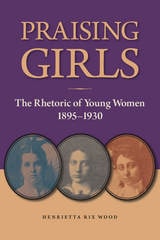
Praising Girls
The Rhetoric of Young Women, 1895-1930Henrietta Rix Wood
Southern Illinois University Press, 2016
The site of the study—Kansas City, Missouri—reflects the diverse rhetorical experiences of girls in cities across the United States at the beginning of the last century. Four case studies examine the writing of privileged white girls at a college preparatory school, Native American girls at an off-reservation boarding school, African American girls at a segregated high school, and working- and middle-class girls at a large whites-only public high school. Wood’s analysis reveals a contemporary concept of epideictic rhetoric that accounts for issues of gender, race, class, and age.

Preaching and the Rise of the American Novel
Dawn Coleman
The Ohio State University Press, 2013

Precarious Partners
Horses and Their Humans in Nineteenth-Century FranceKari Weil
University of Chicago Press, 2020
Weil traces the evolving partnerships established between French citizens and their horses through this era. She considers the newly designed “races” of workhorses who carried men from the battlefield to the hippodrome, lugged heavy loads through the boulevards, or paraded women riders, amazones, in the parks or circus halls—as well as those unfortunate horses who found their fate on a dinner plate. Moving between literature, painting, natural philosophy, popular cartoons, sports manuals, and tracts of public hygiene, Precarious Partners traces the changing social, political, and emotional relations with these charismatic creatures who straddled conceptions of pet and livestock in nineteenth-century France.
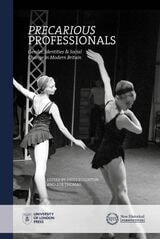
Precarious Professionals
Gender, Identities and Social Change in Modern BritainEdited by Heidi Egginton and Zoë Thomas
University of London Press, 2021
Precarious Professionals uncovers the inequalities and insecurities which lay at the heart of professional life in nineteenth and twentieth-century Britain. This book challenges conventional categories in the history of work, exploring instead the everyday labor of maintaining a professional identity on the margins of the traditional professions. Situating new historical perspectives on gender at the forefront of their research, the contributors explore how professional cultures could not only define themselves against but often flourished outside of, the confines of patriarchal codes and structures.
Precarious Professionals offers twelve fascinating case studies, ranging between the 1840s and the 1960s. From pioneering female lawyers and scientists to ballet dancers, secretaries, historians, humanitarian relief workers, social researchers, and Cold War diplomats, this book reveals that precarity was a thread woven throughout the very fabric of modern professional life. Together, these essays enrich our understanding of the histories and mysteries of professional identity and help us to reimagine the future of work in precarious times.
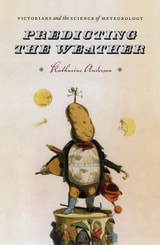
Predicting the Weather
Victorians and the Science of MeteorologyKatharine Anderson
University of Chicago Press, 2005
Studying meteorology as a means to examine the historical identity of prediction, Katharine Anderson offers here an engrossing account of forecasting that analyzes scientific practice and ideas about evidence, the organization of science in public life, and the articulation of scientific values in Victorian culture. In Predicting the Weather, Anderson grapples with fundamental questions about the function, intelligibility, and boundaries of scientific work while exposing the public expectations that shaped the practice of science during this period.
A cogent analysis of the remarkable history of weather forecasting in Victorian Britain, Predicting the Weather will be essential reading for scholars interested in the public dimensions of science.
Preface to Modernism
Art Berman
University of Illinois Press, 1994
literature through empiricism, idealism, and romanticism. Berman demonstrates how
modern social, political, and scientific developments -- including capitalism, socialism,
humanism, psychoanalysis, fascism, and modernism itself -- have altered attitudes toward
time, space, self, creativity, the natural world, and community. "Deserves careful study."
-- Choice
Pregnancy in the Victorian Novel
Livia Arndal Woods
The Ohio State University Press, 2023
In Pregnancy in the Victorian Novel—the first book-length study of the topic—Livia Arndal Woods traces the connections between literary treatments of pregnancy and the medicalization of pregnancy and childbirth occurring over the long nineteenth century. Woods uses the problem of pregnancy in the Victorian novel (in which pregnancy is treated modestly as a rule and only rarely as an embodied experience) to advocate for “somatic reading,” a practice attuned to impressions of the body on the page and in our own messy lived experiences.
Examining works by Emily Brontë, Charlotte Mary Yonge, Anthony Trollope, George Eliot, Thomas Hardy and others, Woods considers instances of pregnancy that are tied to representations of immodesty, poverty, and medical diagnosis. These representations, Woods argues, should be understood in the arc of Anglo-American modernity and its aftershocks, connecting backward to early modern witch trials and forward to the criminalization of women for pregnancy outcomes in twenty-first-century America. Ultimately, she makes the case that by clearing space for the personal and anecdotal in scholarship, somatic reading helps us analyze with uncertainty rather than against it and allows for richer and more relevant textual interpretation.
Prehistoric Copper Mining in Michigan
The Nineteenth-Century Discovery of “Ancient Diggings” in the Keweenaw Peninsula and Isle RoyaleJohn R Halsey
University of Michigan Press, 2018
Pretend We're Dead
Capitalist Monsters in American Pop CultureAnnalee Newitz
Duke University Press, 2006
Newitz looks at representations of serial killers, mad doctors, the undead, cyborgs, and unfortunates mutated by their involvement with the mass media industry. Whether considering the serial killer who turns murder into a kind of labor by mass producing dead bodies, or the hack writers and bloodthirsty actresses trapped inside Hollywood’s profit-mad storytelling machine, she reveals that each creature has its own tale to tell about how a freewheeling market economy turns human beings into monstrosities.
Newitz tracks the monsters spawned by capitalism through b movies, Hollywood blockbusters, pulp fiction, and American literary classics, looking at their manifestations in works such as Norman Mailer’s “true life novel” The Executioner’s Song; the short stories of Isaac Asimov and H. P. Lovecraft; the cyberpunk novels of William Gibson and Marge Piercy; true-crime books about the serial killers Ted Bundy and Jeffrey Dahmer; and movies including Modern Times (1936), Donovan’s Brain (1953), Night of the Living Dead (1968), RoboCop (1987), The Silence of the Lambs (1991), and Artificial Intelligence: AI (2001). Newitz shows that as literature and film tell it, the story of American capitalism since the late nineteenth century is a tale of body-mangling, soul-crushing horror.
Pretexts for Writing
German Romantic Prefaces, Literature, and PhilosophyWilliams, Seán M
Bucknell University Press, 2019
Published by Bucknell University Press. Distributed worldwide by Rutgers University Press.
Primitive Minds
Evolution and Spiritual Experience in the Victorian NovelAnna Neill
The Ohio State University Press, 2013

Print Culture in a Diverse America
Edited by James P. Danky and Wayne A. Wiegand
University of Illinois Press, 1998
In the modern era, there arose a prolific and vibrant print culture—books, newspapers, and magazines issued by and for diverse, often marginalized, groups. This long-overdue collection offers a unique foray into the multicultural world of reading and readers in the United States.
The contributors to this award-winning collection pen interdisciplinary essays that examine the many ways print culture functions within different groups. The essays link gender, class, and ethnicity to the uses and goals of a wide variety of publications and also explore the role print materials play in constructing historical events like the Titanic disaster.
Contributors: Lynne M. Adrian, Steven Biel, James P. Danky, Elizabeth Davey, Michael Fultz, Jacqueline Goldsby, Norma Fay Green, Violet Johnson, Elizabeth McHenry, Christine Pawley, Yumei Sun, and Rudolph J. Vecoli
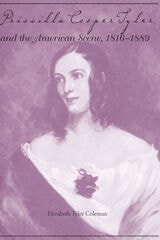
Priscilla Cooper Tyler and the American Scene, 1816-1889
Elizabeth Tyler Coleman
University of Alabama Press, 2006
A study illuminating the cultural intersections of gender, performance, and national identity in nineteenth-century America.
Priscilla Cooper Tyler and the American Scene, 1816–1889 by Elizabeth T. Coleman is a historical and cultural study that brings renewed attention to a remarkable yet often overlooked figure in nineteenth-century American life. The daughter of renowned actor Thomas Cooper, Priscilla Tyler occupied a unique position at the intersection of theatrical culture, literary expression, and political society during a period of profound national transformation.
Tracing Tyler’s life from her early involvement in the stage to her later roles within influential social and political circles, Coleman situates her subject within the broader cultural landscapes of antebellum America, the Civil War, and Reconstruction. Through letters, performances, and social connections, Tyler emerges as an astute observer and participant in the evolving American scene, offering insight into the roles women played in shaping artistic, intellectual, and public life.
The book explores themes of identity, performance, gender, and cultural change, revealing how Tyler’s experiences illuminate the complex interplay between private life and public history. Coleman’s study not only reconstructs the biography of a significant historical figure but also contributes to a deeper understanding of nineteenth-century American theater, literature, and society.
This volume is an important resource for scholars and readers interested in American studies, women’s history, and the cultural history of the nineteenth century.
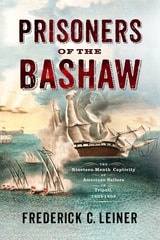
Prisoners of the Bashaw
The Nineteen-Month Captivity of American Sailors in Tripoli, 1803–1805Frederick C. Leiner
Westholme Publishing, 2025
America’s first crisis with the Islamic world: the diplomatic and military mission to free more than three hundred enslaved sailors
On October 31, 1803, the frigate USS Philadelphia ran aground on a reef a few miles outside the harbor of Tripoli. Since April 1801, the United States had been at war with Tripoli, one of the Barbary “pirate” regimes, over the payment of annual tribute—bribes so that American merchant ships would not be seized and their crews held hostage. After hours under fire, the Philadelphia, aground and defenseless, surrendered, and 307 American sailors and marines were captured. Manhandled and stripped of their clothes and personal belongings, the men of the Philadelphia were paraded before the Bashaw of Tripoli, Yusuf Karamanali. The bashaw ordered the crew moved into an old warehouse, and the officers were eventually moved to a dungeon beneath the Bashaw’s castle. While the officers were treated as “gentlemen,” although imprisoned, the sailors worked as enslaved laborers. Regularly beaten and given a meager diet, several died in captivity; escape attempts failed, while a few ended up converting to Islam and joined their captors. President Thomas Jefferson, Congress, U.S. diplomats, and Commodore Edward Preble, commander of the naval squadron off Tripoli, grappled with how to safely free the American captives. The crew of the Philadelphia remained prisoners for nineteen months, until the Tripolitan War ended in June 1805.
The Philadelphia captives became the key to negotiations to end the war; the possibility existed that if threatened too much, the Bashaw would kill the captives. Ultimately, the United States paid $60,000 to get them back—about $200 per man—a sum less than the Bashaw’s initial demands for compensation. In June 1805, the Americans began their journey home. Combining stirring naval warfare, intricate diplomatic negotiations, the saga of surviving imprisonment, and based on extensive primary source research, Prisoners of the Bashaw: The Nineteen-Month Captivity of American Sailors in Tripoli, 1803-1805 by Frederick C. Leiner tells the complete story of America’s first great hostage crisis.
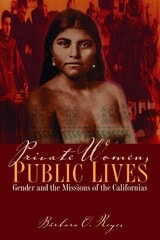
Private Women, Public Lives
Gender and the Missions of the CaliforniasBy Bárbara O. Reyes
University of Texas Press, 2009
Through the lives and works of three women in colonial California, Bárbara O. Reyes examines frontier mission social spaces and their relationship to the creation of gendered colonial relations in the Californias. She explores the function of missions and missionaries in establishing hierarchies of power and in defining gendered spaces and roles, and looks at the ways that women challenged, and attempted to modify, the construction of those hierarchies, roles, and spaces.
Reyes studies the criminal inquiry and depositions of Barbara Gandiaga, an Indian woman charged with conspiracy to murder two priests at her mission; the divorce petition of Eulalia Callis, the first lady of colonial California who petitioned for divorce from her adulterous governor-husband; and the testimonio of Eulalia Pérez, the head housekeeper at Mission San Gabriel who acquired a position of significant authority and responsibility but whose work has not been properly recognized. These three women's voices seem to reach across time and place, calling for additional, more complex analysis and questions: Could women have agency in the colonial Californias? Did the social structures or colonial processes in place in the frontier setting of New Spain confine or limit them in particular gendered ways? And, were gender dynamics in colonial California explicitly rigid as a result of the imperatives of the goals of colonization?
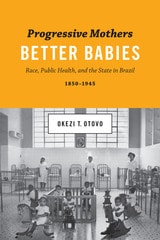
Progressive Mothers, Better Babies
Race, Public Health, and the State in Brazil, 1850-1945By Okezi T. Otovo
University of Texas Press, 2016
In Bahia, Brazil, the decades following emancipation saw the rise of reformers who sought to reshape the citizenry by educating Bahian women in methods for raising “better babies.” The idealized Brazilian would be better equipped to contribute to the labor and organizational needs of a modern nation. Backed by many physicians, politicians, and intellectuals, the resulting welfare programs for mothers and children mirrored complex debates about Brazilian nationality. Examining the local and national contours of this movement, Progressive Mothers, Better Babies investigates families, medical institutions, state-building, and social stratification to trace the resulting policies, which gathered momentum in the aftermath of abolition (1888) and the declaration of the First Republic (1889), culminating during the administration of President Getúlio Vargas (1930–1945).
Exploring the cultural discourses on race, gender, and poverty that permeated medical knowledge and the public health system for almost a century, Okezi T. Otovo draws on extensive archival research to reconstruct the implications for Bahia, where family patronage politics governed poor women’s labor as the mothers who were the focus of medical interventions were often the nannies and nursemaids of society’s wealthier families. The book reveals key transition points as the state of Bahia transformed from being a place where poor families could expect few social services to becoming the home of numerous programs targeting the poorest mothers and their children. Negotiating crucial questions of identity, this history sheds new light on larger debates about Brazil’s past and future.
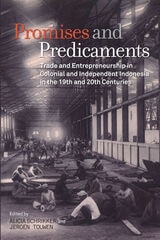
Promises and Predicaments
Trade and Entrepreneurship in Colonial and Independent Indonesia in the 19th and 20th CenturiesEdited by Alicia Schrikker and Jeroen Touwen
National University of Singapore Press, 2015
The authors deal with entrepreneurship and economic specialization within different ethnic groups, the geographical distribution of exports and resource drains from exporting regions, and connections between an export economy and mass poverty. One recurring issue is the way actors from different ethnic groups occupied complementary niches, highlighting the rich variety of roles played by Asian entrepreneurs. A study of the international sugar trade shows how regime change fostered co-operation between different ethnic groups and nationalities involved with trading networks, inter-island shipping, urban public transport, and the construction sector. A comparison of export earnings and population groups involved in trade before and after 1900 shows that unexpected agricultural and industrial transitions could underpin a fundamental shift in income growth, with improved living standards for broad sectors of the population.

Proofs of Genius
Collected Editions from the American Revolution to the Digital AgeAmanda Gailey
University of Michigan Press, 2015

Properties of Modernity
Romantic Spain, Modern Europe, and the Legacies of EmpireMichael Iarocci
Vanderbilt University Press, 2006
Through a close study of Cadalso, Saavedra, and Larra, Iarocci argues that Spanish writers were intensely concerned with the same issues taken up by more famous Romantics and that the ways in which they address these issues provides us with a richer notion, not only of Spain, but of all of Europe.
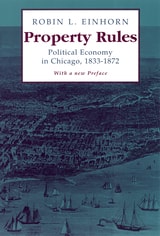
Property Rules
Political Economy in Chicago, 1833-1872Robin L. Einhorn
University of Chicago Press, 1991
A Choice "Outstanding Academic Book"
"[A] masterful study of policy-making in Chicago."—Choice
"[A] major contribution to urban and political history. . . . [A]n excellent book."—Jeffrey S. Adler, American Historical Review
"[A]n enlightening trip. . . . Einhorn's foray helps make sense out of the transition from Jacksonian to Gilded Age politics on the local level. . . . [She] has staked out new ground that others would do well to explore."—Arnold R. Hirsch, American Journal of Legal History
"A well-documented and informative classic on urban politics."—Daniel W. Kwong, Law Books in Review
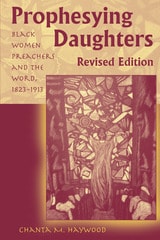
Prophesying Daughters
Black Women Preachers and the Word, 1823-1913Chanta M. Haywood
University of Missouri Press, 2003
In nineteenth-century America, many black women left their homes, their husbands, and their children to spread the Word of God. Descendants of slaves or former “slave girls” themselves, they traveled all over the country, even abroad, preaching to audiences composed of various races, denominations, sexes, and classes, offering their own interpretations of the Bible. When they were denied the pulpit because of their sex, they preached in tents, bush clearings, meeting halls, private homes, and other spaces. They dealt with domestic ideologies that positioned them as subservient in the home, and with racist ideologies that positioned them as naturally inferior to whites. They also faced legalities restricting blacks socially and physically and the socioeconomic reality of often being part of a large body of unskilled laborers.
Jarena Lee, Julia Foote, Maria Stewart, and Frances Gaudet were four women preachers who endured such hardships because of their religious convictions. Often quoting from the scripture, they insisted that they were indeed prophesying daughters whom God called upon to preach. Significantly, many of these women preachers wrote autobiographies in which they present images of assertive, progressive, pious women—steadfast and unmovable in their religious beliefs and bold in voicing their concerns about the moral standing of their race and society at large.
Chanta M. Haywood examines these autobiographies to provide new insight into the nature of prophesying, offering an alternative approach to literature with strong religious imagery. She analyzes how these four women employed rhetorical and political devices in their narratives, using religious discourse to deconstruct race, class, and gender issues of the nineteenth century.
By exploring how religious beliefs become an avenue for creating alternative ideologies, Prophesying Daughters will appeal to students and scholars of African American literature, women’s studies, and religious studies.
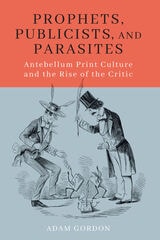
Prophets, Publicists, and Parasites
Antebellum Print Culture and the Rise of the CriticAdam Gordon
University of Massachusetts Press, 2020

Protestant Diplomacy and the Near East
Missionary Influence on American Policy, 1810-1927Joseph L. Grabill
University of Minnesota Press, 1971
Protestant Diplomacy and the Near East was first published in 1971. Minnesota Archive Editions uses digital technology to make long-unavailable books once again accessible, and are published unaltered from the original University of Minnesota Press editions.
For understand of the Middle East today, it is essential to know something of the historical background of that region, traditionally known as the Near East. In tracing the influence of American Protestant missionary activities on American foreign policy and diplomacy in the Near East, Professor Grabill contributes significantly to an understanding of contemporary affairs.
It becomes clear, in this account, that missionaries and philanthropists were the most influential force in the United States' relations with the Near East through the First World War and its aftermath. An important turning point in the history occurred in 1915 when officials of the Ottoman Empire massacred or deported several hundred thousand Turkish Armenians, among whom were the principal constituents of the American missionaries. This prompted the mission groups to shift their emphasis from evangelism and education to the development of the second largest relief organization in the United States history ) eventually called Near East Relief). Through powerful lobbying, the missionaries got their government to consider seriously a protectorate over Armenia or all of Asia Minor. Despite their political failure, the religionists succeeded as cultural frontiersmen through their colleges, such as the American University of Beirut, and their technical assistance programs, which showed the way for the Fulbright, foreign aid, and Peace Corps programs.
The archives of the American Board of Commissioners for Foreign Missions
(Congregational) and the Presbyterian Board of Missions provided rich source material for this book. The illustrations include photographs and maps.
Protestantism and Political Conflict in the Ninteenth-Century Hispanic Caribbean
Martínez-Fernández, Luis
Rutgers University Press, 2001
Catholicism has long been recognized as one of the major forces shaping the Hispanic Caribbean (Cuba, Puerto Rico, and the Dominican Republic) during the nineteenth century, but the role of Protestantism has not been fully explored. Protestantism and Political Conflict in the Nineteenth-Century Hispanic Caribbean traces the emergence of Protestantism in Cuba and Puerto Rico during a crucial period of national consolidation involving both social and political struggle. Using a comparative framework, Martínez-Fernández looks at the ways in which Protestantism, though officially “illegal” for most of the century, established itself, competed with Catholicism, and took differing paths in Cuba and Puerto Rico.
One of the book’s main goals is to trace the links between religion and politics, particularly with regard to early Protestant activities. Protestants encountered a complex social, economic, and political landscape both in Cuba and in Puerto Rico and soon found that their very presence, coupled with their demands for freedom of worship and burial rights, involved them in a series of interrelated struggles in which the Catholic Church was embroiled along with the other main forces of the period—the peasantry, the agrarian bourgeoisie, the mercantile bourgeoisie, and the colonial state. While the established Catholic Church increasingly identified with the conservative, pro-slavery, and colonialist causes, newly arrived Protestants tended to be nationalistic and to pursue particular economic activities—such as cigar exportation in Cuba and the sugar industry in Puerto Rico. The author argues that the early Protestant communities reflected the socio-cultural milieus from which they emerged and were profoundly shaped by the economic activities of their congregants. This influence, in turn, shaped not only the congregations’ composition, but also their political and social orientations.
Proust, Mann, Joyce in the Modernist Context, Second Edition
Gerald Gillespie
Catholic University of America Press, 2010
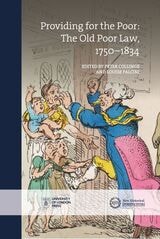
Providing for the Poor
The Old Poor Law, 1750-1834Edited by Peter Collinge and Louise Falcini
University of London Press, 2022
The Old Poor Law, which was established in 1601 in England and Wales and was in force until 1834, was administered by the local parish and dispensed goods and services to paupers, providing a uniquely comprehensive, premodern system of support for the poor. Providing for the Poor brings together academics and practitioners from across disciplines to reexamine the micropolitics of poverty in the long eighteenth century through the eyes of the poor, their providers, and enablers. Covering such topics as the providence of the parochial sixpence, which was given in order to get a beggar to move along to another parish, to coercive marriages, plebeian clothing, and the much broader implications of vagrancy toward the end of the long eighteenth century, this volume aims to bridge the gaps in our understanding of the experiences of people across the social spectrum whose lives were touched by the Old Poor Law. It brings together some of the wider arguments concerning the nature of welfare during economically difficult times and documents the rising bureaucracy inherent in the system to produce a radical new history of the Old Poor Law in astonishing detail.

Provinces of the Mind
The Modern Novel on Provincial TimeVictoria Baena
University of Chicago Press, 2027
How the provinces, rather than cities or capitals, became the key setting dramatized in—but also transformed by—modern novels in English and French.
To be provincial is to mistake one’s narrow milieu for the world: it is to fall prey to an error of scale. But it is also to feel behind, belated, and excluded from the possibilities of the modern world. In this elegant study of the novel “on provincial time,” Victoria Baena argues that the literary geography of “the provinces” played a key role in forging European narratives of modernity.
In the wake of French revolutionaries’ suppression of older provincial identities and as Britain expanded its imperial reach, the provinces were reinvented on various scales: from countryside to small town, from domestic region to faraway colony. Baena brings together Marxist and feminist spatial theory with close attention to the politics of narrative form in order to show how the remarkably mobile concept of the provinces developed across social and cultural frameworks from 1800 to 1933. Offering new interpretations of novels of the realist tradition—by Honoré de Balzac, George Eliot, Emily Brontë, George Sand, Thomas Hardy, Marcel Proust, Alain-Fournier, James Joyce, and Claude McKay—she shows how the question of representing the provinces transformed the modern novel.
Provinces of the Mind illuminates some of the more pernicious fictions of provincialism. But it also describes, often movingly, the desire no longer to be provincial, along with the ambivalence and alienation that can entail. Ultimately, the book shows how literary critics can use the provinces to translate questions of literary geography across borders. By interrogating the provincialisms of our own time and place, Baena suggests, critics might make a better case for those worth retaining and have a better grasp of those to be left behind.
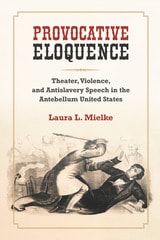
Provocative Eloquence
Theater, Violence, and Antislavery Speech in the Antebellum United StatesLaura L. Mielke
University of Michigan Press, 2019
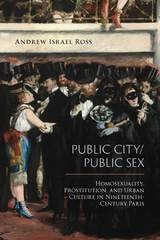
Public City/Public Sex
Homosexuality, Prostitution, and Urban Culture in Nineteenth-Century ParisAndrew Israel Ross
Temple University Press, 2019
In the 1800s, urban development efforts modernized Paris and encouraged the creation of brothels, boulevards, cafés, dancehalls, and even public urinals. However, complaints also arose regarding an apparent increase in public sexual activity, and the appearance of “individuals of both sexes with depraved morals” in these spaces. Andrew Israel Ross’s illuminating study, Public City/Public Sex, chronicles the tension between the embourgeoisement and democratization of urban culture in nineteenth-century Paris and the commercialization and commodification of a public sexual culture, the emergence of new sex districts, as well as the development of gay and lesbian subcultures.
Public City/Public Sex examines how the notion that male sexual desire required suitable outlets shaped urban policing and development. Ross traces the struggle to control sex in public and argues that it was the very effort to police the city that created new opportunities for women who sold sex and men who sought sex with other men. Placing public sex at the center of urban history, Ross shows how those who used public spaces played a central role in defining the way the city was understood.
Public Debate in the Civil War Era
A Rhetorical History of the United States, Volume IVDavid Zarefsky
Michigan State University Press, 2023

Public Properties
Museums in Imperial JapanNoriko Aso
Duke University Press, 2013
Public and Private
Gender, Class, and the British Novel (1764-1878)Patricia McKee
University of Minnesota Press, 1997
Public and Private was first published in 1997. Minnesota Archive Editions uses digital technology to make long-unavailable books once again accessible, and are published unaltered from the original University of Minnesota Press editions.
This groundbreaking work examines the emergent and fluctuating relationship between the public and private social spheres of the late eighteenth and nineteenth centuries. By assessing novels such as Mary Shelley's Frankenstein and Jane Austen's Emma through the lens of the social theories of Jürgen Habermas and Michel Foucault, Patricia McKee presents a fresh and highly original contribution to literary studies.
McKee explores the themes of production and consumption as they relate to gender and class throughout the works of many of the most influential novels of the age including Tobias Smollett's Humphry Clinker, Horace Walpole's The Castle of Otranto, Emma, Frankenstein, Anthony Trollope's Barchester Towers, Charles Dickens's Little Dorrit and The Old Curiosity Shop, Mrs. Henry Wood's East Lynne, and Thomas Hardy's The Return of the Native.
McKee analyzes portrayals of a society in which abstract idealism belonged to knowledgeable, productive men and the realm of ignorance was left to emotional, consuming women and the uneducated. She traces the various ways British literature of the eighteenth and nineteenth centuries worked to reform this social experience. Topics include Dickens's attack on the bureaucratic use of knowledge to maintain the status quo; the function of antiprogressive depictions of knowledge in Trollope, Shelley, and Hardy; and Austen's characterization of the protagonist Emma as an exception in a society that denied women's productive use of knowledge.
Offering a sharp challenge to theorists who have charted a linear division of public and private experience, McKee highlights the unexpected configurations of the emergence of the public and private spheres and the effect of knowledge distribution across class and gender lines.
Patricia McKee is professor of English at Dartmouth College. She is the author of Heroic Commitment in Richardson, Eliot, and James (1986).
Publishing Latinidad
Latinx Literary and Intellectual Production, 1880–1960Jose O. Fernandez
University of Arizona Press, 2025
Publishing Latinidad brings to light the overlooked contributions of early Latinx writers and intellectuals, offering a fresh perspective on their roles in shaping American literary and cultural landscapes.
Jose O. Fernandez meticulously examines the works of notable figures like José Martí, Arturo Schomburg, Jesús Colón, José de la Luz Sáenz, Adela Sloss-Vento, and Américo Paredes, illuminating their innovative approaches to circumventing exclusionary practices in the publishing world. He demonstrates how these writers and intellectuals entered literary, cultural, and intellectual discourses through alternative modes of literary production: crónicas, translations, paratexts, bibliographies, archival practices, sketches, diaries, biographies, unpublished fiction, and scholarly monographs. Through these examples, Fernandez situates Latinx literary production in this time period within the broader context of racial and ethnic solidarity movements in the United States.
Publishing Latinidad is essential reading for anyone interested in the social and cultural underpinnings of Latinx literature and intellectual thought. It challenges traditional narratives and enriches our appreciation of the diverse voices that have long been instrumental in the fight for justice.
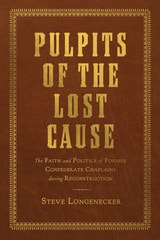
Pulpits of the Lost Cause
The Faith and Politics of Former Confederate Chaplains during ReconstructionSteve Longenecker
University of Alabama Press, 2023
A comparison of the faith and politics of former Confederate chaplains with intriguing insights about the evolution of their postwar beliefs and the Lost Cause
Pulpits of the Lost Cause: The Faith and Politics of Former Confederate Chaplains during Reconstruction is the first in-depth study of former chaplains that juxtaposes their religion and politics, thereby revealing important insights about the Lost Cause movement. Steve Longenecker demonstrates that while some former chaplains vigorously defended the Lost Cause and were predictably conservative in the pulpit, embracing orthodoxy and resisting religious innovation, others were unexpectedly progressive and advocated on behalf of evolution, theological liberalism, and modern biblical criticism.
Former Confederate chaplains embodied both the distinctive white, Southern, regional identity and the variation within it. Most were theologically conservative and Lost Cause racists. But as with the larger South, variation abounded. The Lost Cause, which Longenecker interprets as a broad popular movement with numerous versions, meant different things to different chaplains. It ranged from diehard-ism to tempered sectional forgiveness to full reconciliation to a harmless once-a-year Decoration Day ritual.
This volume probes the careers of ten former chaplains, including their childhoods, wartime experiences, Lost Cause personas, and theologies, making use of manuscripts and published sermons as well as newspapers, diaries, memoirs, denominational periodicals, letters, and the books they themselves produced. In theology, many former chaplains were predictably conservative, while others were unexpectedly broad-minded and advocated evolution, theological liberalism, and modern Biblical criticism. One former chaplain became a social-climbing Harvard progressive. Another wrote innovative, liberal theology read by European scholars. Yet another espoused racial equality, at least in theory if not full practice. Additionally, former chaplains often exhibited the fundamental human trait of compartmentalization, most notably by extolling the past as they celebrated the Lost Cause while simultaneously looking to the future as religious progressives or New South boosters. The stereotypical preacher of the Lost Cause—a gray-clad Bible thumper—existed sufficiently to create the image but hardly enough to be universally accurate.

Punishment in Paradise
Race, Slavery, Human Rights, and a Nineteenth-Century Brazilian Penal ColonyPeter M. Beattie
Duke University Press, 2015
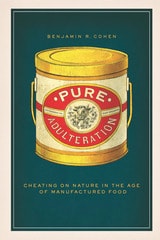
Pure Adulteration
Cheating on Nature in the Age of Manufactured FoodBenjamin R. Cohen
University of Chicago Press, 2019
In the latter nineteenth century, extraordinary changes in food and agriculture gave rise to new tensions in the ways people understood, obtained, trusted, and ate their food. This was the Era of Adulteration, and its concerns have carried forward to today: How could you tell the food you bought was the food you thought you bought? Could something manufactured still be pure? Is it okay to manipulate nature far enough to produce new foods but not so far that you question its safety and health? How do you know where the line is? And who decides?
In Pure Adulteration, Benjamin R. Cohen uses the pure food crusades to provide a captivating window onto the origins of manufactured foods and the perceived problems they wrought. Cohen follows farmers, manufacturers, grocers, hucksters, housewives, politicians, and scientific analysts as they struggled to demarcate and patrol the ever-contingent, always contested border between purity and adulteration, and as, at the end of the nineteenth century, the very notion of a pure food changed.
In the end, there is (and was) no natural, prehuman distinction between pure and adulterated to uncover and enforce; we have to decide. Today’s world is different from that of our nineteenth-century forebears in many ways, but the challenge of policing the difference between acceptable and unacceptable practices remains central to daily decisions about the foods we eat, how we produce them, and what choices we make when buying them.
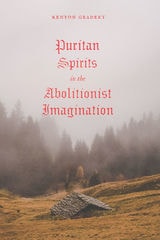
Puritan Spirits in the Abolitionist Imagination
Kenyon Gradert
University of Chicago Press, 2020
Puritan Spirits in the Abolitionist Imagination reveals how the leaders of the nineteenth-century abolitionist movement—from landmark figures like Ralph Waldo Emerson to scores of lesser-known writers and orators—drew upon the Puritan tradition to shape their politics and personae. In a striking instance of selective memory, reimagined aspects of Puritan history proved to be potent catalysts for abolitionist minds. Black writers lauded slave rebels as new Puritan soldiers, female antislavery militias in Kansas were cast as modern Pilgrims, and a direct lineage of radical democracy was traced from these early New Englanders through the American and French Revolutions to the abolitionist movement, deemed a “Second Reformation” by some. Kenyon Gradert recovers a striking influence on abolitionism and recasts our understanding of puritanism, often seen as a strictly conservative ideology, averse to the worldly rebellion demanded by abolitionists.

Pushkin on Literature
Tatiana Wolff
Northwestern University Press, 1998
Pushkin's Button
Serena Vitale
University of Chicago Press, 2000
"Pushkin's Button will keep all constituencies of reader fastened to their seats, as they watch Petersburg's lofty denizens leave no moment of the hurtling Pushkin scandal unrecorded or not speculated on."—Monika Greenleaf,Los Angeles Times
"[A] deliciously entertaining whydunit, a book in which every page seduces with a riddle. . . . Vivacious, seductive, original."—Michael Dirda, Washington Post
"A delightful combination of retrograde pleasures (court balls, the demise of a doomed genius) and primary sources. . . . Illuminating."—Richard Lamb, New York Times Book Review
"A book almost impossible to put down."—George Steiner, New Yorker
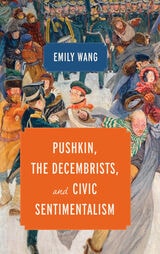
Pushkin, the Decembrists, and Civic Sentimentalism
Emily Wang
University of Wisconsin Press, 2023
Through careful readings of the literature of Pushkin and others active in the northern branch of the Decembrist movement, such as Kondraty Ryleev, Wilhelm Küchelbecker, and Fyodor Glinka, Wang traces the development of “emotional communities” among the members and adjacent writers. This book illuminates what Wang terms “civic sentimentalism”: the belief that cultivating noble sentiments on an individual level was the key to liberal progress for Russian society, a core part of Decembrist ideology that constituted a key difference from their thought and Pushkin’s. The emotional program for Decembrist community members was, in other ways, a civic program for Russia as a whole, one that they strove to enact by any means necessary.
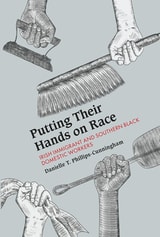
Putting Their Hands on Race
Irish Immigrant and Southern Black Domestic WorkersDanielle T. Phillips-Cunningham
Rutgers University Press, 2020
Putting Their Hands on Race offers an important labor history of 19th and early 20th century Irish immigrant and US southern Black migrant domestic workers. Drawing on a range of archival sources, this intersectional study explores how these women were significant to the racial labor and citizenship politics of their time. Their migrations to northeastern cities challenged racial hierarchies and formations. Southern Black migrant women resisted the gendered racism of domestic service, and Irish immigrant women strove to expand whiteness to position themselves as deserving of labor rights. On the racially fractious terrain of labor, Black women and Irish immigrant women, including Victoria Earle Matthews, the “Irish Rambler”, Leonora Barry, and Anna Julia Cooper, gathered data, wrote letters and speeches, marched, protested, engaged in private acts of resistance in the workplace, and created women’s institutions and organizations to assert domestic workers’ right to living wages and protection.