4743 books match the query 'Religion' and 206 start with p
cover of Political Theology and Early Modernity

Political Theology and Early Modernity

Edited by Graham Hammill and Julia Reinhard Lupton

University of Chicago Press, 2012
Political theology is a distinctly modern problem, one that takes shape in some of the most important theoretical writings of the twentieth and twenty-first centuries. But its origins stem from the early modern period, in medieval iconographies of sacred kinship and the critique of traditional sovereignty mounted by Hobbes and Spinoza. In this book, Graham Hammill and Julia Reinhard Lupton assemble established and emerging scholars in early modern studies to examine the role played by sixteenth- and seventeenth-century literature and thought in modern conceptions of political theology.
 
Political Theology and Early Modernity explores texts by Shakespeare, Machiavelli, Milton, and others that have served as points of departure for such thinkers as Schmitt, Strauss, Benjamin, and Arendt. Written from a spectrum of positions ranging from renewed defenses of secularism to attempts to reconceive the religious character of collective life and literary experience, these essays probe moments of productive conflict, disavowal, and entanglement in politics and religion as they pass between early modern and modern scenes of thought. This stimulating collection is the first to answer not only how Renaissance and baroque literature help explain the persistence of political theology in modernity and postmodernity, but also how the reemergence of political theology as an intellectual and political problem deepens our understanding of the early modern period.
[more]
cover of Politicizing Islam in Austria: The Far-Right Impact in the Twenty-First Century

Politicizing Islam in Austria

The Far-Right Impact in the Twenty-First Century

Farid Hafez

Rutgers University Press, 2024

Among its Continental peers, Austria has stood out for its longstanding state recognition of the Muslim community as early as 1912. A shift has occurred more recently, however, as populist far-right voices within the Austrian government have redirected public discourse and put into question Islam’s previously accepted autonomous status within the country. 

Politicizing Islam in Austria examines this anti-Muslim swerve in Austrian politics through a comprehensive analysis of government policies and regulations, as well as party and public discourses. In their innovative study, Hafez and Heinisch show how the far-right Austrian Freedom Party (FPÖ) adapted anti-Muslim discourse to their political purposes and how that discourse was then appropriated by the conservative center-right Austrian People’s Party (ÖVP). This reconfiguration of the political landscape prepared the way for a right-wing coalition government between conservatives and far-right actors that would subsequently institutionalize anti-Muslim political demands and change the shape of the civic conditions and public perceptions of Islam and the Muslim community in the republic. 
 
[more]
cover of Politics Reformed: The Anglo-American Legacy of Covenant Theology

Politics Reformed

The Anglo-American Legacy of Covenant Theology

Glenn A. Moots

University of Missouri Press, 2022
Many studies have considered the Bible’s relationship to politics, but almost all have ignored the heart of its narrative and theology: the covenant. In this book, Glenn Moots explores the political meaning of covenants past and present by focusing on the theory and application of covenantal politics from the sixteenth through the eighteenth centuries. Moots demands that we revisit political theology because it served as the most important school of politics in early modern Europe and America. He describes the strengths of the covenant tradition while also presenting its limitations and dangers. Contemporary political scientists such as Eric Voegelin, Daniel Elazar, and David Novak are called on to provide insight into both the covenant’s history and its relevance today.
Moots’s work chronicles and critiques the covenant tradition while warning against both political ideology and religious enthusiasm. It provides an inclusive and objective outline of covenantal politics by considering the variations of Reformed theology and their respective consequences for political practice. This includes a careful account of how covenant theology took root on the European continent in the sixteenth century and then inspired ecclesiastical and civil politics in England, Scotland, and America. Moots goes beyond the usual categories of Calvinism or Puritanism to consider the larger movement of which both were a part. By integrating philosophy, theology, and history, Moots also invites investigation of broader political traditions such as natural law and natural right.
Politics Reformed demonstrates how the application of political theology over three centuries has important lessons for our own dilemmas about church and state. It makes a provocative contribution to understanding foundational questions in an era of rising fundamentalism and emboldened secularism, inspiring readers to rethink the importance of religion in political theory and practice, and the role of the covenant tradition in particular.
[more]
cover of Politics and the Order of Love: An Augustinian Ethic of Democratic Citizenship

Politics and the Order of Love

An Augustinian Ethic of Democratic Citizenship

Eric Gregory

University of Chicago Press, 2008

Augustine—for all of his influence on Western culture and politics—was hardly a liberal. Drawing from theology, feminist theory, and political philosophy, Eric Gregory offers here a liberal ethics of citizenship, one less susceptible to anti-liberal critics because it is informed by the Augustinian tradition. The result is a book that expands Augustinian imaginations for liberalism and liberal imaginations for Augustinianism. 
Gregory examines a broad range of Augustine’s texts and their reception in different disciplines and identifies two classical themes which have analogues in secular political theory: love—and related notions of care, solidarity, and sympathy—and sin—as well as related notions of cruelty, evil, and narrow self-interest. From an Augustinian point of view, Gregory argues, love and sin constrain each other in ways that yield a distinctive vision of the limits and possibilities of politics.
In providing a constructive argument for Christian participation in liberal democratic societies, Gregory advances efforts to revive a political theology in which love’s relation to justice is prominent.  Politics and the Order of Love will provoke new conversations for those interested in Christian ethics, moral psychology, and the role of religion in a liberal society.
[more]
cover of Politics in the Pews: The Political Mobilization of Black Churches

Politics in the Pews

The Political Mobilization of Black Churches

Eric L. McDaniel

University of Michigan Press, 2008

"Politics in the Pews probes the internal dynamics of political decision making within the Black church."
---William E. Nelson, Jr., Research Professor, Department of African American and African Studies, Ohio State University

As Eric McDaniel demonstrates in his study of Black congregations in the U.S., a church's activism results from complex negotiations between the pastor and the congregation. The church's traditions, its institutional organization, and its cultural traditions influence the choice to make politics part of the church's mission. The needs of the local community and opportunities to vote, lobby, campaign, or protest are also significant factors.

By probing the dynamics of churches as social groups, McDaniel opens new perspectives on civil rights history and the evangelical politics of the twenty-first century. Politics in the Pews contributes to a clearer understanding of the forces that motivate any organization, religious or otherwise, to engage in politics.

Eric L. McDaniel is Assistant Professor in the Department of Government at the University of Texas at Austin.
[more]
cover of Politics of Religious Freedom

Politics of Religious Freedom

Edited by Winnifred Fallers Sullivan, Elizabeth Shakman Hurd, Saba Mahmood, and Peter G. Danchin

University of Chicago Press, 2015

In a remarkably short period of time, the realization of religious freedom has achieved broad consensus as an indispensable condition for peace. Faced with widespread reports of religious persecution, public and private actors around the world have responded with laws and policies designed to promote freedom of religion. But what precisely is being promoted? What are the cultural and epistemological assumptions underlying this response, and what forms of politics are enabled in the process?
           
The fruits of the three-year Politics of Religious Freedom research project, the contributions to this volume unsettle the assumption—ubiquitous in policy circles—that religious freedom is a singular achievement, an easily understood state of affairs, and that the problem lies in its incomplete accomplishment. Taking a global perspective, the more than two dozen contributors delineate the different conceptions of religious freedom predominant in the world today, as well as their histories and social and political contexts. Together, the contributions make clear that the reasons for persecution are more varied and complex than is widely acknowledged, and that the indiscriminate promotion of a single legal and cultural tool meant to address conflict across a wide variety of cultures can have the perverse effect of exacerbating the problems that plague the communities cited as falling short.
[more]
cover of Politics, Faith, and the Making of American Judaism

Politics, Faith, and the Making of American Judaism

Peter Adams

University of Michigan Press, 2014

In 1862, in the only instance of a Jewish expulsion in America, General Ulysses S. Grant banished Jewish citizens from the region under his military command. Although the order was quickly revoked by President Lincoln, it represented growing anti-Semitism in America. Convinced that assimilation was their best defense, Jews sought to Americanize by shedding distinctive dress, occupations, and religious rituals.

American Jews recognized the benefit and urgency of bridging the divide between Reform and Orthodox Judaism to create a stronger alliance to face the challenges ahead. With Grant’s 1868 presidential campaign, they also realized they could no longer remain aloof from partisan politics. As they became a growing influence in American politics, both political parties courted the new Jewish vote.

Once in office, Grant took notice of the persecution of Jews in Romania and Russia, and he appointed more Jews to office than any president before him. Indeed, Simon Wolf, a Washington lawyer who became one of Grant’s closest advisers, was part of a new generation of Jewish leaders to emerge in the post–Civil War era—thoroughly Americanized, politically mature, and committed to the modernized Judaism of the Reform movement.

In Politics, Faith, and the Making of American Judaism, Peter Adams recounts the history of the American Jewish Community’s assimilation efforts, organization, and political mobilization in the late 19th century, as political and cultural imperatives crafted a new, American brand of Judaism.
[more]
cover of Politics, Religion, and Art: Hegelian Debates

Politics, Religion, and Art

Hegelian Debates

Douglas Moggach

Northwestern University Press, 2011
The period from 1780 to 1850 witnessed an unprecedented explosion of philosophical creativity in the German territories. In the thinking of Kant, Schiller, Fichte, Hegel, and the Hegelian school, new theories of freedom and emancipation, new conceptions of culture, society, and politics, arose in rapid succession. The members of the Hegelian school, forming around Hegel in Berlin and most active in the 1830’s and 1840’s, are often depicted as mere epigones, whose writings are at best of historical interest. In Politics, Religion, and Art: Hegelian Debates, Douglas Moggach moves the discussion past the Cold War–era dogmas that viewed the Hegelians as proto-Marxists and establishes their importance as innovators in the fields of theology, aesthetics, and ethics and as creative contributors to foundational debates about modernity, state, and society.
[more]
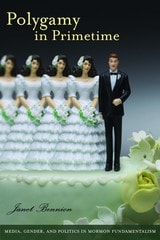
cover of Polygamy in Primetime: Media, Gender, and Politics in Mormon Fundamentalism

Polygamy in Primetime

Media, Gender, and Politics in Mormon Fundamentalism

Janet Bennion

Brandeis University Press, 2011
Recently, polygamy has become a “primetime” phenomenon. Television shows like Big Love and Sister Wives demonstrate the “progressive” side of polygamy, while horror stories from victims of abusive marriages offer less upbeat experiences among the adherents of the fundamentalist Church of Jesus Christ of Latter Day Saints (FLDS Church). Bennion, herself a product of Mormon polygamy, seeks to dispel the myths and misinformation that surround this topic. This study, based on seventeen years of ethnographic research among the Allred Group (Apostolic United Brethren) and on an analysis of recent blog journal entries written by a range of polygamous women, examines the variety and complexity of contemporary Mormon fundamentalist life in the Intermountain West. Although Bennion highlights problems associated with polygamy, including evidence that some forms are at high risk for father-child incest, she challenges the media-driven depiction of plural marriage as uniformly abusive and harmful to women. She shows how polygamist families can provide both economic security and social sustenance for some women, and how the authority of the husband can be undermined by the stresses of providing for multiple wives and children. Going beyond the media’s obsession with the sexual aspects of polygamous marriage, Bennion offers a rich description of familial, social, and legal contexts. Throughout, she makes the case for legalizing polygamy in order to allow greater visibility and regulation of the practice.
[more]
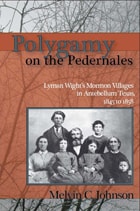
cover of Polygamy on the Pedernales: Lyman Wight's Mormon Village in Antebellum Texas

Polygamy on the Pedernales

Lyman Wight's Mormon Village in Antebellum Texas

Melvin C. Johnson

Utah State University Press, 2006

In the wake of Joseph Smith Jr.’s murder in 1844, his following splintered, and some allied themselves with a maverick Mormon apostle, Lyman Wight. Sometimes called the "Wild Ram of Texas," Wight took his splinter group to frontier Texas, a destination to which Smith, before his murder, had considered moving his followers, who were increasingly unwelcome in the Midwest. He had instructed Wight to take a small band of church members from Wisconsin to establish a Texas colony that would prepare the ground for a mass migration of the membership. Having received these orders directly from Smith, Wight did not believe the former’s death changed their significance. If anything, he felt all the more responsible for fulfilling what he believed was a prophet’s intention.

Antagonism with Brigham Young and the other LDS apostles grew, and Wight refused to join with them or move to their new gathering place in Utah. He and his small congregation pursued their own destiny, becoming an interesting component of the Texas frontier, where they had a significant economic role as early millers and cowboys and a political one as a buffer with the Comanches. Their social and religious practices shared many of the idiosyncracies of the larger Mormon sect, including polygamous marriages, temple rites, and economic cooperatives. Wight was a charismatic but authoritarian and increasingly odd figure, in part because of chemical addictions. His death in 1858 while leading his shrinking number of followers on yet one more migration brought an effective end to his independent church.
[more]
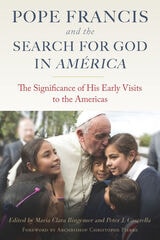
cover of Pope Francis and the Search for God in America: The Significance of His Early Visits to the Americas

Pope Francis and the Search for God in America

The Significance of His Early Visits to the Americas

Maria Clara Bingemer

Catholic University of America Press, 2021
In Tutti Fratelli, Pope Francis has called again for a “culture of encounter,” But how should his theology, pastoral practice, and social message be understood and applied in the Church of the Americas, a single but complex reality that extends from South to North? This volume offers analyses from experts looking back to the Argentine pontiff’s first fateful encuentros in the Americas as a help for understanding the present reality of the Church in the Western Hemisphere. The group includes theologians, historians, and political scientists, and the unique contribution of the volume lies in the panoramic perspective offered by the book as a whole. The initial essays set the stage for the volume as a whole, offering rich insight into Argentine and Latin American history, the world from which the Pope came and to which he returned in 2015, as well as surveying the impact of the Latin American “theology of the people” on the Pope’s visit to the U.S. Additional essays address theological, historical, and pastoral engagements that cut across several of the visits. The final group of essays is dedicated to the visits themselves and is arranged in the order that they occurred. Pope Francis and the Search for God in América is offered to all the members of the Church in América, South and North, old and young, with the hope that it will spur even more thought, reflection, prayer, and service.
[more]
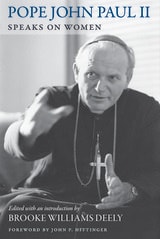
cover of Pope John Paul II Speaks on Women

Pope John Paul II Speaks on Women

Brooke Williams Deely

Catholic University of America Press, 2014

In Pope John Paul II Speaks on Women, Brooke Williams Deely presents a comprehensive record of John Paul II's reflections. This collection brings to the forefront the full context and content of his original contributions. Since John Paul II encouraged women and men to expand what he has adumbrated, this book facilitates ongoing dialogue. The principle of the organization of the volume is chronological, compiling John Paul II's teachings on the subject of women arranged by date over the entire term of his Papacy. Since this influential Pope addressed the situation of women from the beginning of his pontificate, this overview of his writings and his spoken addresses best showcases the development and historical context of his thought.
[more]
cover of Popular Religion in America: Symbolic Change and the Modernization Process in Historical Perspective

Popular Religion in America

Symbolic Change and the Modernization Process in Historical Perspective

Peter W. Williams

University of Illinois Press, 1989

"Williams provides a thought-provoking overview of popular religion in America that will intrigue specialist and student alike. . . . He has both answered many questions and raised important new ones on the nature and development of American popular religion." --Journal for the Scientific Study of Religion

"Pioneering. . . . I for one am glad he combined scholarship and chutzpah for this modestly immodest first word." --Catholic Historical Review
 

[more]
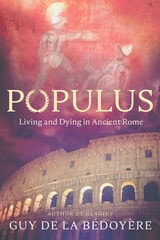
cover of Populus: Living and Dying in Ancient Rome

Populus

Living and Dying in Ancient Rome

Guy de la Bédoyère

University of Chicago Press, 2024

This revealing look at life in ancient Rome offers a compelling journey through the vivid landscape of politics, domestic life, entertainment, and inequality experienced daily by Romans of all social strata.

Frenzied crowds, talking ravens, the stench of the Tiber River: life in ancient Rome was stimulating, dynamic, and often downright dangerous. The Romans relaxed and gossiped in baths, stole precious water from aqueducts, and partied and dined to excess. Everyone from senators to the enslaved crowded into theaters and circuses to watch their favorite singers, pantomime, and comedies and scream their approval at charioteers. The lucky celebrated their accomplishments with elaborate tombs. Amid pervasive inequality and brutality, beauty also flourished through architecture, poetry, and art.
 
From the smells of fragrant cookshops and religious sacrifices to the cries of public executions and murderous electoral mobs, Guy de la Bédoyère’s Populus draws on a host of historical and literary sources to transport us into the intensity of daily life at the height of ancient Rome.
 
[more]
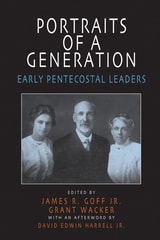
cover of Portraits of a Generation: Early Pentecostal Leaders

Portraits of a Generation

Early Pentecostal Leaders

James Goff

University of Arkansas Press, 2002

A spirit of religious revival blazed across the United States just after 1900. With a focus on Holy Spirit power, early adherents stirred an enthusiastic response, first at a Bible school in Topeka and then in a small mission on Asuza Street in Los Angeles. Almost immediately, the movement spread to Houston, Chicago, and then northeastern urban centers. By the early 1910s the fervor had reached most parts of the United States, Canada, and northern Mexico, and eventually the converts called themselves pentecostals. Today there are pentecostals all over the world. From the beginning the movement was unusually diverse: women and African Americans were active in many of the early fellowships, and although some groups were segregated, some were interracial. Everytwhere, ordinary people passionately devoted themselves to salvation, Holy Ghost baptism evidenced by speaking in tongues, divine healing, and anticipation of the Lord’s imminent return.

This movement saw itself as leaderless, depending on individual conversion and a radical equality of souls — or, as early devotees would say, on the Holy Spirit. But a closer look reveals a host of forceful, clear-eyed leaders. This volume offers twenty biographical portraits of the first-generation pioneers who wove the different strands of Holy Spirit revivalism into a coherent and dramatically successful movement.
[more]
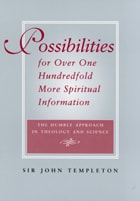
cover of Possibilities for Over One Hundredfold More Spiritual Information: The Humble Approach in Theology and Science

Possibilities for Over One Hundredfold More Spiritual Information

The Humble Approach in Theology and Science

Sir John Templeton

Templeton Press, 2000
Sir John Templeton challenges the reader to apply the same energy that has been devoted to scientific inquiry to the pursuit of spiritual information. The world is at a state of unprecedented technical expertise, but why has our knowledge and faith in our own spirituality stalled and become obsolete in recent times?
Possibilities for Over One Hundredfold More Spiritual Information seeks to address this question. It points out that our spiritual knowledge would also have the capacity to increase dramatically if we were to open our minds to the endless possibilities that await us in terms of our spiritual lives. These include altruistic love for all people, new knowledge of the Divine, and a greater sense of our place in the universe. In order for us as human beings to take advantage of all of the spiritual gifts that we have been given, we need to be open and receptive to our individual spiritual natures, and to open ourselves to the limitless spiritual possibilities available to us.
The book acknowledges the ancient scriptures and thinkers who have guided us for centuries. Vastly expanded research and the use of scientific method would only enhance our understanding of the wisdom contained within these wise teachings. The benefits of extending our spiritual knowledge might, in fact, exceed the benefits we have realized thus far from scientific and medical advances.
Possibilities seeks to reawaken our desire for spiritual knowledge pushed aside so long ago in our quest for scientific knowledge. When these fields work together, the world will reap greater rewards that we can ever imagine.

[more]
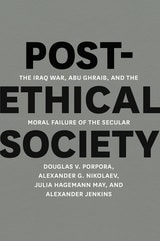
cover of Post-Ethical Society: The Iraq War, Abu Ghraib, and the Moral Failure of the Secular

Post-Ethical Society

The Iraq War, Abu Ghraib, and the Moral Failure of the Secular

Douglas V. Porpora, Alexander G. Nikolaev, Julia Hagemann May, and Alexander Jenkins

University of Chicago Press, 2013

We’ve all seen the images from Abu Ghraib: stress positions, US soldiers kneeling on the heads of prisoners, and dehumanizing pyramids formed from black-hooded bodies. We have watched officials elected to our highest offices defend enhanced interrogation in terms of efficacy and justify drone strikes in terms of retribution and deterrence. But the mainstream secular media rarely addresses the morality of these choices, leaving us to ask individually: Is this right?

In this singular examination of the American discourse over war and torture, Douglas V. Porpora, Alexander Nikolaev, Julia Hagemann May, and Alexander Jenkins investigate the opinion pages of American newspapers, television commentary, and online discussion groups to offer the first empirical study of the national conversation about the 2003 invasion of Iraq and the revelations of prisoner abuse at Abu Ghraib a year later. Post-Ethical Society is not just another shot fired in the ongoing culture war between conservatives and liberals, but a pensive and ethically engaged reflection of America’s feelings about itself and our actions as a nation. And while many writers and commentators have opined about our moral place in the world, the vast amount of empirical data amassed in Post-Ethical Society sets it apart—and makes its findings that much more damning.
[more]
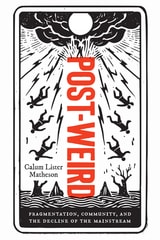
cover of Post-Weird: Fragmentation, Community, and the Decline of the Mainstream

Post-Weird

Fragmentation, Community, and the Decline of the Mainstream

Calum Lister Matheson

Rutgers University Press, 2026

An ambitious look at rhetoric and psychosis that explores how communities form when society collapses

American society seems to have fractured. Common touchpoints of authority have receded in recent decades and beliefs that were once taboo are now openly shared, from neo-Nazism to occultism to conspiracy thinking. In this book, Calum Lister Matheson goes beyond the fraying of contemporary American culture to ask how splinter communities form in our current media environment, what keeps them together, and what they build from the ruins of shared language.

In his stirring exploration of how people communicate when old forms of authority and meaning collapse, Matheson examines far-flung groups that have departed the mainstream—Sandy Hook deniers, Appalachian serpent handlers, pro-anorexia bloggers, incels, transvestigators, pseudoscientific reactionaries, and more—and finds unexpected similarities among their many differences. Key among their parallels is the insistence that the symbols shared by each community represent a hidden truth that cannot be questioned or interpreted but is revealed through signs—words, images, videos, and texts. By documenting American fringe cultures, extremism, and the social functions of language, this book rethinks concepts like irony, psychosis, propriety, and what it means to be normal in weird times. 
[more]
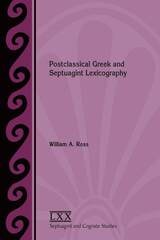
cover of Postclassical Greek and Septuagint Lexicography

Postclassical Greek and Septuagint Lexicography

William A. Ross

SBL Press, 2022
A long-standing tradition within biblical scholarship sets the Greek text of the Septuagint constantly in relationship with its supposed Hebrew or Aramaic Vorlage, examining the two together in terms of their grammatical alignment as a standard. Yet another tradition frames the discussion in different terms, preferring instead to address the Septuagint first of all in light of its contemporary Greek linguistic environment and only then attempting to describe its language and style as a text. It is this latter approach that William A. Ross employs in this textually based study of the Greek versions of Judges, a so-called double text in the textual history of the Septuagint. The results of his study offer a window into the Old Greek translation and its later revision, two distinct stages of Greek Judges with numerous instances of divergent vocabulary choices that reflect deliberateness in both the original selection and the subsequent change within the textual development of the book. Ross’s study illustrates the practicalities and payoff of a Greek-oriented lexicographical method that situates the language of the Septuagint squarely within its contemporary historical and linguistic context.

[more]
cover of Postcolonial Perspectives in African Biblical Interpretations

Postcolonial Perspectives in African Biblical Interpretations

Musa W. Dube

SBL Press, 2012
This volume foregrounds biblical interpretation within the African history of colonial contact, from North Atlantic slavery to the current era of globalization. It reads of the prolonged struggle for justice and of hybrid identities from multifaceted contexts, where the Bible co-exists with African Indigenous Religions, Islam, and other religions. Showcasing the dynamic and creative approaches of an emerging and thriving community of biblical scholarship from the African continent and African diaspora, the volume critically examines the interaction of biblical texts with African people and their cultures within a postcolonial framework. While employing feminist/womanist, postcolonial, Afrocentric, social engagement, creative writing, reconstruction, and HIV/AIDS perspectives, the authors all engage with empire in their own ways: in specific times, forms, and geography. This volume is an important addition to postcolonial and empires studies in biblical scholarship. The contributors are David Tuesday Adamo, Lynn Darden, H. J. M. (Hans) van Deventer, Musa W. Dube, John D. K. Ekem, Ernest M. Ezeogu, Elelwani B. Farisani, Sylvester A. Johnson, Emmanuel Katongole, Malebogo Kgalemang, Temba L. J. Mafico, Madipoane Masenya (ngwan’a Mphahlele), Andrew M. Mbuvi, Sarojini Nadar, Elivered Nasambu-Mulongo, Jeremy Punt, Gerrie Snyman, Lovemore Togarasei, Sam Tshehla, Robert Wafawanaka, Robert Wafula, Gerald West, Alice Y. Yafeh-Deigh, and Gosnell L. Yorke.
[more]
cover of Postcolonialism and the Hebrew Bible:The Next Step

Postcolonialism and the Hebrew Bible

The Next Step

Roland Boer

SBL Press, 2013

This volume returns to where initial interest in postcolonial biblical criticism began: the Hebrew Bible. It does so not to celebrate the significant achievements of postcolonial analysis over the last few decades but to ask what the next step might be. In these essays, established and newer scholars, many from the interstices of global scholarship, discuss specific texts, neo/post/colonial situations, and theoretical issues. Moving from the Caribbean to Greenland, from Ezra-Nehemiah to the Gibeonites, this collection seeks out new territory, new questions, and possibly some new answers. The contributors are Roland Boer, Steed Davidson, Richard Horsley, Uriah Y. Kim, Judith McKinlay, Johnny Miles, Althea Spencer-Miller, Leo Perdue, Christina Petterson, Joerg Rieger, and Gerald West.
[more]
cover of Postsecular Benjamin: Agency and Tradition

Postsecular Benjamin

Agency and Tradition

Brian Britt

Northwestern University Press, 2016
In readings of Walter Benjamin's work, religion often marks a boundary between scholarly camps, but it rarely receives close and sustained scrutiny. Benjamin's most influential writings pertain to modern art and culture, but he frequently used religious language while rejecting both secularism and religious revival. Benjamin was, in today's terms, postsecular. Postsecular Benjamin explicates Benjamin's engagements with religious traditions as resources for contemporary debates on secularism, conflict, and identity. Brian Britt argues that what animates this work on tradition is the question of human agency, which he pursues through lively and sustained experimentation with ways of thinking, reading, and writing.
[more]
cover of Poverty and the Quest for Life: Spiritual and Material Striving in Rural India

Poverty and the Quest for Life

Spiritual and Material Striving in Rural India

Bhrigupati Singh

University of Chicago Press, 2015

The Indian subdistrict of Shahabad, located in the dwindling forests of the southeastern tip of Rajasthan, is an area of extreme poverty. Beset by droughts and food shortages in recent years, it is the home of the Sahariyas, former bonded laborers, officially classified as Rajasthan’s only “primitive tribe.” From afar, we might consider this the bleakest of the bleak, but in Poverty and the Quest for Life, Bhrigupati Singh asks us to reconsider just what quality of life means. He shows how the Sahariyas conceive of aspiration, advancement, and vitality in both material and spiritual terms, and how such bridging can engender new possibilities of life.

Singh organizes his study around two themes: power and ethics, through which he explores a complex terrain of material and spiritual forces. Authority remains contested, whether in divine or human forms; the state is both despised and desired; high and low castes negotiate new ways of living together, in conflict but also cooperation; new gods move across rival social groups; animals and plants leave their tracks on human subjectivity and religiosity; and the potential for vitality persists even as natural resources steadily disappear. Studying this milieu, Singh offers new ways of thinking beyond the religion-secularism and nature-culture dichotomies, juxtaposing questions about quality of life with political theologies of sovereignty, neighborliness, and ethics, in the process painting a rich portrait of perseverance and fragility in contemporary rural India. 
[more]
cover of Poverty, Law, and Divine Justice in Persian and Hellenistic Judah

Poverty, Law, and Divine Justice in Persian and Hellenistic Judah

Johannes Unsok Ro

SBL Press, 2018

A view of Persian and Hellenistic Judean communities through theological and socioeconomic lenses

Johannes Unsok Ro employs philological, historical, and sociological approaches to investigate the close connections between socioeconomic structures, social inequality, and theological developments in the Judean communities in Persian- and Hellenistic-era Palestine. Ro contends that competing points of view from communities of lay returnees, priestly returnees, and communities of resident Judeans and Samaritans were juxtaposed within the Hebrew Bible, which took shape during the postexilic period. By exploring issues such as the relationship between the shaping of the canon and literacy in the Judean community, the term strangers in the biblical law codes, the socioeconomic structures of Judean communities reflected in the biblical law codes, the development of the theological concept of divine punitive justice, the piety of the poor in certain psalms, and the concept of poverty in the Dead Sea Scrolls, Ro illustrates that the communities behind each text and its redactions can be ascertained through sociological and theological lenses.

Features

  • Demonstration that a theology of the poor materialized orally among the poor but found written expression among Levites
  • Insight into the socioeconomic and theological concerns of the authorial groups behind various biblical law codes
  • A case that biblical “poverty” sometimes refers to humility and a theologically reflected consciousness of lowliness toward God
[more]
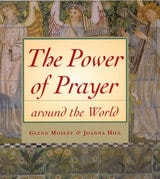
cover of Power Of Prayer Around The World

Power Of Prayer Around The World

Glenn Mosley

Templeton Press, 2005


Universally, the power of prayer has been recognized by many cultures for immeasurable time. Whether it be a part of a formal service recited with a congregation of worshipers or an individual, quiet moment, prayer is part of the lives of people from a variety of religions.

There seems to be an innate urge among humanity to connect with a higher source of energy and love when we need guidance or direction, and this is called prayer. By reading the prayers from religions such as Buddhism, Hinduism, Christianity, and Islam, from cultures in Africa, India, Egypt, and China, we begin to share the sense of a common experience.

The deepest inner feelings and longings are similar—concern for family, assistance in healing, a longing for peace, or a wish for greater wisdom. For some people, prayer can be thought of as a way to ask for specific goals or special favors. This type of prayer may or may not be effective. Another type of prayer exists when all selfish desire is put aside and we feel ourselves in communion with God. At this point, our greatest wish is that God's will be done.

There may be pressing concerns that make us turn our sights upward, but we learn to let go of the end result. At this point, prayer becomes a way of opening up to the universal, loving, creative energy that exists and is far greater than any person could imagine. This is the source of miracles, of faith and unconditional love. Prayer then becomes more than a means to an end; it becomes a state of humility and of awe. It can exist whether we are washing the floor or composing a symphony. Prayer is communion with the Divine, a universal loving creative force that exists in a variety of ways for people around the world.

This book brings together an inspirational collection of prayer suitable for all ages and traditions. In addition, it offers insight and guidance about the nature of prayer that will be useful for the serious seeker.


[more]
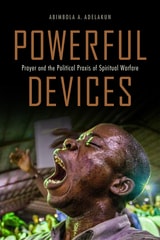
cover of Powerful Devices: Prayer and the Political Praxis of Spiritual Warfare

Powerful Devices

Prayer and the Political Praxis of Spiritual Warfare

Abimbola Adunni Adelakun

Rutgers University Press, 2023
Powerful Devices studies spiritual warfare performances as an apparatus for disestablishing structures of power and knowledge, and establishing righteousness in their stead. Drawing on performance studies’ emphasis on radicality and breaking of social norms as devices of social transformation, the book demonstrates how Christian groups with dominant cultural power but who perceive themselves as embattled wield the ideas of performance activism. Combining religious studies with ethnography, Powerful Devices explores Nigerian Pentecostals and US Evangelicals’ praxis of transnational spiritual warfare. By closely studying spiritual warfare prayers as a “device,” Powerful Devices shows how the rituals of prayer enable an apprehension of time, paradigms of self-enhancement, and the subversion of politics and authority. A critical intervention, Powerful Devices explores charismatic Christianity’s relationship to science and secular authority, technology and temporality, neoliberalism, and reactionary ideology.
[more]
cover of Powers of Distinction: On Religion and Modernity

Powers of Distinction

On Religion and Modernity

Nancy Levene

University of Chicago Press, 2017

In this major new work, philosopher of religion Nancy Levene examines the elemental character of religion and modernity. Deep in their operating systems, she argues, are dualisms of opposition and identity that cannot be reconciled with the forms of life they ostensibly support. These dualisms are dead ends, but they conceal a richer position—another kind of dualism constitutive of mutual relation. This dualism is difficult to distinguish and its concept of relation difficult to commit to. It risks contention and even violence. But it is also the indispensable support for modernity’s most innovative ideals: democracy, criticism, and interpretation.
 
In readings from Abraham to the present, Levene recovers this richer dualism in its difference from the alternatives—other dualisms, nondualism, multiplication. From Abraham we get the biblical call to give up tribal belonging for a promised land of covenantal relation. Yet modernity, inclusive of this call, is also the principle that critiques the promise when it divides self from other, us from them.

Drawing on a long tradition of thinkers and scholars even as she breaks new ground, Levene offers here nothing less than a new way of understanding modernity as an ethical claim about our world, a philosophy of the powers of distinction to include rather than to divide.
 
[more]
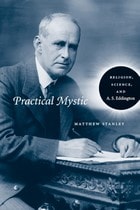
cover of Practical Mystic: Religion, Science, and A. S. Eddington

Practical Mystic

Religion, Science, and A. S. Eddington

Matthew Stanley

University of Chicago Press, 2007

Science and religion have long been thought incompatible. But nowhere has this apparent contradiction been more fully resolved than in the figure of A. S. Eddington (1882–1944), a pioneer in astrophysics, relativity, and the popularization of science, and a devout Quaker. Practical Mystic uses the figure of Eddington to shows how religious and scientific values can interact and overlap without compromising the integrity of either.

Eddington was a world-class scientist who not only maintained his religious belief throughout his scientific career but also defended the interrelation of science and religion while drawing inspiration from both for his practices. For instance, at a time when a strict adherence to deductive principles of physics had proved fruitless for understanding the nature of stars, insights from Quaker mysticism led Eddington to argue that an outlook less concerned with certainty and more concerned with further exploration was necessary to overcome the obstacles of incomplete and uncertain knowledge.

By examining this intersection between liberal religion and astrophysics, Practical Mystic questions many common assumptions about the relationship between science and spirituality. Matthew Stanley’s analysis of Eddington’s personal convictions also reveals much about the practice, production, and dissemination of scientific knowledge at the beginning of the twentieth century.
[more]
cover of Praise of Folly

Praise of Folly

Desiderius Erasmus; Translated by John Wilson

University of Michigan Press, 1958
The Praise of Folly by Desiderius Erasmus is an enduring classic that satirically critiques the societal and religious norms of its time. Translated by John Wilson in 1668, this seminal work uses wit and humor to examine the folly prevalent in various human behaviors and institutions, making it a timeless piece that continues to resonate. With a foreword by Kenneth E. Boulding, this edition delves into the essence of folly through a monologue by the allegorical character, Folly herself. She extols the virtues of foolishness in a world riddled with pretentious wisdom and self-importance. Erasmus, with his sharp intellect and playful prose, not only entertains but also provokes deep reflection on the paradoxes of human nature and the pursuit of wisdom, making The Praise of Folly a profound yet accessible read for anyone interested in literature, philosophy, and social commentary.
[more]
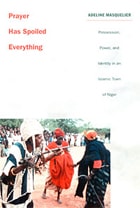
cover of Prayer Has Spoiled Everything: Possession, Power, and Identity in an Islamic Town of Niger

Prayer Has Spoiled Everything

Possession, Power, and Identity in an Islamic Town of Niger

Adeline Masquelier

Duke University Press, 2001

Bori, in the Mawri society of Niger, are mischievous and invisible beings that populate the bush. Bori is also the practice of taming these wild forces in the context of possession ceremonies. In Prayer Has Spoiled Everything Adeline Masquelier offers an account of how this phenomenon intervenes—sometimes subtly, sometimes dramatically—in human lives, providing a constantly renewed source of meaning for Mawri peasants confronted with cultural contradictions and socio-economic marginalization.
To explore the role of bori possession in local definitions of history, power, and identity, Masquelier spent a total of two years in Niger, focusing on the diverse ways in which spirit mediums share, transform, and contest a rapidly changing reality, threatened by Muslim hegemony and financial hardship. She explains how the spread of Islam has provoked irreversible change in the area and how prayer—a conspicuous element of daily life that has become virtually synonymous with Islamic practice in this region of west Africa—has thus become equated with the loss of tradition. By focusing on some of the creative and complex ways that bori at once competes with and borrows from Islam, Masquelier reveals how possession nonetheless remains deeply embedded in Mawri culture, representing more than simple resistance to Islam, patriarchy, or the state. Despite a widening gap between former ways of life and the contradictions of the present, it maintains its place as a feature of daily life in which villagers participate with varying degrees of enthusiasm and approval.
Specialists in African studies, in the anthropology of religion, and in the historical transformations of colonial and postcolonial societies will welcome this study.
[more]
cover of Prayers and Rituals at a Time of Illness and Dying: The Practices of Five World Religions

Prayers and Rituals at a Time of Illness and Dying

The Practices of Five World Religions

Patricia Fosarelli

Templeton Press, 2008

In the course of caring for the ill or dying, health care professionals are sometimes the only ones available to provide spiritual comfort to their patients. In our modern pluralistic society, where patients could come from any number of religious traditions, it can often be difficult to find exactly the right words in these situations.

Prayers and Rituals at a Time of Illness and Dying: The Practices of Five World Religions by experienced physician and theologian Pat Fosarelli offers clear instructions for health care professionals on how to better understand the needs of their Buddhist, Hindu, Muslim, Christian, and Jewish patients during these difficult times. Devoting separate chapters to each tradition, Fosarelli briefly outlines the basic beliefs and then looks at the main tenets of each religion, exploring the varied approaches that they take to illness and end-of-life issues. For each tradition, she also describes practices and offers suitable prayers. Each chapter suggests modifications that may be necessary for Western hospitals, modifications for children, and specific suggestions about what not to do or say in respect to different faith traditions.

This easy-to-use, pocket-sized resource will be referenced again and again by physicians, paramedics, hospital and military chaplains, pastoral counselors, hospice providers, and other medical professionals.
[more]
cover of Prayers and the Construction of Israelite Identity

Prayers and the Construction of Israelite Identity

Susanne Gillmayr-Bucher

SBL Press, 2019

Substantial insights into various identity discourses reflected in the biblical prayers

This collection of essays from an international group of scholars focuses on how biblical prayers of the Persian and early Hellenistic periods shaped identity, evoked a sense of belonging to specific groups, and added emotional significance to this affiliation. Contributors draw examples from different biblical texts, including Genesis, Samuel, Kings, Chronicles, Ezra and Nehemiah, Psalms, Jonah, and Daniel.

Features

  • Thorough study of prayers that play a key role for a biblical book’s (re)construction of the people’s history and identity
  • An examination of ways biblical figures are remodeled by their prayers by introducing other, sometimes even contradictory, discourses on identity
  • An exploration of different ways in which psalms from postexilic times shaped, reflected, and modified identity discourses
[more]
cover of Prayers for Dark People

Prayers for Dark People

W.E.B. Du Bois

University of Massachusetts Press, 1980

A collection of prayers written by Du Bois for students at Atlanta University, thoughtfully compiled and introduced by Herbert Aptheker. These prayers are deeply committed to paying attention to and caring for the inner lives of Black Americans. Biblical familiarity and agnosticity are both present in these autobiographical writings, uplifting the hopes and practices of W. E. B. Du Bois's life, while meditating on the still relevant question of how to make “a good life for all.”
[more]
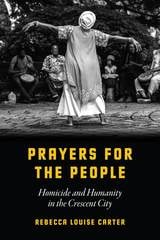
cover of Prayers for the People: Homicide and Humanity in the Crescent City

Prayers for the People

Homicide and Humanity in the Crescent City

Rebecca Louise Carter

University of Chicago Press, 2019

“Grieve well and you grow stronger.” Anthropologist Rebecca Louise Carter heard this wisdom over and over while living in post-Katrina New Orleans, where everyday violence disproportionately affects Black communities. What does it mean to grieve well? How does mourning strengthen survivors in the face of ongoing threats to Black life?
 
Inspired by ministers and guided by grieving mothers who hold birthday parties for their deceased sons, Prayers for the People traces the emergence of a powerful new African American religious ideal at the intersection of urban life, death, and social and spiritual change. Carter frames this sensitive ethnography within the complex history of structural violence in America—from the legacies of slavery to free but unequal citizenship, from mass incarceration and overpolicing to social abandonment and the unequal distribution of goods and services. And yet Carter offers a vision of restorative kinship by which communities of faith work against the denial of Black personhood as well as the violent severing of social and familial bonds. A timely directive for human relations during a contentious time in America’s history, Prayers for the People is also a hopeful vision of what an inclusive, nonviolent, and just urban society could be.
 
[more]
cover of Praying Legally

Praying Legally

Shalom E. Holtz

SBL Press, 2019

Explore the lengthy history of legal metaphors in ancient prayer

In biblical and other ancient Near Eastern sources, prayer is an opportunity to make one’s case before divine judges. Prayers were formulated using courtroom or trial language, including demands for judgment, confessions, and accusations. The presence of these legal concepts reveals ancient Near Eastern thoughts about what takes place when one prays. Holtz highlights legal concepts that appear in prayers, including the motif of the speakers' oppression in Psalms the possibility of countersuit against God through prayer, and divine attention and inattention as legal responses. By reading ancient prayers together with legal texts, this book shows how speakers took advantage of prayer as an opportunity to have their day in the divine court and even sue against divine injustice.

Features

  • Identification of legal vocabulary and concepts that appear in ancient prayers
  • Analysis of legal metaphors in prayer examples in Akkadian and postbiblical rabbinic texts
  • Interpretations of trial records and texts from Psalms and Lamentations
[more]
cover of Praying in the Pine Straw: The Camp-Meeting Experience in Alabama

Praying in the Pine Straw

The Camp-Meeting Experience in Alabama

Robert C. Morgan

University of Alabama Press, 2025

Step into the South’s brush arbors and piney woods where faith runs deep, stories run wild, and the old-time camp meeting was anything but quiet.

Praying in Pine Straw immerses readers in the raw, rollicking, and deeply human world of Alabama’s camp meetings—a Southern tradition where fire-and-brimstone preaching echoed through pine forests and where faith was often accompanied by contradiction. From “treeing the Devil” to “holy laughter,” these revivals blended heartfelt worship with all the complications of human nature. Mule-drawn wagons brought the faithful to rustic camps, where gospel fervor mingled with whiskey traders, local politicians, and opportunists of every kind. Preachers thundered against sin—even as they sometimes flirted with it themselves.

Robert C. Morgan offers a textured portrait of camp meetings as both spiritual experience and cultural spectacle, reviving a Southern tradition that flourished from the late nineteenth to mid-twentieth centuries. With a blend of humor and keen insight, Praying in the Pine Straw unveils the enduring contradictions of “old-time religion” and its significant influence on Southern culture and faith—a legacy that is both treasured and complex.
[more]
cover of Preaching Prevention: Born-Again Christianity and the Moral Politics of AIDS in Uganda

Preaching Prevention

Born-Again Christianity and the Moral Politics of AIDS in Uganda

Lydia Boyd

Ohio University Press, 2015

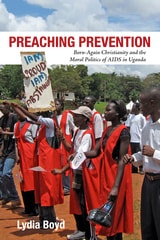
Preaching Prevention examines the controversial U.S. President’s Emergency Plan for AIDS Relief (PEPFAR) initiative to “abstain and be faithful” as a primary prevention strategy in Africa. This ethnography of the born-again Christians who led the new anti-AIDS push in Uganda provides insight into both what it means for foreign governments to “export” approaches to care and treatment and the ways communities respond to and repurpose such projects. By examining born-again Christians’ support of Uganda’s controversial 2009 Anti-Homosexuality Bill, the book’s final chapter explores the enduring tensions surrounding the message of personal accountability heralded by U.S. policy makers.

Preaching Prevention is the first to examine the cultural reception of PEPFAR in Africa. Lydia Boyd asks, What are the consequences when individual responsibility and autonomy are valorized in public health initiatives and those values are at odds with the existing cultural context? Her book investigates the cultures of the U.S. and Ugandan evangelical communities and how the flow of U.S.-directed monies influenced Ugandan discourses about sexuality and personal agency. It is a pioneering examination of a global health policy whose legacies are still unfolding.

[more]
cover of Preaching and the Rise of the American Novel

Preaching and the Rise of the American Novel

Dawn Coleman

The Ohio State University Press, 2013
Preaching and the Rise of the American Novel by Dawn Coleman recovers a crucial moment in the history of the intimate yet often contentious relationship between religion and literature. Coleman’s book highlights the intersection of two cultural trajectories in America around 1850, both often downplayed in literary histories: a boom in preaching, associated with the growth of evangelicalism and the country’s oratorical traditions, and the long struggle of the novel, still facing considerable disdain at mid-century, to achieve moral legitimacy and aesthetic autonomy.
 
Before the Civil War, the preacher in the pulpit was the culture’s paradigmatic voice of moral authority, and novelists who wished to establish the moral value of their own storytelling needed to incorporate sermons. This book explores how antebellum ministers sought to preach effective, authoritative sermons and how novelists sought to claim a similar authority through canny representations of preachers, often veiled critiques of actual ministers, and sermonic voice, or a creative reworking of the sound of preaching. Such intense engagement with sermons shaped some of the period’s most interesting and important novels, including The Scarlet Letter, The Quaker City, Moby-Dick, Uncle Tom’s Cabin, and Clotel.
 
In illuminating how novelists sought to displace traditional religious institutions, Preaching and the Rise of the American Novel reminds readers of the deep connections between Americans’ religious practices and their literature and speaks to how the processes of secularization are often less concerned with rejecting the elements of religion than reimagining them.
[more]
cover of Preaching in Arduous Times: Outline of Perspectives from the Hebrews Sermon

Preaching in Arduous Times

Outline of Perspectives from the Hebrews Sermon

Maarten Kater

Central European University Press, 2026
The overarching research question which is answered in this study by means of several different angles is: ‘What kind of perspectives could an investigation of the Hebrews sermon o er to the homiletical praxis of people living in arduous times?’. This study want to indicate and illustrate that the Hebrews sermon o ers piercing perspectives for the discipline of homiletics and, moreover, the wider field of practical theology, especially dealing with the formative aspects of worship, preaching, and attitudes. Hebrews is on the God who speaks to us ‘today’ from the very start. But what in the world does it mean when we use this language in our four-dimensional space-time as it is mediated and embodied speech? It turns out that in this canonical sermon many directions for a homiletical theory are to be considered and to process. The three dimensions of time, the value of religious spaces, the art of persuasion, preaching Christ as sacramentum and exemplum which is listener-orientated communication at the same time, the bifurcation of explanation and application, the theology of language. Moreover, Hebrews is connected with the formation and developing of attitudes in the various spheres as cognitive, affective, behavioural, interpersonal, social and political. Each time has its arduous aspects. This study aims to stimulate preaching in these times, sometimes within weary and worn -out congregations, and to encourage the fainthearted preachers and listeners by means of a sermon as a song of love. If you would like to order the book for delivery outside of the Netherlands, please email orders@aup.nl
[more]
cover of Preaching in the Age of Chaucer: Selected Sermons in Translation (Medieval Texts in Translation Series)

Preaching in the Age of Chaucer

Selected Sermons in Translation (Medieval Texts in Translation Series)

Siegfried Wenzel

Catholic University of America Press, 2008
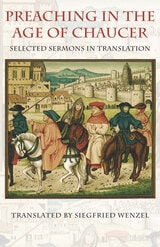
Introducing modern readers to the riches of preaching in later medieval England, distinguished scholar Siegfried Wenzel offers translations of twenty-five Latin sermons written between 1350 and 1450. T
[more]
cover of Preaching to Convert: Evangelical Outreach and Performance Activism in a Secular Age

Preaching to Convert

Evangelical Outreach and Performance Activism in a Secular Age

John Fletcher

University of Michigan Press, 2015

Preaching to Convert offers an intriguing new perspective on the outreach strategies of U.S. evangelicals, framing them as examples of activist performance, broadly defined as acts performed before an audience in the hopes of changing hearts and minds. Most writing about activist performance has focused on left-progressive causes, events, and actors. Preaching to Convert argues against such a constricted view of activism and for a more nuanced understanding of U.S. evangelicalism as a movement defined by its desire to win converts and spread the gospel.
 
The book positions evangelicals as a diverse, complicated group confronting the loss of conservative Christianity’s default status in 21st-century U.S. culture. In the face of an increasingly secular age, evangelicals have been reassessing models of outreach. In acts like handing out Bible tracts to strangers on the street or going door-to-door with a Bible in hand, in elaborately staged horror-themed morality plays or multimillion-dollar creationist discovery centers, in megachurch services beamed to dozens of satellite campuses, and in controversial “ex-gay” ministries striving to return gays and lesbians to the straight and narrow, evangelicals are redefining what it means to be deeply committed in a pluralist world. The book’s engaging style and careful argumentation make it accessible and appealing to scholars and students across a range of fields.
[more]
cover of Preaching to Latinos: Welcoming the Hispanic Moment in the U.S. Church

Preaching to Latinos

Welcoming the Hispanic Moment in the U.S. Church

Michael Kueber

Catholic University of America Press, 2022
There is a wide and growing gap in the Catholic Church in the United States between the clergy, who are mostly of European descent, and the large percentages of Catholics who identify as Latinos. While the US Church has made a concerted effort to build Hispanic ministries, many clergy and lay ministers are still ill-equipped to understand the cultural background of their parishioners, especially the large numbers who are foreign born. Because of this disconnect, the Church risks missing "the Hispanic Moment" in the US Church, in which the faith and traditions of these newest waves of US immigration could not just exist in parallel to English-language congregations, but enrich and enliven the faith of the whole community while passing on the faith to subsequent generations. Learning Spanish--while helpful--is not enough. There are intercultural competencies that can only be developed through practice, but it also helps already-busy clergy to have a concise guide. In addition to knowing the scholarly literature on cross-cultural preaching and Hispanic culture, Father Michael Kueber has twenty years of experience serving first generation Hispanic immigrants and their second generation children. In Preaching to Latinos, Kueber provides the readers with best practices for preaching to and leading their churches. As a member of an ecumenical community, he is able to speak to members of all Christian denominations.
[more]
cover of Predestination and Preaching in Genevan Theology from Calvin to Pictet

Predestination and Preaching in Genevan Theology from Calvin to Pictet

Pieter Rouwendal

Central European University Press, 2026
Given the conclusions of recent research, that predestination was no central dogma to, and did not affect the method of reformed theology, this study investigates the question if and how the doctrine of predestination affected the ideas and the practise of preaching. The relation of predestination and covenant, congregation, atonement, faith etc. are researched in the theology and sermons of John Calvin, Theodore Beza, John Diodati and Theodore Tronchin, Francis Turretin, and Benedict Pictet. This study shows that in Genevan Reformed theology from Calvin to Pictet, predestination and the external call were inseparably connected, but that the doctrine of predestination neither dominated the content nor restricted the address of the external call. “…a detailed and finely argued study…” Donald K. McKim – Journal of Reformed Theology 12-2 (2018) If you would like to order the book for delivery outside of the Netherlands, please email orders@aup.nl
[more]
cover of Predicting the Past in the Ancient Near East: Mantic Historiography in Ancient Mesopotamia, Judah, and the Mediterranean World

Predicting the Past in the Ancient Near East

Mantic Historiography in Ancient Mesopotamia, Judah, and the Mediterranean World

Matthew Neujahr

SBL Press, 2012

This work provides an in-depth investigation of after-the-fact predictions in ancient Near Eastern texts from roughly 1200 B.C.E.–70 C.E. It argues that the Akkadian, Aramaic, Hebrew, and Greek works discussed are all part of a developing scribal discourse of “mantic historiography” by which scribes blend their local traditions of history writing and predictive texts to produce a new mode of historiographic expression. This in turn calls into question the use and usefulness of traditional literary categories such as “apocalypse” to analyze such works.
[more]
cover of Predicting the Past: The Utah War's Twenty-First Century Future

Predicting the Past

The Utah War's Twenty-First Century Future

William Mackinnon

Utah State University Press, 2009
14th volume in the Leonard J. Arrington Lecture Series
[more]
cover of Prefaces to Canon Law Books in Latin Christianity: Selected Translations, 500-1317, second edition

Prefaces to Canon Law Books in Latin Christianity

Selected Translations, 500-1317, second edition

Robert Somerville

Catholic University of America Press, 2021
An updated and expanded version of the original edition, published in 1998. That original edition went up through 1245. This new version extends to 1317 and adds two important prefaces. Praise for the First Edition “Both students and specialists can be grateful to the authors for this major contribution in English to the study of medieval canon law. It is a clear statement--one emphasized by the late John Gilchrist-that because of its critical importance in medieval life and culture canon law should not remain the obscure domain of specialists, but should be shared with students and non-specialists alike.” – The American Journal of Legal History “[A] learned and useful book, which for the first time assembles a body of canonistic prefaces, presents them in an accessible form, and provides students of medieval canonical thought with a valuable new resource for study and teaching.” – The Catholic Historical Review “This volume is an important and welcome addition to a field of studies where translations into English are few and far between. The breadth of the works selected, the quality of the translations, and the attention to detail that has long characterized the work of both editors make this a valuable resource for specialist and student alike.” – Church History “A welcome combination: a text that is informative for students and professionals alike. The translations succeed in rendering accessible to a general audience some otherwise highly inaccessible material. Somerville and Brasington are to be greatly commended for undertaking this very original enterprise and bringing it to successful parturition.” – Journal of Law and Religion “Somerville and Brasington have chosen to let their compilers and commentators speak for themselves. In doing so, they have had to wrestle with often obscure Latin and frequently less than satisfactory editions. That they succeed in making these texts intelligible through translation and annotation is no small feat.” – Sixteenth Century Journal “This is a significant, elegantly presented contribution to the field of theology, cultural history, and canon law.” – Theological Studies
[more]
cover of Preserving the Sacred: Historical Perspectives on the Ojibwa Midewiwin

Preserving the Sacred

Historical Perspectives on the Ojibwa Midewiwin

Michael Angel

University of Manitoba Press, 2002
The Midewiwin is the traditional religious belief system central to the world view of Ojibwa in Canada and the US. It is a highly complex and rich series of sacred teachings and narratives whose preservation enabled the Ojibwa to withstand severe challenges to their entire social fabric throughout the 19th and 20th centuries. It remains an important living and spiritual tradition for many Aboriginal people today.
____ The rituals of the Midewiwin were observed by many 19th century Euro-Americans, most of whom approached these ceremonies with hostility and suspicion. As a result, although there were many accounts of the Midewiwin published in the 19th century, they were often riddled with misinterpretations and inaccuracies.
____ Historian Michael Angel compares the early texts written about the Midewiwin, and identifies major, common misconceptions in these accounts. In his explanation of the historical role played by the Midewiwin, he provides alternative viewpoints and explanations of the significance of the ceremonies, while respecting the sacred and symbolic nature of the Midewiwin rituals, songs, and scrolls.
[more]
cover of Pressed by a Double Loyalty: Hungarian Attendance at the Second Vatican Council, 1959-1965

Pressed by a Double Loyalty

Hungarian Attendance at the Second Vatican Council, 1959-1965

András Fejérdy

Central European University Press, 2017
The Second Vatican Council is the single most influential event in the 20th century history of the Catholic Church. The book analyzes the relationship between the Council and the "Ostpolitik" of the Vatican through the history of the Hungarian presence at Vatican II. Pope John XXIII, elected in 1958, was a catalyst. The pope thought that his most urgent task was to renew contacts with the Church behind the iron curtain. Hungarian participation at the Council was also made possible by the new, pragmatic model in Hungarian church politics. After the crushing of the 1956 Revolution, churches in Hungary thought that the regime would last and were willing to compromise. Vatican II – in the perspective of Hungary – was not primarily an ecclesial event, but it remained closely joined to the negotiations between the Holy See and the Kádár regime: during the Council Hungary became the experimental laboratory of the Vatican's new eastern policy. Was it a Vatican decision or a Soviet instruction? Fejérdy suggests that it was a decision of the Holy See.
[more]
cover of Priestly Celibacy

Priestly Celibacy

Gary B. Selin

Catholic University of America Press, 2016

Pope Francis has called mandatory priestly celibacy a "gift for the Church," but added "since it is not a dogma, the door is always open" to change. As this Church discipline continues to be debated, it is important for Catholics to delve into the theological and not merely pragmatic reasons behind its continuation. Priestly Celibacy: Theological Foundations, therefore, fills a critical gap in the current theological literature on this important topic of ecclesial ministry and life, and also helps to contribute to the advancement of the rather underdeveloped theology of priestly celibacy.
[more]
cover of Priests and Cults in the Book of the Twelve

Priests and Cults in the Book of the Twelve

Lena-Sofia Tiemeyer

SBL Press, 2016

Key essays that explore a range of attitudes toward clergy and ritual

This book discusses the depictions of the cult and its personnel in the twelve prophetic books commonly referred to as the Book of the Twelve or the Minor Prophets. The articles in the volume explore the following questions: How did these prophetic writers envision the priests and the Levites? What did they think about the ritual aspects of ancient Israelite faith, including not only the official temple cult in Jerusalem but also cultic expressions outside the capital? What, in their views, characterized a faithful priest and what should the relationship be between his cultic performance and the ways in which he lived his life? How does the message of each individual author fit in with the wider Israelite traditions? Finally, who were these prophetic authors, in which historical contexts did they live and work, and what stylistic tools did they use to communicate their message?

Features:

  • Essays investigate the ways in which key texts in the Book of the Twelve endorse, criticize, seek to reform, or seek to abolish the cult and clergy
  • Articles focus on the books of Hosea, Joel, Amos, Zephaniah, Zechariah, and Malachi, but include other texts
  • Exploration of how the attitudes towards cult and clergy in these key texts tie in with the attitudes found elsewhere in the Book of the Twelve
  • [more]