Results by title
3258 books match the query 'Performing Arts' and 173 start with p
Privileged Spectatorship
Theatrical Interventions in White SupremacyDani Snyder-Young
Northwestern University Press, 2021
Many professional theater artists attempt to use live performances in formal theater spaces to disrupt racism and create a more equitable society. Privileged Spectatorship: Theatrical Interventions in White Supremacy examines the impact of such projects, looking at how and why they do and do not intervene in white supremacy. In this incisive study, Dani Snyder-Young examines audience responses to a range of theatrical events that focus on race‑related conflict or racial identity in the contemporary United States. The audiences for these performances, produced at mainstream not‑for‑profit professional theaters in major American cities in 2013–18, reflect dominant patterns of theater attendance: the majority of spectators are older, affluent, white, and describe themselves as politically progressive. Snyder-Young studies the ways these audience members consume the stories of racialized others and analyzes how different artistic, organizational, and programmatic strategies can (or cannot) mitigate white privilege.
This book is essential reading for scholars and students of theater, performance studies, and critical ethnic studies and for theater practitioners interested in equity and inclusion.

Problem Solved!
The Music and Theater of The Negro ProblemStew Stewart and Heidi Rodewald, Edited and with an Introduction by Brandon Woolf
University of Michigan Press, 2027
Problem Solved! invites readers into the exhilarating, unpredictable artistic world of The Negro Problem, the genre-defying music and theater collective behind the Tony and Obie Award–winning Passing Strange. Blending previously unpublished song lyrics, playscripts, critical essays, intimate interviews, and performance texts, the collection charts more than three decades of daring experimentation across rock music, musical theater, avant-garde performance, and other interdisciplinary forms of social and artistic critique.
Equal parts archive, mixtape, and critical meditation, the book captures The Negro Problem’s unique ability to move between seriousness and satire, activism and irony, intellectual rigor and irresistible melody. In addition to theatrical texts written and composed by Stew Stewart and Heidi Rodewald, the volume features a contextual essay by historian Scott Kurashige, close readings of The Total Bent by performance studies scholar Tavia Nyong’o, dramaturgical analyses of Passing Strange by volume editor Brandon Woolf, and a long-form interview about the band’s origins from co-leader Heidi Rodewald. The volume explores how the band challenges conventional ideas about race, identity, authenticity, activism, and musical theater through humor, contradiction, experimentation, and joyful disruption. Problem Solved! invites general readers, music enthusiasts, scholars, and theater lovers alike to explore how song can boldly and beautifully rise to meet our fractious cultural moment.
Producing
Lewis, Jon
Rutgers University Press, 2015
Producing Bollywood
Inside the Contemporary Hindi Film IndustryTejaswini Ganti
Duke University Press, 2012
Producing Sovereignty
The Rise of Indigenous Media in CanadaKarrmen Crey
University of Minnesota Press, 2024
Exploring how Indigenous media has flourished across Canada from the 1990s to the present
In the early 1990s, Indigenous media experienced a boom across Canada, resulting in a vast landscape of film, TV, and digital media. Coinciding with a resurgence of Indigenous political activism, Indigenous media highlighted issues around sovereignty and Indigenous rights to broader audiences in Canada. In Producing Sovereignty, Karrmen Crey considers the conditions—social movements, state policy, and evolutions in technology—that enabled this proliferation.
Exploring the wide field of media culture institutions, Crey pays particular attention to those that Indigenous media makers engaged during this cultural moment, including state film agencies, arts organizations, provincial broadcasters, and more. Producing Sovereignty ranges from the formation of the Aboriginal Film and Video Art Alliance in the early 1990s and its partnership with the Banff Centre for the Arts to the Canadian Broadcasting Corporation’s 2016 production of Highway of Tears—an immersive 360-degree short film directed by Anishinaabe filmmaker Lisa Jackson—highlighting works by Indigenous creators along the way and situating Indigenous media within contexts that pay close attention to the role of media-producing institutions.
Importantly, Crey focuses on institutions with limited scholarly attention, shifting beyond the work of the National Film Board of Canada to explore lesser-known institutions such as educational broadcasters and independent production companies that create programming for the Aboriginal Peoples Television Network. Through its refusal to treat Indigenous media simply as a set of cultural aesthetics, Producing Sovereignty offers a revealing media history of this cultural moment.
Production Culture
Industrial Reflexivity and Critical Practice in Film and TelevisionJohn Thornton Caldwell
Duke University Press, 2008
Drawing on interviews, observations of sets and workplaces, and analyses of TV shows, industry documents, economic data, and promotional materials, Caldwell shows how film and video workers function in a transformed, post-network industry. He chronicles how workers have responded to changes including media convergence, labor outsourcing, increasingly unstable labor and business relations, new production technologies, corporate conglomeration, and the proliferation of user-generated content. He explores new struggles over “authorship” within collective creative endeavors, the way that branding and syndication have become central business strategies for networks, and the “viral” use of industrial self-reflexivity to motivate consumers through DVD bonus tracks, behind-the-scenes documentaries, and “making-ofs.” A significant, on-the-ground analysis of an industry in flux, Production Culture offers new ways of thinking about media production as a cultural activity.
Professional Wrestling
Politics and PopulismEdited by Sharon Mazer, Heather Levi, Eero Laine, and Nell Haynes
Seagull Books, 2020
This edited volume asks how professional wrestling is implicated in the current resurgence of populist politics, whether right-wing and Trump–inflected, or leftist and socialist. How might it do more than reflect and, in so doing, reaffirm the status quo? While provoked by the disruptive performances of Trump as candidate and president, and mindful of his longstanding ties to the WWE, this timely volume looks more broadly and internationally at the infusion of professional wrestling’s worldview into the twinned discourses of politics and populism. The contributors are scholars from a wide range of disciplines: theater and performance studies; cultural, media, and communication studies; anthropology and sociology; and gender and sexuality studies. Together they argue that the game’s popularity and its populist tendencies open it to the left as well as to the right, to contestation as well as to conformity, making it an ideal site for working on feminist and activist projects and ideas.
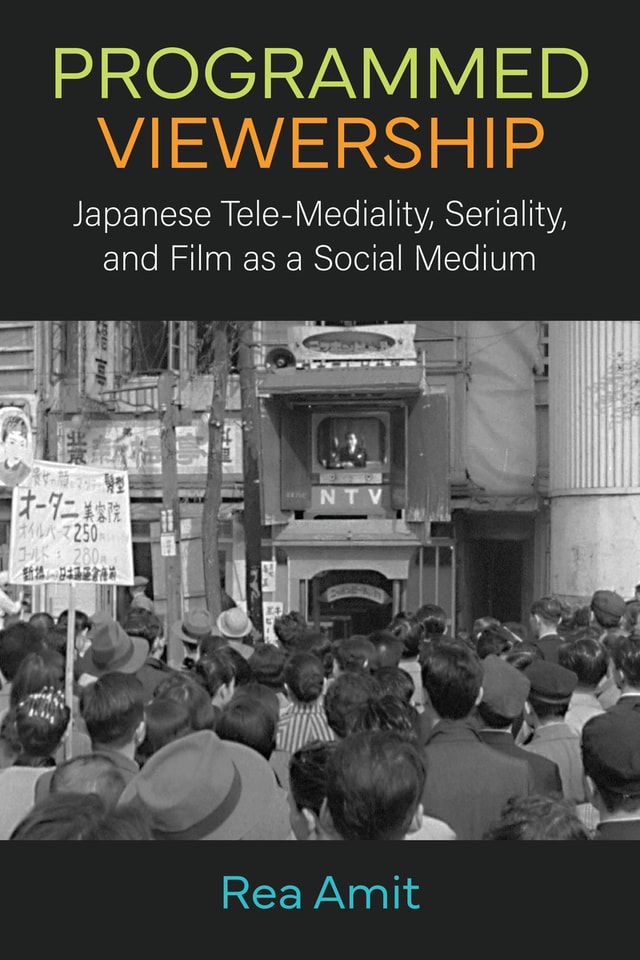
Programmed Viewership
Japanese Tele-Mediality, Seriality, and Film as a Social MediumRea Amit
University of Michigan Press, 2027
Programmed Viewership examines the concept of “program” in Japanese cinema as an organizing framework that links marketing and promotion, exhibition and distribution, and viewing practices in public and domestic spaces. Rea Amit defines “program” as the ideological infrastructure or platform that perpetuates habitual and ritualistic patterns in film production and reception. Amit takes a holistic approach to understanding more than a century of Japanese cinema through the analysis of material film ephemera, cinema theatre, film content, and viewership. This framework positions programming, rather than provenance, as the decisive factor that confers a film’s cultural and institutional identity. While earlier scholarship has gestured toward loosening the tie between cinematic identity and its nation of origin, Programmed Viewership extends this insight by emphasizing that production constitutes only one dimension of a broader programmatic system.
Project Planning for the Stage
Tools and Techniques for Managing Extraordinary PerformancesRich Dionne
Southern Illinois University Press, 2018
Project Planning for the Stage is organized into four sections corresponding to the life cycle of a theatre production: defining the goals and scope of the production and assembling the crew; planning, estimating, and scheduling; executing and managing; and closing and strike. Each section focuses on relevant concepts and skills and outlines the application of effective project-planning procedures and techniques—including critical path analysis and Gantt charts.
This book will be a valuable addition to the libraries of technical managers in live entertainment. Technical directors, costume shop managers, master electricians, properties masters, and video supervisors—anyone managing even part of a production—need to understand project-planning concepts such as the boundaries of authority and responsibility, parametric and bottom-up estimates, and precedence diagrams. The incredibly useful and powerful tools outlined in this book allow any technical manager to deliver the best possible outcome for a production.
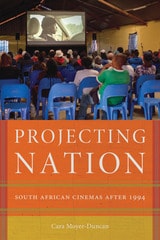
Projecting Nation
South African Cinemas after 1994Cara Moyer-Duncan
Michigan State University Press, 2020

Projecting the Nation
History and Ideology on the Israeli ScreenEran Kaplan
Rutgers University Press, 2020
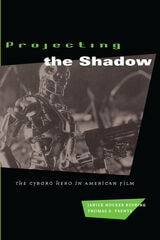
Projecting the Shadow
The Cyborg Hero in American FilmJanice Hocker Rushing and Thomas S. Frentz
University of Chicago Press, 1995
Through in-depth examinations of six representative films—Jaws, The Deer Hunter, The Manchurian Candidate, Blade Runner, The Terminator, and Terminator 2—Rushing and Frentz track the narrative's thread from the hunter to his technological nemesis, demonstrating how each film represents an unfolding hunter myth.
For each movie, Rushing and Frentz show how uninitiated male hunters slowly lose control over their weapons. In Jaws, a 'soft' man, dominated by technology, can re-acquire the heroic hunter qualities he needs by teaming up with a 'savage' man and a 'technological' man. In doing so, he can still conquer the prey. The Manchurian Candidate charts how technology can turn a human into a weapon; Blade Runner perfects the artificial human with its manufactured replicants who are "more than human"; and The Terminator introduces a female hunter who leads humanity in its struggle against technology.
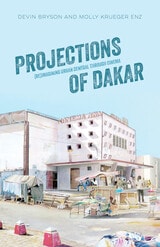
Projections of Dakar
(Re)Imagining Urban Senegal through CinemaDevin Bryson and Molly Krueger Enz
Ohio University Press, 2024
Like contemporary Senegalese cinema, African urban centers are often perceived as sites of despair and social decay. In each chapter of this book, Devin Bryson and Molly Krueger Enz focus on a particular urban issue and analyze how Senegalese filmmakers document and reimagine it from diverse perspectives and contexts. The authors draw from interviews and ethnographic observations to center filmmakers’ practices and conceptualizations of contemporary cinema in Dakar. Bryson and Enz trace developments in production, distribution, viewership, and audience response since 2012 to study how these films and their production both reveal and contribute to how people live in the city, relate to one another, build their lives, advocate for change, find joy and meaning, and build community. They also document and articulate more equitable and inclusive forms of these activities. Ultimately, the book illustrates how Senegalese filmmakers reimagine Africa as a place that will lead to a better future for its inhabitants.
Prologues and Epilogues of Restoration Theater
Gender and Comedy, Performance and PrintDiana Solomon
University of Delaware Press, 2013
Published by University of Delaware Press. Distributed worldwide by Rutgers University Press.
Prometheus Bound
Aeschylus
University of Chicago Press, 2013
A stand-alone edition of Aeschylus’s Prometheus Bound taken from Chicago’s renowned translations of the Greek tragedies.
In the wake of the Olympian gods’ clash with the Titans, Zeus punishes his former ally and fellow deity, Prometheus, for having dared to bring knowledge to humankind. In this sole surviving play of Aeschylus’s Prometheus trilogy, we find Prometheus chained in a desolate landscape, suffering great cruelty at the hands of his fellow gods.
Drawn from the authoritative third edition of the University of Chicago Press’s Complete Greek Tragedies series, David Grene’s searing translation of Prometheus Bound is presented here in a stand-alone edition. An introduction by Glenn W. Most and Mark Griffith provides essential information about the play’s first production, plot, and reception in antiquity.
Provocative Eloquence
Theater, Violence, and Antislavery Speech in the Antebellum United StatesLaura L. Mielke
University of Michigan Press, 2019
Psycho Paths
Tracking the Serial Killer Through Contemporary American Film and FictionPhilip L. Simpson
Southern Illinois University Press, 2000
Philip L. Simpson provides an original and broad overview of the evolving serial killer genre in the two media most responsible for its popularity: literature and cinema of the 1980s and 1990s.
The fictional serial killer, with a motiveless, highly individualized modus operandi, is the latest manifestation of the multiple murderers and homicidal maniacs that haunt American literature and, particularly, visual media such as cinema and television. Simpson theorizes that the serial killer genre results from a combination of earlier genre depictions of multiple murderers, inherited Gothic storytelling conventions, and threatening folkloric figures reworked over the years into a contemporary mythology of violence. Updated and repackaged for mass consumption, the Gothic villains, the monsters, the vampires, and the werewolves of the past have evolved into the fictional serial killer, who clearly reflects American cultural anxieties at the start of the twenty-first century.
Citing numerous sources, Simpson argues that serial killers’ recent popularity as genre monsters owes much to their pliability to any number of authorial ideological agendas from both the left and the right ends of the political spectrum. Serial killers in fiction are a kind of debased and traumatized visionary, whose murders privately and publicly re-empower them with a pseudo-divine aura in the contemporary political moment. The current fascination with serial killer narratives can thus be explained as the latest manifestation of the ongoing human fascination with tales of gruesome murders and mythic villains finding a receptive audience in a nation galvanized by the increasingly apocalyptic tension between the extremist philosophies of both the New Right and the anti-New Right.
Faced with a blizzard of works of varying quality dealing with the serial killer, Simpson has ruled out the catalog approach in this study in favor of in-depth an analysis of the best American work in the genre. He has chosen novels and films that have at least some degree of public name-recognition or notoriety, including Red Dragon and The Silence of the Lambs by Thomas Harris, Manhunter directed by Michael Mann, Henry: Portrait of a Serial Killer directed by John McNaughton, Seven directed by David Fincher, Natural Born Killers directed by Oliver Stone, Zombie by Joyce Carol Oates, and American Psycho by Bret Easton Ellis.
Psycho-Sexual
Male Desire in Hitchcock, De Palma, Scorsese, and FriedkinBy David Greven
University of Texas Press, 2013
Bridging landmark territory in film studies, Psycho-Sexual is the first book to apply Alfred Hitchcock’s legacy to three key directors of 1970s Hollywood—Brian De Palma, Martin Scorsese, and William Friedkin—whose work suggests the pornographic male gaze that emerged in Hitchcock’s depiction of the voyeuristic, homoerotically inclined American man. Combining queer theory with a psychoanalytic perspective, David Greven begins with a reconsideration of Psycho and the 1956 remake of The Man Who Knew Too Much to introduce the filmmaker’s evolutionary development of American masculinity.
Psycho-Sexual probes De Palma’s early Vietnam War draft-dodger comedies as well as his film Dressed to Kill, along with Scorsese’s Taxi Driver and Friedkin’s Cruising as reactions to and inventive elaborations upon Hitchcock’s gendered themes and aesthetic approaches. Greven demonstrates how the significant political achievement of these films arises from a deeply disturbing, violent, even sorrowful psychological and social context. Engaging with contemporary theories of pornography while establishing pornography’s emergence during the classical Hollywood era, Greven argues that New Hollywood filmmakers seized upon Hitchcock’s radical decentering of heterosexual male dominance. The resulting images of heterosexual male ambivalence allowed for an investment in same-sex desire; an aura of homophobia became informed by a fascination with the homoerotic. Psycho-Sexual also explores the broader gender crisis and disorganization that permeated the Cold War and New Hollywood eras, reimagining the defining premises of Hitchcock criticism.
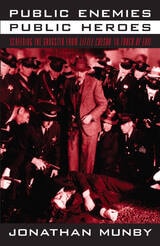
Public Enemies, Public Heroes
Screening the Gangster from Little Caesar to Touch of EvilJonathan Munby
University of Chicago Press, 1999
Beginning in the early 1930s, these films told compelling stories about ethnic urban lower-class desires to "make it" in an America dominated by Anglo-Saxon Protestant ideals and devastated by the Great Depression. By the late 1940s, however, their focus shifted to the problems of a culture maladjusting to a new peacetime sociopolitical order governed by corporate capitalism. The gangster no longer challenged the establishment; the issue was not "making it," but simply "making do."
Combining film analysis with archival material from the Production Code Administration (Hollywood's self-censoring authority), Munby shows how the industry circumvented censure, and how its altered gangsters (influenced by European filmmakers) fueled the infamous inquisitions of Hollywood in the postwar '40s and '50s by the House Committee on Un-American Activities. Ultimately, this provocative study suggests that we rethink our ideas about crime and violence in depictions of Americans fighting against the status quo.
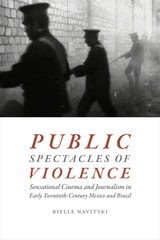
Public Spectacles of Violence
Sensational Cinema and Journalism in Early Twentieth-Century Mexico and BrazilRielle Navitski
Duke University Press, 2017
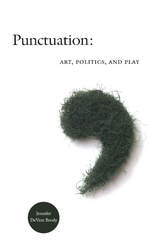
Punctuation
Art, Politics, and PlayJennifer DeVere Brody
Duke University Press, 2008
Brody provides a playful, erudite meditation on punctuation’s power to direct discourse and, consequently, to shape human subjectivity. Her analysis ranges from a consideration of typography as a mode for representing black subjectivity in Ralph Ellison’s Invisible Man to a reflection on hyphenation and identity politics in light of Strunk and White’s prediction that the hyphen would disappear from written English. Ultimately, Brody takes punctuation off the “stage of the page” to examine visual and performance artists’ experimentation with non-grammatical punctuation. She looks at different ways that punctuation performs as gesture in dances choreographed by Bill T. Jones, in the hybrid sculpture of Richard Artschwager, in the multimedia works of the Japanese artist Yayoi Kusama, and in Miranda July’s film Me and You and Everyone We Know. Brody concludes with a reflection on the future of punctuation in the digital era.
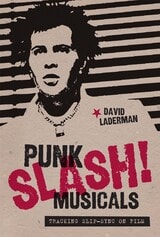
Punk Slash! Musicals
Tracking Slip-Sync on FilmBy David Laderman
University of Texas Press, 2010
Punk Slash! Musicals is the first book to deal extensively with punk narrative films, specifically British and American punk rock musicals produced from roughly 1978 to 1986. Films such as Jubilee, Breaking Glass, Times Square, Smithereens, Starstruck, and Sid and Nancy represent a convergence between independent, subversive cinema and formulaic classical Hollywood and pop musical genres.
Guiding this project is the concept of "slip-sync." Riffing on the commonplace lip-sync phenomenon, "slip-sync" refers to moments in the films when the punk performer "slips" out of sync with the performance spectacle, and sometimes the sound track itself, engendering a provocative moment of tension. This tension frequently serves to illustrate other thematic and narrative conflicts, central among these being the punk negotiation between authenticity and inauthenticity.
Laderman emphasizes the strong female lead performer at the center of most of these films, as well as each film's engagement with gender and race issues. Additionally, he situates his analyses in relation to the broader cultural and political context of the neo-conservatism and new electronic audio-visual technologies of the 1980s, showing how punk's revolution against the mainstream actually depends upon a certain ironic embrace of pop culture.
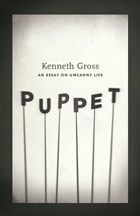
Puppet
An Essay on Uncanny LifeKenneth Gross
University of Chicago Press, 2011
The puppet creates delight and fear. It may evoke the innocent play of childhood, or become a tool of ritual magic, able to negotiate with ghosts and gods. Puppets can be creepy things, secretive, inanimate while also full of spirit, alive with gesture and voice. In this eloquent book, Kenneth Gross contemplates the fascination of these unsettling objects—objects that are also actors and images of life.
The poetry of the puppet is central here, whether in its blunt grotesquery or symbolic simplicity, and always in its talent for metamorphosis. On a meditative journey to seek the idiosyncratic shapes of puppets on stage, Gross looks at the anarchic Punch and Judy show, the sacred shadow theater of Bali, and experimental theaters in Europe and the United States, where puppets enact everything from Baroque opera and Shakespearean tragedy to Beckettian farce. Throughout, he interweaves accounts of the myriad faces of the puppet in literature—Collodi’s cruel, wooden Pinocchio, puppetlike characters in Kafka and Dickens, Rilke’s puppet-angels, the dark puppeteering of Philip Roth’s Micky Sabbath—as well as in the work of artists Joseph Cornell and Paul Klee. The puppet emerges here as a hungry creature, seducer and destroyer, demon and clown. It is a test of our experience of things, of the human and inhuman. A book about reseeing what we know, or what we think we know, Puppet evokes the startling power of puppets as mirrors of the uncanny in life and art.