Results by title
2018 books match the query 'Political aspects' and 156 start with p
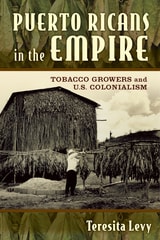
Puerto Ricans in the Empire
Tobacco Growers and U.S. ColonialismTeresita A. Levy
Rutgers University Press, 2015
Most studies of Puerto Rico’s relations with the United States have focused on the sugar industry, recounting a tale of victimization and imperial abuse driven by the interests of U.S. sugar companies. But in Puerto Ricans in the Empire, Teresita A. Levy looks at a different agricultural sector, tobacco growing, and tells a story in which Puerto Ricans challenged U.S. officials and fought successfully for legislation that benefited the island.
Levy describes how small-scale, politically involved, independent landowners grew most of the tobacco in Puerto Rico. She shows how, to gain access to political power, tobacco farmers joined local agricultural leagues and the leading farmers’ association, the Asociación de Agricultores Puertorriqueños (AAP). Through their affiliation with the AAP, they successfully lobbied U.S. administrators in San Juan and Washington, participated in government-sponsored agricultural programs, solicited agricultural credit from governmental sources, and sought scientific education in a variety of public programs, all to boost their share of the tobacco-leaf market in the United States. By their own efforts, Levy argues, Puerto Ricans demanded and won inclusion in the empire, in terms that were defined not only by the colonial power, but also by the colonized.
The relationship between Puerto Rico and the United States was undoubtedly colonial in nature, but, as Puerto Ricans in the Empire shows, it was not unilateral. It was a dynamic, elastic, and ever-changing interaction, where Puerto Ricans actively participated in the economic and political processes of a negotiated empire.
[more]
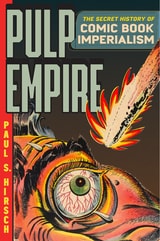
Pulp Empire
The Secret History of Comic Book ImperialismPaul S. Hirsch
University of Chicago Press, 2021
Winner of the Popular Culture Association's Ray and Pat Browne Award for Best Book in Popular or American Culture
In the 1940s and ’50s, comic books were some of the most popular—and most unfiltered—entertainment in the United States. Publishers sold hundreds of millions of copies a year of violent, racist, and luridly sexual comics to Americans of all ages until a 1954 Senate investigation led to a censorship code that nearly destroyed the industry. But this was far from the first time the US government actively involved itself with comics—it was simply the most dramatic manifestation of a long, strange relationship between high-level policy makers and a medium that even artists and writers often dismissed as a creative sewer. In Pulp Empire, Paul S. Hirsch uncovers the gripping untold story of how the US government both attacked and appropriated comic books to help wage World War II and the Cold War, promote official—and clandestine—foreign policy and deflect global critiques of American racism.
As Hirsch details, during World War II—and the concurrent golden age of comic books—government agencies worked directly with comic book publishers to stoke hatred for the Axis powers while simultaneously attempting to dispel racial tensions at home. Later, as the Cold War defense industry ballooned—and as comic book sales reached historic heights—the government again turned to the medium, this time trying to win hearts and minds in the decolonizing world through cartoon propaganda.
Hirsch’s groundbreaking research weaves together a wealth of previously classified material, including secret wartime records, official legislative documents, and caches of personal papers. His book explores the uneasy contradiction of how comics were both vital expressions of American freedom and unsettling glimpses into the national id—scourged and repressed on the one hand and deployed as official propaganda on the other. Pulp Empire is a riveting illumination of underexplored chapters in the histories of comic books, foreign policy, and race.
[more]
Punctuations
How the Arts Think the PoliticalMichael J. Shapiro
Duke University Press, 2019
In Punctuations Michael J. Shapiro examines how punctuation—conceived not as a series of marks but as a metaphor for the ways in which artists engage with intelligibility—opens pathways for thinking through the possibilities for oppositional politics. Drawing on Theodor Adorno, Alain Robbe-Grillet, and Roland Barthes, Shapiro demonstrates how punctuation's capacity to create unexpected rhythmic pacing makes it an ideal tool for writers, musicians, filmmakers, and artists to challenge structures of power. In works ranging from film scores and jazz compositions to literature, architecture, and photography, Shapiro shows how the use of punctuation reveals the contestability of dominant narratives in ways that prompt readers, viewers, and listeners to reflect on their acceptance of those narratives. Such uses of punctuation, he theorizes, offer models for disrupting structures of authority, thereby fostering the creation of alternative communities of sense from which to base political mobilization.
[more]
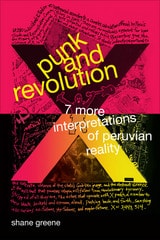
Punk and Revolution
Seven More Interpretations of Peruvian RealityShane Greene
Duke University Press, 2016
In Punk and Revolution Shane Greene radically uproots punk from its iconic place in First World urban culture, Anglo popular music, and the Euro-American avant-garde, situating it instead as a crucial element in Peru's culture of subversive militancy and political violence. Inspired by José Carlos Mariátegui's Seven Interpretive Essays on Peruvian Reality, Greene explores punk's political aspirations and subcultural possibilities while complicating the dominant narratives of the war between the Shining Path and the Peruvian state. In these seven essays, Greene experiments with style and content, bends the ethnographic genre, and juxtaposes the textual and visual. He theorizes punk in Lima as a mode of aesthetic and material underproduction, rants at canonical cultural studies for its failure to acknowledge punk's potential for generating revolutionary politics, and uncovers the intersections of gender, ethnicity, class, and authenticity in the Lima punk scene. Following the theoretical interventions of Debord, Benjamin, and Bakhtin, Greene fundamentally redefines how we might think about the creative contours of punk subculture and the politics of anarchist praxis.
[more]
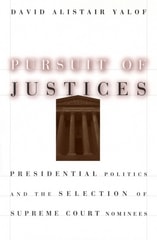
Pursuit of Justices
Presidential Politics and the Selection of Supreme Court NomineesDavid Alistair Yalof
University of Chicago Press, 1999
Although the Senate confirmation of Supreme Court nominees is the most public part of the nomination process, the most critical phase—the initial selection of nominees—is usually hidden from view. In Pursuit of Justices, David Yalof takes the reader behind the scenes of what happens before the Senate hearings to show how presidents go about deciding who will sit on the highest court in the land. As Yalof shows, an intricate web of forces—competing factions within the executive branch, organized interests, and the president's close associates—all vie for influence during this phase of presidential decisionmaking.
Yalof draws on the papers of seven modern presidents, from Truman to Reagan, and firsthand interviews with key figures, such as Ramsey Clark, Edwin Meese, and President Gerald Ford. He documents and analyzes the selection criteria these presidents used, the pool of candidates from which they chose, their strategies, and the political pressures affecting their decisions, both successes and failures. Yalof also disputes much conventional wisdom about the selection process, including the widely held view that presidents choose nominees primarily to influence future decisions of the high court. In a substantial epilogue, Yalof offers insightful observations about the selections of Presidents George Bush and Bill Clinton.
By focusing on a neglected area of presidential politics, Yalof offers a fascinating and unprecedented glimpse into the intricate world of executive branch decisionmaking and the Supreme Court appointment process as a whole.
Winner of the 2000 Richard E. Neustadt Award for Best Book on the American Presidency
[more]
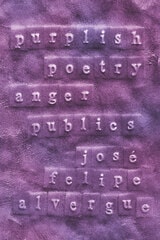
purplish
poetry anger publicsJosé Felipe Alvergue
University of Iowa Press, 2025
José Felipe Alvergue examines anger in American poetry, while reflecting on the permissible/policed cultural affects of our time. By way of BIPOC and QTPOC poets engaging with negativity—frustration, anger, distress—Alvergue argues that affects that reflect a counternarrative to benevolence challenge the colonial underpinnings of “American publics” as a concept of democratic participation and practice of community. Purple politics play out daily within spaces we rely on for shared comfort and belonging, namely neighborhoods, dinner tables, school board meetings, and social media. Purplish America describes the uncertain terrain of potential violence, potential conflict, distrust, and post-factualism upon which language and soma are still expected to thrive.
purplish challenges the idea of an objective or unbiased cultural rationale to purple regions in America by historicizing how anger has been systemically cleansed from the collective sentiments regarding nation-building throughout key moments of our national heritage.
purplish challenges the idea of an objective or unbiased cultural rationale to purple regions in America by historicizing how anger has been systemically cleansed from the collective sentiments regarding nation-building throughout key moments of our national heritage.
[more]