3027 books match the query 'Sociology' and 166 start with p
cover of Protestors and Their Targets

Protestors and Their Targets

James Jasper

Temple University Press, 2020

The strategic interactions between protestors and their targets shape the world around us in profound ways. The editors and contributors to Protesters and Their Targets—all leading scholars in the study of social movements—look at why movements do what they do and why their interactions with other societal actors turn out as they do. They recognize that targets are not stationary but react to the movement and require the movement to react back.

This edited collection analyzes how social movements select their targets, movement-target interactions, and the outcomes of those interactions. Case studies examine school closures in Sweden, the U.S. labor movement, Bolivian water and Mexican corn, and other global issues to show the strategic thinking, shifting objectives, and various degrees of success in the actions and nature of these protest movements. 

Protesters and Their Targets seeks to develop a set of tools for the further development of the field’s future work on this underexplored set of interactions.

[more]
cover of Psychoanalysis and Social Theory: The Limits of Sociology

Psychoanalysis and Social Theory

The Limits of Sociology

Ian Craib

University of Massachusetts Press, 1989
Provides an introductory analysis of attempts to combine cycle analytical and social theory. Starting from a discussion of the work of Freud, the book goes on to look at more recent attempts to combine the two in the work of members of the Frankfurt school and others such as Christopher Badcock, Christopher Lasch, Talcott Parsons and Eric Erickson. The analysis also covers modern feminist approaches to Freud, notably through the writings of Nancy Chodorow and Juliet Mitchell. The author argues that there is no simple way of combining psychoanalytical and social theory, and that both approaches are limited in scope.
[more]
cover of Psychology and Politics: Intersections of Science and Ideology in the History of Psy-Sciences

Psychology and Politics

Intersections of Science and Ideology in the History of Psy-Sciences

Ferenc Eros

Central European University Press, 2019

Psy-sciences (psychology, psychiatry, psychoanalysis, pedagogy, criminology, special education, etc.) have been connected to politics in different ways since the early twentieth century. Here in twenty-two essays scholars address a variety of these intersections from a historical perspective. 
The chapters include such diverse topics as the cultural history of psychoanalysis, the complicated relationship between psychoanalysis and the occult, and the struggles for dominance between the various schools of psychology. They show the ambivalent positions of the "psy" sciences in the dictatorships and authoritarian regimes of Nazi Germany, East European communism, Latin-American military dictatorships, and South African apartheid, revealing the crucial role of psychology in legitimating and "normalizing" these regimes.

The authors also discuss the ideological and political aspects of mental health and illness in Hungary, Germany, post-WW1 Transylvania, and Russia. Other chapters describe the attempt by critical psychology to understand the production of academic, therapeutic, and everyday psychological knowledge in the context of the power relations of modern capitalist societies.
[more]
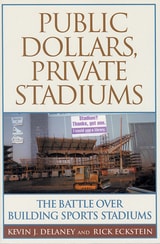
cover of Public Dollars, Private Stadiums: The Battle over Building Sports Stadiums

Public Dollars, Private Stadiums

The Battle over Building Sports Stadiums

Delaney, Kevin J.

Rutgers University Press, 2003

The authors provide an eye-opening account of recent battles over publicly financed stadiums in some of America’s largest cities. Their interviews with the key decision makers present a behind-the-scenes look at how and why powerful individuals and organizations foist these sports palaces on increasingly unreceptive communities.

 Delaney and Eckstein show that in the face of studies demonstrating that new sports facilities don’t live up to their promise of big money, proponents are using a new tactic to win public subsidies¾intangible “social” rewards, such as prestige and community cohesion. The authors find these to be empty promises as well, demonstrating that new stadiums may exacerbate, rather than erase, social problems in cities.
[more]
cover of Public Opinion and American Foreign Policy

Public Opinion and American Foreign Policy

Ole R. Holsti

University of Michigan Press, 1996
One of the central issues in democratic theory is the proper role of public opinion in the conduct of international affairs. The capacity of the public to make informed judgments about these complex issues which are often far removed from their experience has been questioned. In addition, the impact of public opinion on foreign policy-making has been debated. In Public Opinion and American Foreign Policy Ole Holsti addresses these crucial issues using extensive data on public attitudes and preferences on international affairs. Holsti concludes that although the American public is not well informed about many aspects of foreign affairs, its opinions are usually stable and reasonable reactions to real world events, are not lacking in structure, and can often have an important impact on foreign policies. Holsti surveys changing perceptions of the effect of public opinion on foreign policy since World War I. According to Holsti, this war transformed the issue of public participation in foreign affairs from a theoretical into a practical one that many postwar leaders had to confront. World War II and its immediate aftermath are equally significant. The Vietnam War stimulated a new wave of theory and research that challenged many aspects of the post-World War II view of public opinion. The author assesses the hypothesis that the bipartisan foreign policy consensus of the post-World War II period has, during the past two decades, given way to sharp partisan cleavages, reinforced by ideological differences. The end of the Cold War has also raised new questions about public opinion and foreign policy. Holsti explores the determinants of public opinion on foreign policy, the impact of gender, generation, education, religion, and race on foreign policy attitudes, and the relationship of the opinions of the general public to the opinions of leaders. This book will be of interest to political scientists, historians, political psychologists, and anyone with an interest in American foreign policy and the domestic factors that may affect its formulation and implementation.
[more]
cover of Public Religions in the Modern World

Public Religions in the Modern World

José Casanova

University of Chicago Press, 1994

In a sweeping reconsideration of the relation between religion and modernity, Jose Casanova surveys the roles that religions may play in the public sphere of modern societies.

During the 1980s, religious traditions around the world, from Islamic fundamentalism to Catholic liberation theology, began making their way, often forcefully, out of the private sphere and into public life, causing the "deprivatization" of religion in contemporary life. No longer content merely to administer pastoral care to individual souls, religious institutions are challenging dominant political and social forces, raising questions about the claims of entities such as nations and markets to be "value neutral", and straining the traditional connections of private and public morality.

Casanova looks at five cases from two religious traditions (Catholicism and Protestantism) in four countries (Spain, Poland, Brazil, and the United States). These cases challenge postwar—and indeed post-Enlightenment—assumptions about the role of modernity and secularization in religious movements throughout the world.

This book expands our understanding of the increasingly significant role religion plays in the ongoing construction of the modern world.
[more]
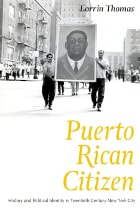
cover of Puerto Rican Citizen: History and Political Identity in Twentieth-Century New York City

Puerto Rican Citizen

History and Political Identity in Twentieth-Century New York City

Lorrin Thomas

University of Chicago Press, 2010

By the end of the 1920s, just ten years after the Jones Act first made them full-fledged Americans, more than 45,000 native Puerto Ricans had left their homes and entered the United States, citizenship papers in hand, forming one of New York City’s most complex and distinctive migrant communities. In Puerto Rican Citizen, Lorrin Thomas for the first time unravels the many tensions—historical, racial, political, and economic—that defined the experience of this group of American citizens before and after World War II.

Building its incisive narrative from a wide range of archival sources, interviews, and first-person accounts of Puerto Rican life in New York, this book illuminates the rich history of a group that is still largely invisible to many scholars. At the center of Puerto Rican Citizen are Puerto Ricans’ own formulations about political identity, the responses of activists and ordinary migrants to the failed promises of American citizenship, and their expectations of how the American state should address those failures. Complicating our understanding of the discontents of modern liberalism, of race relations beyond black and white, and of the diverse conceptions of rights and identity in American life, Thomas’s book transforms the way we understand this community’s integral role in shaping our sense of citizenship in twentieth-century America.
[more]
cover of Pulled Over: How Police Stops Define Race and Citizenship

Pulled Over

How Police Stops Define Race and Citizenship

Charles R. Epp, Steven Maynard-Moody, and Donald P. Haider-Markel

University of Chicago Press, 2014

In sheer numbers, no form of government control comes close to the police stop. Each year, twelve percent of drivers in the United States are stopped by the police, and the figure is almost double among racial minorities. Police stops are among the most recognizable and frequently criticized incidences of racial profiling, but, while numerous studies have shown that minorities are pulled over at higher rates, none have examined how police stops have come to be both encouraged and institutionalized.

Pulled Over deftly traces the strange history of the investigatory police stop, from its discredited beginning as “aggressive patrolling” to its current status as accepted institutional practice. Drawing on the richest study of police stops to date, the authors show that who is stopped and how they are treated convey powerful messages about citizenship and racial disparity in the United States. For African Americans, for instance, the experience of investigatory stops erodes the perceived legitimacy of police stops and of the police generally, leading to decreased trust in the police and less willingness to solicit police assistance or to self-censor in terms of clothing or where they drive. This holds true even when police are courteous and respectful throughout the encounters and follow seemingly colorblind institutional protocols. With a growing push in recent years to use local police in immigration efforts, Hispanics stand poised to share African Americans’ long experience of investigative stops.
 
In a country that celebrates democracy and racial equality, investigatory stops have a profound and deleterious effect on African American and other minority communities that merits serious reconsideration. Pulled Over offers practical recommendations on how reforms can protect the rights of citizens and still effectively combat crime.
[more]
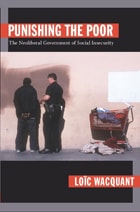
cover of Punishing the Poor: The Neoliberal Government of Social Insecurity

Punishing the Poor

The Neoliberal Government of Social Insecurity

Loïc Wacquant

Duke University Press, 2009

The punitive turn of penal policy in the United States after the acme of the Civil Rights movement responds not to rising criminal insecurity but to the social insecurity spawned by the fragmentation of wage labor and the shakeup of the ethnoracial hierarchy. It partakes of a broader reconstruction of the state wedding restrictive “workfare” and expansive “prisonfare” under a philosophy of moral behaviorism. This paternalist program of penalization of poverty aims to curb the urban disorders wrought by economic deregulation and to impose precarious employment on the postindustrial proletariat. It also erects a garish theater of civic morality on whose stage political elites can orchestrate the public vituperation of deviant figures—the teenage “welfare mother,” the ghetto “street thug,” and the roaming “sex predator”—and close the legitimacy deficit they suffer when they discard the established government mission of social and economic protection. By bringing developments in welfare and criminal justice into a single analytic framework attentive to both the instrumental and communicative moments of public policy, Punishing the Poor shows that the prison is not a mere technical implement for law enforcement but a core political institution. And it reveals that the capitalist revolution from above called neoliberalism entails not the advent of “small government” but the building of an overgrown and intrusive penal state deeply injurious to the ideals of democratic citizenship.
[more]
cover of Punishment and Culture

Punishment and Culture

Philip Smith

University of Chicago Press, 2008

From the chain gang to the electric chair, the problem of how to deal with criminals has long been debated. What explains this concern with getting punishment right? And why do attitudes toward particular punishments change radically over time? In addressing these questions, Philip Smith attacks the comfortable myth that punishment is about justice, reason, and law. Instead he argues that punishment is an essentially irrational act founded in ritual as a means to control evil without creating more of it in the process.
            Punishment and Culture traces three centuries of the history of punishment, looking in detail at issues ranging from public executions and the development of the prison to Jeremy Bentham’s notorious panopticon and the invention of the guillotine. Smith contends that each of these attempts to achieve sterile bureaucratic control was thwarted as uncontrollable cultural forces generated alternative visions of heroic villains, darkly gothic technologies, and sacred awe. Moving from Andy Warhol to eighteenth-century highwaymen to Orwell’s 1984, Smith puts forward a dazzling account of the cultural landscape of punishment. His findings will fascinate students of sociology, history, criminology, law, and cultural studies.
[more]
cover of Punishment and Inequality in America

Punishment and Inequality in America

Bruce Western

Russell Sage Foundation, 2006
Over the last thirty years, the prison population in the United States has increased more than seven-fold to over two million people, including vastly disproportionate numbers of minorities and people with little education. For some racial and educational groups, incarceration has become a depressingly regular experience, and prison culture and influence pervade their communities. Almost 60 percent of black male high school drop-outs in their early thirties have spent time in prison. In Punishment and Inequality in America, sociologist Bruce Western explores the recent era of mass incarceration and the serious social and economic consequences it has wrought. Punishment and Inequality in America dispels many of the myths about the relationships among crime, imprisonment, and inequality. While many people support the increase in incarceration because of recent reductions in crime, Western shows that the decrease in crime rates in the 1990s was mostly fueled by growth in city police forces and the pacification of the drug trade. Getting "tough on crime" with longer sentences only explains about 10 percent of the fall in crime, but has come at a significant cost. Punishment and Inequality in America reveals a strong relationship between incarceration and severely dampened economic prospects for former inmates. Western finds that because of their involvement in the penal system, young black men hardly benefited from the economic boom of the 1990s. Those who spent time in prison had much lower wages and employment rates than did similar men without criminal records. The losses from mass incarceration spread to the social sphere as well, leaving one out of ten young black children with a father behind bars by the end of the 1990s, thereby helping perpetuate the damaging cycle of broken families, poverty, and crime. The recent explosion of imprisonment is exacting heavy costs on American society and exacerbating inequality. Whereas college or the military were once the formative institutions in young men's lives, prison has increasingly usurped that role in many communities. Punishment and Inequality in America profiles how the growth in incarceration came about and the toll it is taking on the social and economic fabric of many American communities.
[more]
cover of Purging the Poorest: Public Housing and the Design Politics of Twice-Cleared Communities

Purging the Poorest

Public Housing and the Design Politics of Twice-Cleared Communities

Lawrence J. Vale

University of Chicago Press, 2013
The building and management of public housing is often seen as a signal failure of American public policy, but this is a vastly oversimplified view. In Purging the Poorest, Lawrence J. Vale offers a new narrative of the seventy-five-year struggle to house the “deserving poor.”

In the 1930s, two iconic American cities, Atlanta and Chicago, demolished their slums and established some of this country’s first public housing. Six decades later, these same cities also led the way in clearing public housing itself. Vale’s groundbreaking history of these “twice-cleared” communities provides unprecedented detail about the development, decline, and redevelopment of two of America’s most famous housing projects: Chicago’s Cabrini-Green and Atlanta’s Techwood /Clark Howell Homes. Vale offers the novel concept of design politics to show how issues of architecture and urbanism are intimately bound up in thinking about policy. Drawing from extensive archival research and in-depth interviews, Vale recalibrates the larger cultural role of public housing, revalues the contributions of public housing residents, and reconsiders the role of design and designers.

[more]
cover of Purple Power: The History and Global Impact of SEIU

Purple Power

The History and Global Impact of SEIU

Edited by Luís LM Aguiar and Joseph A. McCartin

University of Illinois Press, 2023

Chartered in 1921, the Service Employees International Union (SEIU) is a worldwide organization that represents more than two million workers in occupations from healthcare and government service to custodians and taxi drivers. Women form more than half the membership while people in minority groups make up approximately forty percent.

Luís LM Aguiar and Joseph A. McCartin edit essays on one of contemporary labor’s bedrock organizations. The contributors explore key episodes, themes, and features in the union’s recent history and evaluate SEIU as a union with global aspirations and impact. The first section traces the SEIU’s growth in the last and current centuries. The second section offers in-depth studies of key campaigns in the United States, including the Justice for Janitors and Fight for $15 movements. The third section focuses on the SEIU’s work representing low-wage workers in Canada, Australia, Europe, and Brazil. An interview with Justice for Janitors architect Stephen Lerner rounds out the volume.

Contributors: Luís LM Aguiar, Adrienne E. Eaton, Janice Fine, Euan Gibb, Laurence Hamel-Roy, Tashlin Lakhani, Joseph A. McCartin, Yanick Noiseux, Benjamin L. Peterson, Allison Porter, Alyssa May Kuchinski, Maite Tapia, Veronica Terriquez, and Kyoung-Hee Yu
[more]
cover of Pushing Back the Gates: Neighborhood Perspectives on University-Driven Revitalization in West Philadelphia

Pushing Back the Gates

Neighborhood Perspectives on University-Driven Revitalization in West Philadelphia

Harley F Etienne

Temple University Press, 2013

As college and university administrators expand and develop their urban campuses, they have also become developers—and primary drivers—of neighborhood change. But how do institutions contend with urban real estate needs, revitalization opportunities, and community outreach? And how do the residents benefit? Pushing Back the Gates provides a lively discussion of neighborhood-level perspectives of the dynamic changes brought about by institutions' urban planning efforts.

Harley Etienne outlines the rationale for university-driven development and neighborhood revitalization balanced by caution for the limitations of the model. He provides a summary of the University of Pennsylvania's West Philadelphia Initiatives and the challenges and successes of this unique plan. Etienne also examines the implementation of similar efforts at different universities around the country.

Pushing Back the Gates speaks to communities, university leaders, and urban developers who navigate the boundary between neighborhood revitalization through physical development and investments in incumbent populations and human capital.
 

[more]
cover of Putting Children First: How Low-Wage Working Mothers Manage Child Care

Putting Children First

How Low-Wage Working Mothers Manage Child Care

Ajay Chaudry

Russell Sage Foundation, 2004
In the five years following the passage of federal welfare reform law, the labor force participation of low-income, single mothers with young children climbed by more than 25 percent. With significantly more hours spent outside the home, single working mothers face a serious childcare crunch—how can they provide quality care for their children? In Putting Children First, Ajay Chaudry follows 42 low-income families in New York City over three years to illuminate the plight of these mothers and the ways in which they respond to the difficult challenge of providing for their children's material and developmental needs with limited resources. Using the words of the women themselves, Chaudry tells a startling story. Scarce subsidies, complicated bureaucracies, inflexible work schedules, and limited choices force families to piece together care arrangements that are often unstable, unreliable, inconvenient, and of limited quality. Because their wages are so low, these women are forced to rely on inexpensive caregivers who are often under-qualified to serve the developmental needs of their children. Even when these mothers find good, affordable care, it rarely lasts long because their volatile employment situations throw their needs into constant flux. The average woman in Chaudry's sample had to find five different primary caregivers in her child's first four years, while over a quarter of them needed seven or more in that time. This book lets single, low-income mothers describe the childcare arrangements they desire and the ways that options available to them fail to meet even their most basic needs. As Chaudry tracks these women through erratic childcare spells, he reveals the strategies they employ, the tremendous costs they incur and the anxiety they face when trying to ensure that their children are given proper care. Honest, powerful, and alarming, Putting Children First gives a fresh perspective on work and family for the disadvantaged. It infuses a human voice into the ongoing debate about the effectiveness of welfare reform, showing the flaws of a social policy based solely on personal responsibility without concurrent societal responsibility, and suggesting a better path for the future.
[more]
cover of Putting Poor People to Work: How the Work-First Idea Eroded College Access for the Poor

Putting Poor People to Work

How the Work-First Idea Eroded College Access for the Poor

Kathleen M. Shaw

Russell Sage Foundation, 2006

Today, a college education is increasingly viewed as the gateway to the American Dream—a necessary prerequisite for social mobility. Yet recent policy reforms in the United States effectively steer former welfare recipients away from an education that could further their career prospects, forcing them directly into the workforce where they often find only low-paying jobs with little opportunity for growth. In Putting Poor People to Work, Kathleen Shaw, Sara Goldrick-Rab, Christopher Mazzeo, and Jerry A. Jacobs explore this troubling disconnect between the principles of "work-first" and "college for all." Using comprehensive interviews with government officials and sophisticated data from six states over a four year period, Putting Poor People to Work shows how recent changes in public policy have reduced the quantity and quality of education and training available to adults with low incomes. The authors analyze how two policies encouraging work—the federal welfare reform law of 1996 and the Workforce Investment Act of 1998—have made moving people off of public assistance as soon as possible, with little regard to their long-term career prospects, a government priority. Putting Poor People to Work shows that since the passage of these "work-first" laws, not only are fewer low-income individuals pursuing postsecondary education, but when they do, they are increasingly directed towards the most ineffective, short-term forms of training, rather than higher-quality college-level education. Moreover, the schools most able and ready to serve poor adults—the community colleges—are deterred by these policies from doing so. Having a competitive, agile workforce that can compete with any in the world is a national priority. In a global economy where skills are paramount, that goal requires broad popular access to education and training. Putting Poor People to Work shows how current U.S. policy discourages poor Americans from seeking out a college education, stranding them in jobs with little potential for growth. This important new book makes a powerful argument for a shift in national priorities that would encourage the poor to embrace both work and education, rather than having to choose between the two. Institute for Research on Poverty Affiliated Books on Poverty and Public Policy">An Institute for Research on Poverty Affiliated Book on Poverty and Public Policy
[more]