Results by title
8812 books match the query 'Political Science' and 592 start with p
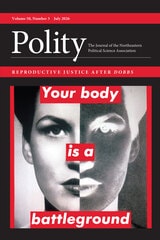
Polity, volume 58 number 3 (July 2026)
The University of Chicago Press
University of Chicago Press Journals, 2026

Polity, volume 58 number 4 (October 2026)
The University of Chicago Press
University of Chicago Press Journals, 2026
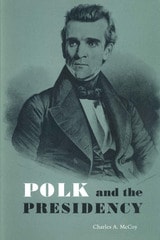
Polk and the Presidency
By Charles A. McCoy
University of Texas Press, 1960
“Who is James K. Polk?” was a rallying cry of the Whigs during the campaign of 1844. Polk answered that question adequately by winning the election against his Whig opponent, Henry Clay.
Today the question might be recast—respectfully, not derisively—“Who was James K. Polk?” Few persons could give more than a perfunctory answer, even though when he left office the United States was half again larger than it was when he became president.
Polk, unlike his close friend Andrew Jackson, has been the subject of but few books. Stern and serious-minded, intent upon his work, he never caught the public’s imagination as did some of the more magnetic personalities who filled the office of president. His lack of personal charm, however, should not hide from generations of Americans the great benefit he brought their country and his key role in developing the powers of the presidency.
This book will be a revelation to readers who might be confounded, even momentarily, by the question “Who was James K. Polk?” It is based on the assumption that the presidential power-role, though expressed in the Constitution and prescribed by law, is not a static role but a dynamic one, shaped and developed by a president’s personal reaction to the crises and circumstances of the times during which he serves. And Polk faced many crises, among them the Mexican War, the Oregon boundary dispute, the tariff question, Texas’s admission to the Union, and the establishment by the United States of a more stable and respected position in the world of nations.
Based on the dynamic power-role theory, the book analyzes its theme of how and why James K. Polk, the eleventh president of the United States, responded to the challenges of his times and thereby increased the authority and importance of the presidential role for future incumbents.
Charles McCoy became interested in writing this book after two of his friends, both informed historians, pointed out to him that James K. Polk was a neglected figure in American history. Preliminary research showed this to be true, but without reason—for, as the eminent historian George Bancroft said, “viewed from the standpoint of results, [Polk’s administration] was perhaps the greatest in our national history, certainly one of the greatest.” For his own astute appraisal of the Polk administration, McCoy emphasized the use of firsthand sources of information: the Polk Diary; newspapers of the period; the unpublished papers of Polk, Jackson, Trist, Marcy, and Van Buren; and congressional documents and reports.

Polpop 2
Politics and Popular Culture in America TodayJames Combs
University of Wisconsin Press, 1991
This book takes another look at politics and popular culture. The author has tried to explain the politics of popular culture as part of historical and cultural processes, helping the reader understand not only how popular culture has affected our politics, but also where it is taking us.
Polycentric Games and Institutions
Readings from the Workshop in Political Theory and Policy AnalysisMichael D. McGinnis, Editor
University of Michigan Press, 2000
The readings in this volume illustrate several varieties of institutional analysis. Each reading builds upon the foundation of game theory to address similar sets of questions concerning institutions and self-governance. The chapters in the first section lay out interrelated frameworks for analysis. Section two illustrates the normative component of institutions and their effects on human behavior. Readings in the following two sections detail how these frameworks have been applied to models of specific situations. Section five presents a modeling exercise exploring the functions of monitoring and enforcement, and the sixth section discusses approaches to the problems of complexity that confront individuals playing polycentric games. The final readings provide overviews of experimental research on the behavior of rational individuals.
Contributors include Arun Agrawal, Sue E. S. Crawford, Clark C. Gibson, Roberta Herzberg, Larry L. Kiser, Michael McGinnis, Stuart A. Marks, Elinor Ostrom, Vincent Ostrom, James Walker, Franz J. Weissing, John T. Williams, and Rick Wilson.
Michael McGinnis is Associate Professor, Department of Political Science and Co-Associate Director, Workshop in Political Theory and Policy Analysis, Indiana University.
Polycentric Governance and Development
Readings from the Workshop in Political Theory and Policy AnalysisMichael D. McGinnis, Editor
University of Michigan Press, 1999
The central insight of the research collected in the volume is this: much can be learned by a careful examination of the ways in which local communities have organized themselves to solve collective problems, achieve common aspirations, and resolve conflicts. The first two sections deal with efforts to manage water and other common-pool resources on a relatively small scale. Section three moves to the macro-level of analysis, with particular attention given to examples of constitutional order from Africa, while section four demonstrates that local organizations and informal networks can play essential roles in furthering democratization and development. The concluding section addresses issues at the national level, by linking the practical world of resource management and development policy to the abstract world of the policy analyst. This collection of essays is designed to illustrate how all the pieces fit together and to suggest connections among multiple levels and modes of analysis.
Contributors include Paula C. Baker, William Blomquist, Larry L. Kiser, Ronald J. Oakerson, Elinor Ostrom, Vincent Ostrom, Roger B. Parks, Stephen L. Percy, Charles M. Tiebout, Martha Vandivort, Robert Warren, Gordon P. Whitaker, and Rick Wilson.
Michael McGinnis is Associate Professor, Department of Political Science and Co-Associate Director, Workshop in Political Theory and Policy Analysis, Indiana University.
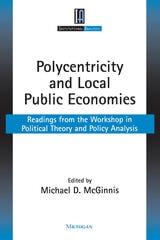
Polycentricity and Local Public Economies
Readings from the Workshop in Political Theory and Policy AnalysisMichael D. McGinnis, Editor
University of Michigan Press, 1999
The study of metropolitan political economies in the United States has provided much of the intellectual inspiration for the research of the Workshop in Political Theory and Policy Analysis at Indiana University. The readings collected in Polycentricity and Local Public Economies present an overview of the results of this research program on police services and metropolitan governance as well as enduring lessons for institutional analysis and public policy. Polycentricity and Local Public Economies presents both explorations of broad general concepts and specific empirical analyses. The many interactions between the two modes of analysis provide valuable insights for the reader. Readings in the first section cover basic theoretical concepts and analytical distinctions that apply to the study of institutions generally. The second section includes conceptual pieces specifically addressed to the nature of governance in metropolitan areas, while section three reports on a series of empirical studies of police performance. Section four again broadens the focus to highlight the overall organization of local public economies. The final section discusses conceptual advances that have continuing relevance for research and policy debates.Contributors include William Blomquist, Kathryn Firmin-Sellers, Roy Gardner, Dele Olowu, Elinor Ostrom, Vincent Ostrom, Amos Sawyer, Edella Schlager, Shui Yan Tang, Wai Fung Lam, and James S. Wunsch.
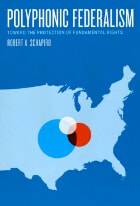
Polyphonic Federalism
Toward the Protection of Fundamental RightsRobert A. Schapiro
University of Chicago Press, 2009
The relationship between the states and the national government is among the most contested issues in the United States. And questions about where power should reside, how decisions should be made, and how responsibility should be allocated have been central to the American experiment in federalism. In Polyphonic Federalism, Robert A. Schapiro defends the advantages of multiple perspectives in government, arguing that the resulting “polyphony” creates a system that is more efficient, democratic, and protective of liberties.
This groundbreaking volume contends that contemporary views of federalism are plagued by outmoded dualist notions that seek to separate state and federal authority. Instead, Schapiro proposes a polyphonic model that emphasizes the valuable interaction of state and federal law, one that more accurately describes the intersecting realities of local and national power. Through an analysis of several legal and policy debates, Polyphonic Federalism demonstrates how a multifaceted government can best realize the potential of federalism to protect fundamental rights.

Poor Kids in a Rich Country
America's Children in Comparative PerspectiveLee Rainwater
Russell Sage Foundation, 2003
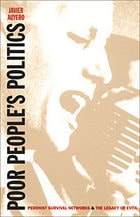
Poor People's Politics
Peronist Survival Networks and the Legacy of EvitaJavier Auyero
Duke University Press, 2000
Looking closely at the slum-dwellers’ informal problem-solving networks, which are necessary for material survival, and the different meanings of Peronism within these networks, Auyero presents the first ethnography of urban clientelism ever carried out in Argentina. Revealing a deep familiarity with the lives of the urban poor in Villa Paraíso, a stigmatized and destitute shantytown of Buenos Aires, Auyero demonstrates the ways in which local politicians present their vital favors to the poor and how the poor perceive and evaluate these favors. Having penetrated the networks, he describes how they are structured, what is traded, and the particular way in which women facilitate these transactions. Moreover, Auyero proposes that the act of granting favors or giving food in return for votes gives the politicians’ acts a performative and symbolic meaning that flavors the relation between problem-solver and problem-holder, while also creating quite different versions of contemporary Peronism. Along the way, Auyero is careful to situate the emergence and consolidation of clientelism in historic, cultural, and economic contexts.
Poor People’s Politics reexamines the relationship between politics and the destitute in Latin America, showing how deeply embedded politics are in the lives of those who do not mobilize in the usual sense of the word but who are far from passive. It will appeal to a wide range of students and scholars of Latin American studies, sociology, anthropology, political science, history, and cultural studies.
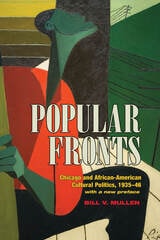
Popular Fronts
Chicago and African-American Cultural Politics, 1935-46Bill V. Mullen
University of Illinois Press, 2015
With a new preface Bill V. Mullen updates his dynamic reappraisal of a critical moment in American cultural history. Mullen's study includes reassessments of the politics of Richard Wright's critical reputation and a provocative reading of class struggle in Gwendolyn Brooks' A Street in Bronzeville. He also takes an in-depth look at the institutions that comprised Chicago's black popular front: the Chicago Defender, the period's leading black newspaper; Negro Story, the first magazine devoted to publishing short stories by and about African Americans; and the WPA-sponsored South Side Community Art Center.
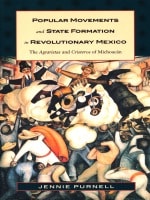
Popular Movements and State Formation in Revolutionary Mexico
The Agraristas and Cristeros of MichoacanJennie Purnell
Duke University Press, 1999
Rather than viewing the cristeros (supporters of the Church) as victims of false consciousness or as religious fanatics, as others have done, Purnell shows that their motivations—as well as the motivations of the agraristas (supporters of the revolutionary state)—stem from local political conflicts that began decades, and sometimes centuries, before the Revolution. Drawing on rich but underutilized correspondence between peasants and state officials written over the course of the nineteenth and twentieth centuries, Purnell shows how these conflicts shaped the relationships between property rights, religious practice, and political authority in the center-west region of Mexico and provides a nuanced understanding of the stakes and interests involved in subsequent conflicts over Mexican anticlericalism and agrarian reform in the 1920s.

Popular Politics and Rebellion in Mexico
Manuel Lozada and La Reforma, 1855-1876Zachary Brittsan
Vanderbilt University Press, 2015
Popular Politics and Rebellion in Mexico also explores the conditions under which a significant segment of Mexican society aligned itself with conservative interests and French interlopers, revealing this constituency to be more than a collection of reactionary traitors to the nation. To the contrary, armed rebellion--or at least the specter of force--protected local commercial interests in the short run and enhanced the long-term prospects for political autonomy. Manuel Lozada's story adds a necessary layer of complexity to our understanding of the practical and ideological priorities that informed the tumultuous conflicts of the mid-nineteenth century.
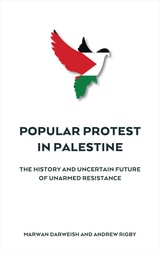
Popular Protest in Palestine
The History and Uncertain Future of Unarmed ResistanceMarwan Darweish and Andrew Rigby
Pluto Press, 2015

Popular Resistance in Palestine
A History of Hope and EmpowermentMazin B. Qumsiyeh
Pluto Press, 2011
The book contains hundreds of stories of the heroic and highly innovative methods of resistance employed by the Palestinians over more than 100 years. The author also analyses the successes, failures, missed opportunities and challenges facing ordinary Palestinians as they struggle for freedom against incredible odds. This is the only book to critically and comparatively study the uprisings of 1920-21, 1929, 1936-9, 1970s, 1987-1991 and 2000-2006.
The compelling human stories told in this book will inspire people of all faiths and political backgrounds to chart a better and more informed direction for a future of peace with justice.
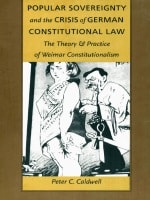
Popular Sovereignty and the Crisis of German Constitutional Law
The Theory and Practice of Weimar ConstitutionalismPeter C. Caldwell
Duke University Press, 1997
Caldwell makes accessible the rich literature in German constitutional thought of the Weimar period, most of which has been unavailable in English until now. On the liberal left, Hugo Preuss and Hans Kelsen defended a concept of democracy that made the constitution sovereign and, in a way, created the "Volk" through constitutional procedure. On the right, Carl Schmitt argued for a substantial notion of the "Volk" that could overrule constitutional procedure in a state of emergency. Rudolf Smend and Heinrich Triepel located in the constitution a set of inviolable values of the political community, while Hermann Heller saw in it a guarantee of substantial social equality. Drawing on the work of these major players from the 1920s, Caldwell reveals the various facets of the impassioned constitutional struggles that permeated German legal and political culture during the Weimar Republic.
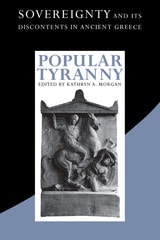
Popular Tyranny
Sovereignty and Its Discontents in Ancient GreeceEdited by Kathryn A. Morgan
University of Texas Press, 2003
The nature of authority and rulership was a central concern in ancient Greece, where the figure of the king or tyrant and the sovereignty associated with him remained a powerful focus of political and philosophical debate even as Classical Athens developed the world's first democracy. This collection of essays examines the extraordinary role that the concept of tyranny played in the cultural and political imagination of Archaic and Classical Greece through the interdisciplinary perspectives provided by internationally known archaeologists, literary critics, and historians.
The book ranges historically from the Bronze and early Iron Age to the political theorists and commentators of the middle of the fourth century B.C. and generically across tragedy, comedy, historiography, and philosophy. While offering individual and sometimes differing perspectives, the essays tackle several common themes: the construction of authority and of constitutional models, the importance of religion and ritual, the crucial role of wealth, and the autonomy of the individual. Moreover, the essays with an Athenian focus shed new light on the vexed question of whether it was possible for Athenians to think of themselves as tyrannical in any way. As a whole, the collection presents a nuanced survey of how competing ideologies and desires, operating through the complex associations of the image of tyranny, struggled for predominance in ancient cities and their citizens.

Population Dynamics and Supply Systems
A Transdisciplinary ApproachEdited by Diana Hummel
Campus Verlag, 2008
Population Trends in New Jersey
James W. Hughes
Rutgers University Press, 2022
The authors also highlight key trends that will continue to transform the state: domestic migration out of the state and immigration into it; increasing diversity; slower overall population growth; contracting fertility; the household revolution and changing living arrangements; generational disruptions; and suburbanization versus re-urbanization. All of these factors help place in context the result of the 2020 decennial U.S. Census.
While the book focuses on New Jersey, the Garden State is a template of demographic, economic, social, and other forces characterizing the United States in the twenty-first century.

Population, Agriculture, and Biodiversity
Problems and ProspectsJ. Perry Gustafson
University of Missouri Press, 2020
The world population is projected to be nine to ten billion by 2050, signaling the need to increase world food production by more than 70 percent on the same amount of land currently under production—and this without further damaging our fragile environment. The essays in this collection, written by experts for laypersons, present the problems we face with clarity and assess our prospects for solving them, calling for action but holding out viable solutions.

Populism in Latin America
Michael L. Conniff
University of Alabama Press, 1999
Populism in Latin America provides a lively, accessible, and up-to- date introduction to the fascinating populist leaders who dominated much of 20th-century Latin American politics.
From the earliest years in the La Plata region to the end of the 1990s, Latin American populists proved amazingly successful at gaining high office, holding onto power, maintaining their followings, and renewing their careers. They raised more campaign money, got more voters to the polls, and held followers' allegiances far better than traditional politicians. Certainly some populist leaders corrupted their countries, others manipulated their followers, and still others disgraced themselves. Nevertheless, populist leaders were extraordinarily effective in reaching masses of voters, and some left positive legacies for future generations. Populism in Latin America provides an in-depth and thought-provoking assessment of the most prominent of these colorful and charismatic leaders, whose impact has been profound yet not fully recognized.
Latin American scholars here survey the populist experiences in those nations most profoundly influenced by this distinctively Latin American way of conducting the public's business--Argentina, Brazil, Chile, Mexico, Peru, Venezuela, Ecuador, and Panama. Joel Horowitz, for example, examines Argentina's strong legacy of populism, beginning with the remarkable Hip-lito Yrigoyen, moving through the archetypal Juan and Evita Perón, and ending with still-active president Carlos Menem. Ximena Sosa-Buchholz provides a fascinating view of populism in Ecuador, a country often overlooked by students of modern politics. Kurt Weyland challenges the notion that neoliberal, or monetarist, economic policies are incompatible with populism. Other populist leaders profiled include Lazaro Cardenas, Romulo Betancourt, and Alberto Fujimori to name a few.
In his epilogue and bibliographic essay, volume editor Michael Conniff suggests new directions for further research and offers a comprehensive survey of the evolution of major writings, theories, and methodologies in the field.
Populism in Latin America
Second EditionMichael L. Conniff
University of Alabama Press, 2012
A scholarly analysis of the origins, evolution, and enduring impact of populism in Latin American political life.
This updated edition of Populism in Latin America discusses new developments in populism as a political phenomenon and the emergence of new populist political figures in Mexico, Argentina, and Venezuela in particular.
For more than one hundred years—from the beginning of the twentieth to the early twenty-first century—Latin American populists proved amazingly successful at gaining high office, holding on to power, maintaining their followings, and renewing their careers. They raised more campaign money, got more voters to the polls,and held followers’ allegiances far better than traditional politicians. Certainly some populist leaders were corrupt, others manipulated their followers, and still others disgraced themselves. Nevertheless, populist leaders were extraordinarily effective in reaching masses of voters, and some left positive legacies for future generations.
Populism in Latin America examines the notion of populism in the political and social culture of Latin American societies as expressed through the populist leaders of several Latin American countries including Argentina, Brazil, Mexico, Chile, Ecuador, Panama, Peru, and Venezuela. This second edition also includes a new preface by Kenneth M. Roberts, professor of comparative and Latin American politics and the Robert S. Harrison Director of the Institute for the Social Sciences at Cornell University.
Contributors
Jorge Basurto / Michael L. Conniff / Paul W. Drake / Steve Ellner / Joel Horowitz /
Kenneth M. Roberts / W. Frank Robinson /Ximena Sosa / Steve Stein / Kurt Weyland
Populism to Progressivism In Alabama
Sheldon Hackney
University of Alabama Press, 2010
WINNER OF THE ALBERT J. BEVERIDGE AWARD OF THE AMERICAN HISTORICAL ASSOCIATION
A classic study of race, reform, and political change in the New South.
Populism to Progressivism in Alabama by Sheldon Hackney is a landmark study of the political and social transformation of Alabama during the pivotal years between 1890 and 1910. Widely recognized as a classic work of Southern history, the book examines the rise of the Populist movement, the emergence of Progressive reform, and the forces that reshaped political power in the state at the turn of the twentieth century.
Hackney explores the complex relationships among race, class, economic change, agrarian protest, and democratic participation. He investigates how farmers, laborers, political leaders, and reformers responded to industrialization, shifting economic conditions, and the challenges of governance in the New South. Central to the narrative are debates over voting rights, disfranchisement, race relations, and the creation of new political institutions that would shape Alabama's future for generations.
Combining quantitative methods with traditional historical scholarship, Hackney provides a nuanced interpretation of both Populism and Progressivism, challenging simplistic accounts of reform and political change. Essential reading for understanding Alabama and the modern South, this influential volume remains a foundational resource for historians, political scientists, students, and anyone interested in the history of American democracy and regional transformation.
Populism, Education, and Teaching the Manners of Democracy
Robert V Bullough Jr.
Rutgers University Press, 2027
In an era of intense polarization, misinformation, and challenges to democratic norms, American citizens have become disenchanted with democracy and instead embraced populism and grievance. In Populism, Education, and Teaching the Manners of Democracy Robert V. Bullough Jr. offers readers a range of concepts useful for re-imagining the practice of democratic citizenship, both in the classroom as well as for themselves as citizens. Structured around five democratic manners that Bullough argues teachers, students, and citizens should cultivate, hospitality, attuned listening, voice, reflectivity, and evidential discernment, he argues that democracy is a peculiar and demanding way of life that shares with education the goal of human flourishing. By embracing these five manners, we can counter the current grievance culture and instead promote personal and social growth, reorienting education toward democratic living.
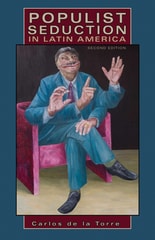
Populist Seduction in Latin America
Carlos de la Torre
Ohio University Press, 2010
Is Latin America experiencing a resurgence of leftwing governments, or are we seeing a rebirth of national-radical populism? Are the governments of Hugo Chávez, Evo Morales, and Rafael Correa becoming institutionalized as these leaders claim novel models of participatory and direct democracy? Or are they reenacting older traditions that have favored plebiscitary acclamation and clientelist distribution of resources to loyal followers? Are we seeing authentic forms of expression of the popular will by leaders who have empowered those previously disenfranchised? Or are these governments as charismatic, authoritarian, and messianic as their populist predecessors?
This new and expanded edition of Populist Seduction in Latin America explores the ambiguous relationships between democracy and populism and brings de la Torre’s earlier work up to date, comparing classical nationalist, populist regimes of the 1940s, such as those of Juan Perón and José María Velasco Ibarra, with their contemporary neoliberal and radical successors. De la Torre explores their similarities and differences, focusing on their discourses and uses of political symbols and myths.
Populist Seduction in Latin America
The Ecuadorian ExperienceCarlos De La Torre
Ohio University Press, 2000
earlier work up to date, comparing classical nationalist, populist regimes of the 1940s, such as those of Juan Perón and José María Velasco Ibarra, with their contemporary neoliberal and radical successors. De la Torre explores their similarities and differences, focusing on their discourses and uses of political symbols and myths.
Porkopolis
American Animality, Standardized Life, and the Factory FarmAlex Blanchette
Duke University Press, 2020

Portraits of Justice
The Wisconsin Supreme Court's First 150 YearsTrina E. Gray
Wisconsin Historical Society Press, 2003

Portugal and Africa
Ris Af#81David Birmingham
Ohio University Press, 2004
Positive Political Theory I
Collective PreferenceDavid Austen-Smith and Jeffrey S. Banks
University of Michigan Press, 2000
Positive Political Theory II
Strategy and StructureDavid Austen-Smith and Jeffrey S. Banks
University of Michigan Press, 2005
other book like it.”
—Norman Schofield, Washington University
“The authors succeed brilliantly in tackling a large
number of important questions concerning the
interaction among voters and elected representatives
in the political arena, using a common, rigorous
language.”
—Antonio Merlo, University of Pennsylvania
Positive Political Theory II: Strategy and Structure
is the second volume in Jeffrey Banks and David
Austen-Smith’s monumental study of the links
between individual preferences and collective choice.
The book focuses on representative systems, including
both elections and legislative decision-making
processes, clearly connecting individual preferences to
collective outcomes. This book is not a survey. Rather,
it is the coherent, cumulative result of the authors’
brilliant efforts to indirectly connect preferences to
collective choice through strategic behaviors such as
agenda-selection and voting.
The book will be an invaluable reference and teaching
tool for economists and political scientists, and an
essential companion to any scholar interested in the
latest theoretical advances in positive political theory.
Positive Theories of Congressional Institutions
Kenneth A. Shepsle and Barry R. Weingast, Editors
University of Michigan Press, 1995
Post-Anarchism
A ReaderEdited by Duane Rousselle and Sureyyya Evren
Pluto Press, 2011
Post-anarchism has been of considerable importance in the discussions of radical intellectuals across the globe in the last decade. In its most popular form, it demonstrates a desire to blend the most promising aspects of traditional anarchist theory with developments in post-structuralist and post-modernist thought. Post-Anarchism: A Reader includes the most comprehensive collection of essays about this emergent body of thought, making it an essential and accessible resource for academics, intellectuals, activists and anarchists interested in radical philosophy.
Many of the chapters have been formative to the development of a distinctly 'post-anarchist' approach to politics, aesthetics, and philosophy. Others respond to the so-called 'post-anarchist turn' with caution and scepticism. The book also includes original contributions from several of today's 'post-anarchists', inviting further debate and new ways of conceiving post-anarchism across a number of disciplines.
Post-Authoritarian Cultures
Spain and Latin America's Southern ConeLuis Martín-Estudillo
Vanderbilt University Press, 2008
Post-Communism
An IntroductionLeslie Holmes
Duke University Press, 1997

Post-Communism
An IntroductionLeslie Holmes
Duke University Press, 0
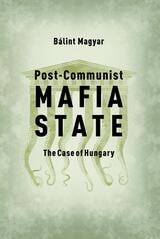
Post-Communist Mafia State
The Case of HungaryBálint Magyar
Central European University Press, 2016
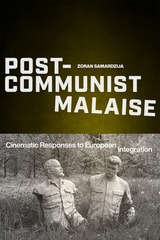
Post-Communist Malaise
Cinematic Responses to European IntegrationZoran Samardzija
Rutgers University Press, 2020
Post-Communist Restitution and the Rule of Law
Csongor Kuti
Central European University Press, 2009

Post-Ethical Society
The Iraq War, Abu Ghraib, and the Moral Failure of the SecularDouglas V. Porpora, Alexander G. Nikolaev, Julia Hagemann May, and Alexander Jenkins
University of Chicago Press, 2013
In this singular examination of the American discourse over war and torture, Douglas V. Porpora, Alexander Nikolaev, Julia Hagemann May, and Alexander Jenkins investigate the opinion pages of American newspapers, television commentary, and online discussion groups to offer the first empirical study of the national conversation about the 2003 invasion of Iraq and the revelations of prisoner abuse at Abu Ghraib a year later. Post-Ethical Society is not just another shot fired in the ongoing culture war between conservatives and liberals, but a pensive and ethically engaged reflection of America’s feelings about itself and our actions as a nation. And while many writers and commentators have opined about our moral place in the world, the vast amount of empirical data amassed in Post-Ethical Society sets it apart—and makes its findings that much more damning.
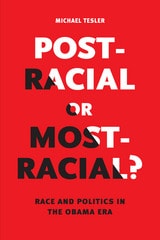
Post-Racial or Most-Racial?
Race and Politics in the Obama EraMichael Tesler
University of Chicago Press, 2016
Michael Tesler shows how, in the years that followed the 2008 election—a presidential election more polarized by racial attitudes than any other in modern times—racial considerations have come increasingly to influence many aspects of political decision making. These range from people’s evaluations of prominent politicians and the parties to issues seemingly unrelated to race like assessments of public policy or objective economic conditions. Some people even displayed more positive feelings toward Obama’s dog, Bo, when they were told he belonged to Ted Kennedy. More broadly, Tesler argues that the rapidly intensifying influence of race in American politics is driving the polarizing partisan divide and the vitriolic atmosphere that has come to characterize American politics.
One of the most important books on American racial politics in recent years, Post-Racial or Most-Racial? is required reading for anyone wishing to understand what has happened in the United States during Obama’s presidency and how it might shape the country long after he leaves office.
Post-Soviet Chaos
Violence and Dispossession in KazakhstanJoma Nazpary
Pluto Press, 2001
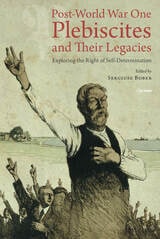
Post-World War One Plebiscites and Their Legacies
Exploring the Right of Self-DeterminationSergiusz Bober
Central European University Press, 2024
Plebiscites, or referendums, are epitomes of direct democracy and the right of self-determination. While direct democracy has always been a key subject in the theory and practice of western liberal democracies, the issue of self-determination has been propelled to the fore by the hegemonistic moves of Russia. By providing a historical analysis of the post-World War One plebiscites, this book deals with enduring, painfully contemporary, and in in any case fundamental, concepts.
The contributors to this edited volume approach the referendums comparatively. After grounding the analysis theoretically, the authors look at detailed aspects of individual cases, with the two plebiscites held in the Danish-German border region of Schleswig in the winter of 1920 as points of departure. They then extend the exploration through the inter-war period and address the effects of border delimitations on everyday life or gender roles in the context of ethnic mobilization. Finally, the book places the post-World War One plebiscites in a long-term perspective. The concluding essays assess, among others, the applicability of plebiscitary solutions to contemporary conflicts, taking into consideration issues of borders, religion, language, identity, and minority rights.
Post-capitalist Futures
Political Economy Beyond Crisis and HopeAdam Fishwick
Pluto Press, 2021
Postcolonial Air and Atmospheres
Elemental life and environmental crisisEdited by Sarah Nuttall and Isabel Hofmeyr
University College London, 2026
Postcolonial Developments
Agriculture in the Making of Modern IndiaAkhil Gupta
Duke University Press, 1998
Based on fieldwork done in the village of Alipur in rural north India from the early 1980s through the 1990s, Postcolonial Developments examines development itself as a post–World War II sociopolitical ideological formation, critiques related policies, and explores the various uses of the concept of the “indigenous” in several discursive contexts. Gupta begins with an analysis of the connections and conflicts between the world food economy, transnational capital, and technological innovations in wheat production. He then examines narratives of village politics in Alipur to show how certain discourses influenced governmental policies on the green revolution. Drawing links between village life, national trends, and global forces, Gupta concludes with a discussion of the implications of environmentalism as exemplified by the Rio Earth Summit and an examination of how global environmental treaties may detrimentally affect the lives of subaltern peoples.
With a series of subtle observations on rural politics, nationalism, gender, modernization, and difference, this innovative study capitalizes on many different disciplines: anthropology, sociology, comparative politics, cultural geography, ecology, political science, agricultural economics, and history.
Postcolonial Disaster
Narrating Catastrophe in the Twenty-First CenturyPallavi Rastogi
Northwestern University Press, 2020
Rastogi creates a narratology for postcolonial disaster fiction and brings concepts from Disaster Studies into the realm of literary analysis.
Postcolonial Hauntings
Play and Transnational FeminismSushmita Chatterjee
University of Illinois Press, 2024
Often examined separately, play and hauntings in fact act together to frame postcolonial issues. Sushmita Chatterjee showcases their braided workings in social and political fabrics. Drawing on this intertwined idea of play and hauntings, Chatterjee goes to the heart of conundrums within transnational postcolonial feminisms by examining the impossible echoes of translations, differing renditions of queer, and the possibilities of solidarity beyond the fraternal friendships that cement nation-states. Meaning-plays, or slippages through language systems as we move from one language to another, play a pivotal role in a global world. As Chatterjee shows, an attentiveness to meaning-plays discerns the past and present, here and there, and moves us toward responsive ethics in our theories and activisms.
Insightful and stimulating, Postcolonial Hauntings centers the inextricable work of play and hauntings as a braided ethics for postcolonial transnational struggles.
Postcolonial Imperialism
Critique of the Society of DazzlementsJoseph Tonda. Translated by Cheryl Smeall
Duke University Press, 2026
Postcolonial Insecurities
India, Sri Lanka, and the Question of NationhoodSankaran Krishna
University of Minnesota Press, 1999
An exploration of the connections between ethnicity and nation-building.
This ambitious work explores the vexed connections among nation-building, ethnic identity, and regional conflict by focusing on a specific event: Indian political and military intervention in the ethnic conflict between the Sinhalese and Tamils in Sri Lanka.
Drawing on interviews with leading players in the Indian–Sri Lankan debacle, Sankaran Krishna offers a persuasive analysis of this episode. The intervention serves as a springboard to a broader inquiry into the interworkings of nation building, ethnicity, and “foreign” policy. Krishna argues that the modernist effort to construct nation-states on the basis of singular notions of sovereignty and identity has reached a violent dead end in the postcolonial world of South Asia. Showing how the nationalist agenda that seeks to align territory with identity has unleashed a spiral of regional, statist, and insurgent violence, he makes an eloquent case for reimagining South Asia along postnational lines—as a “confederal” space.Postcolonial Insecurities counters the perception of “ethnicity” as an inferior and subversive principle compared with the progressive ideal of the “nation.” Krishna, in fact, shows ethnicity to be indispensable to the production and reproduction of the nation itself.