Results by title
702 books match the query 'America' and 3 start with q
Q & A Queer And Asian
Queer & Asian In AmericaAlvin Eng
Temple University Press, 1998
Q & A approaches matters of identity from a variety of points of view and academic disciplines in order to explore the multiple crossings of race and ethnicity with sexuality and gender. Drawing together the work of visual artists, fiction writers, community organizers, scholars, and participants in roundtable discussions, the collection gathers an array of voices and experiences that represent the emerging communities of a queer Asian America. Collectively, these contributors contend that Asian American studies needs to be more attentive to issues of sexuality and that queer studies needs to be more attentive to other aspects of difference, especially race and ethnicity. Vigorously rejecting the notion that a symmetrical relationship between race and homosexuality would weaken lesbian/gay and queer movements, the editors refuse to "believe that a desirably queer world is one in which we remain perpetual aliens -- queer houseguests -- in a queer nation."
Queequeg's Coffin
Indigenous Literacies and Early American LiteratureBirgit Brander Rasmussen
Duke University Press, 2012
By recovering the literatures and textual practices that were indigenous to the Americas, Birgit Brander Rasmussen reimagines the colonial conflict as one organized by alternative but equally rich forms of literacy. From central Mexico to the northeastern shores of North America, in the Andes and across the American continents, indigenous peoples and European newcomers engaged each other in dialogues about ways of writing and recording knowledge. In Queequeg's Coffin, such exchanges become the foundation for a new kind of early American literary studies.
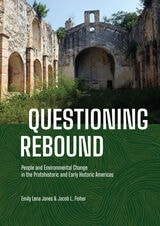
Questioning Rebound
People and Environmental Change in the Protohistoric and Early Historic AmericasEmily Lena Jones and Jacob L. Fisher
University of Utah Press, 2022
The extent of human impact on world environments is undeniable. At scales ranging from local to global, investigations continue to demonstrate that the ecosystems to which we currently belong are structured by human behavior. Catastrophic events such as war, disaster, disease, or economic decay have, at various times throughout history, led to the human abandonment of particular environments. What happens to a human-structured environment when the manner in which people use it abruptly changes? In Questioning Rebound, authors Emily Lena Jones and Jacob L. Fisher explore the archaeological record of the Americas during the period immediately following European contact, a time when the human footprint on the land abruptly shifted. During this era of disease-driven mortality, genocide, incarceration, and forced labor of Indigenous peoples, American landscapes changed in fundamental ways, producing short-lived ecosystems that later became the basis of myths regarding the natural state of environments across the Americas.
Questioning Rebound explores the record and the causes of environmental change during the period following European contact, featuring case studies throughout the Americas. While both the record for and the apparent causes of the changes in the human footprint vary, the record of post- contact environmental change consistently reflects the impacts of past social upheaval.