Results by title
3576 books match the query 'American' and 10 start with q
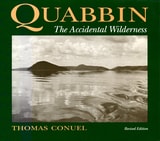
Quabbin
The Accidental WildernessThomas Conuel
University of Massachusetts Press, 1990
When one looks out on the quiet waters and forested hills of Quabbin Reservoir in west central Massachusetts, it is hard to imagine that the area was once dotted with buildings and farmlands or that it echoed with the activity of several villages and towns. Today, the daytime silence may be broken only by the cry of a hawk overhead or the slap of a plunging fish, and the evening calm, by the lonesome howl of a coyote. But in the nineteenth century, things were quite different.
In 1895, engineers for the Metropolitan Water Board began to search the state of Massachusetts for a site on which to construct a reservoir to supply water for the growing city of Boston. Sixty-five miles west of the city, in a region of high hills and running streams known as the Swift River Valley, they found what they were looking for. When Quabbin Reservoir was finally completed and filled in 1946, the engineers had created the third largest body of fresh water in New England and hand accomplished one of the larger public works projects of its time. They had also uprooted and displaced the valley's inhabitants, leveled and flooded four towns and six villages—and formed a magnificent wilderness on some 85,000 acres.
The valley that was once known for its picturesque villages and mill ponds is now, over forty years later, home to a wide array of wildlife. Coyote, bobcat, and deer flourish, and Quabbin's eagle restoration project, begun in 1982, produced the first nesting pair of bald eagles in Massachusetts in almost a century. Today, the bald eagle population at Quabbin is estimated at forty-one birds.
But this accidental wilderness is being increasingly threatened. As early as the 1950s, the sounds of power boats occasionally intruded on the peaceful silence of the waters. In more recent years, acid rain, ozone and other pollutants, the ravages of a herd of hungry deer, and demands for increased recreational use are all jeopardizing Quabbin's waters and forests.
This book tells the story of Quabbin, tracing Quabbin's history, describing its natural resources, and discussing the environmental challenges it currently faces. The original edition, issued by the Massachusetts Audubon Society in 1981, has now been expanded and updated.
Qualified Hope
A Postmodern Politics of TimeMitchum Huehls
The Ohio State University Press, 2009
Quarter Notes
Improvisations and InterviewsCharles Wright
University of Michigan Press, 1995
This satisfying collection includes reminiscences and meditations on the details of memory and what it means to visit the past; the vices of titleism and the hydrosyllabic foot in poetry; a comparison of poems and journeys; appreciation of poets Donald Justice and John Crow Ransom; an attempt to define "image"; discussions of the current state of poetry; and various highlights from the Charles Wright Literary Festival.
Charles Wright's books of poetry include The World of the Ten Thousand Things and Country Music: Selected Early Poems. He received the 1993 Ruth Lilly Poetry Prize and the 1992 Award of Merit Medal from the American Academy of Arts and Letters. He is Souder Family Professor of English, University of Virginia.

Queen in Blue
Ambalila Hemsell
University of Wisconsin Press, 2020
Queequeg's Coffin
Indigenous Literacies and Early American LiteratureBirgit Brander Rasmussen
Duke University Press, 2012
By recovering the literatures and textual practices that were indigenous to the Americas, Birgit Brander Rasmussen reimagines the colonial conflict as one organized by alternative but equally rich forms of literacy. From central Mexico to the northeastern shores of North America, in the Andes and across the American continents, indigenous peoples and European newcomers engaged each other in dialogues about ways of writing and recording knowledge. In Queequeg's Coffin, such exchanges become the foundation for a new kind of early American literary studies.
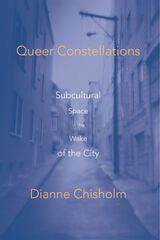
Queer Constellations
Subcultural Space In The Wake Of The CityDianne Chisholm
University of Minnesota Press, 2004
Discovers parallels between modern gay and lesbian views of urban life and Benjamin’s Paris, “the capital of the nineteenth century”
Queer Constellations investigates the dreams and catastrophes of recent urban history viewed through new queer narratives of inner-city life. The “gay village,” “gay mecca,” “gai Paris,” the “lesbian flaneur,” the “lesbian bohème”—these and other urban phantasmagoria feature paradoxically in this volume as figures of revolutionary utopia and commodity spectacle, as fossilized archetypes of social transformation and ruins of haunting cultural potential.
Dianne Chisholm introduces readers to new practices of walking, seeing, citing, and remembering the city in works by Neil Bartlett, Samuel R. Delany, Robert Glück, Alan Hollinghurst, Gary Indiana, Eileen Myles, Sarah Schulman, Gail Scott, Edmund White, and David Wojnarowicz. Reading these authors with reference to the history, sociology, geography, and philosophy of space, particularly to the everyday avant-garde production and practice of urban space, Chisholm reveals how—and how effectively—queer narrative documentary resembles and reassembles Walter Benjamin’s constellations of Paris, “capital of the nineteenth century.” Considering experimental queer writing in critical conjunction with Benjamin’s city writing, the book shows how a queer perspective on inner-city reality exposes contradictions otherwise obscured by mythic narratives of progress.If Benjamin regards the Paris arcade as a microcosm of high capitalism, wherein the (un)making of industrial society is perceived retrospectively, in contemporary queer narrative we see the sexually charged and commodity-entranced space of the gay bathhouse as a microcosm of late capitalism and as an exemplary site for excavating the contradictions of mass sex. In Chisholm’s book we discover how, looking back on the ruins of queer mecca, queer authors return to Benjamin to advance his “dialectics of seeing;” how they cruise the paradoxes of market capital, blasting a queer era out of the homogeneous course of history.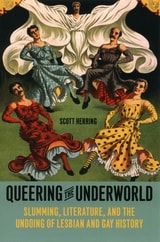
Queering the Underworld
Slumming, Literature, and the Undoing of Lesbian and Gay HistoryScott Herring
University of Chicago Press, 2007
In this major rethinking of American literature and culture, Scott Herring explores how a key group of authors manipulated this genre to paradoxically evade the confines of sexual identification. Queering the Underworld examines a range of writers, from Jane Addams and Willa Cather to Carl Van Vechten and Djuna Barnes, revealing how they fulfilled the conventions of slumming literature but undermined its goals, and in the process, queered the genre itself. Their work frustrated the reader’s desire for sexual knowledge, restored the inscrutability of sexual identity, and cast doubt on the value of a homosexual subculture made visible and therefore subject to official control.
Herring is persuasive and polemical in connecting these writers to ongoing debates about lesbian and gay history and politics, and Queering the Underworld will be widely read by students and scholars of literature, history, and sexuality.
Questions in the Vestibule
PoemsRachel Hadas
Northwestern University Press, 2016
Rachel Hadas reaches the peak of her poetic prowess in Questions in the Vestibule. A deeply personal and meditative collection in three sections, Questions moves through the liminal space of solitude and the coded landscape of dreams toward the startling power of a life-changing love.
Hadas’s voice and her formal elegance, as distinctive and distinguished as ever, endow this new work with a precise and thoughtful beauty. Questions in the Vestibule takes readers into a new territory of unapologetic bliss.
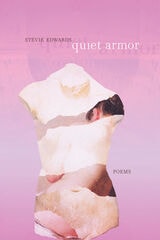
Quiet Armor
PoemsStevie Edwards
Northwestern University Press, 2023
Quiet Armor, the third full-length collection from poet Stevie Edwards, examines how capitalism and patriarchy impact romantic relationships and, more broadly, intimacy. Edwards considers the ways in which confessional performances of vulnerability can be coercive, whether popular culture encourages men to seek validation through sexual excess and aggression, and how we encourage women to be complicit in figurative and literal violence against other women.
Drawing on historical and mythological figures—including Medusa, Persephone, Shakespeare’s Lavinia, Saint Agatha, and Saint Christina—Edwards builds a fierce investigation into how rape culture has shaped the literary canon, academia, and the world at large. She brings readers into the quiet and intimate spaces we create despite trauma—or perhaps even because of it. Ultimately, Quiet Armor seeks to reclaim positive intimacy, showing us not only the desperate battles but also the healing embraces. All the while, these poems ask us: What does the end of rape culture look like? How do we get there?

Quite Mad
An American Pharma MemoirSarah Fawn Montgomery
The Ohio State University Press, 2018
Blending memoir with literary journalism, Montgomery’s Quite Mad: An American Pharma Memoir examines America’s history of mental illness treatment—lobotomies to sterilization, the rest cure to Prozac—to challenge contemporary narratives about mental health. Questioning what it means to be a woman with highly stigmatized disorders, Montgomery also asks why mental illness continues to escalate in the United States despite so many “cures.” Investigating the construction of mental illness as a “female” malady, Montgomery exposes the ways current attitudes towards women and their bodies influence madness as well as the ways madness has transformed to a chronic Illness in our cultural imagination. Montgomery’s Quite Mad is one woman’s story, but it offers a beacon of hope and truth for the millions of individuals living with mental illness and issues a warning about the danger of diagnosis and the complex definition of sanity.