Results by title
3071 books match the query 'Business & Economics' and 7 start with q

Quantifying Systemic Risk
Edited by Joseph G. Haubrich and Andrew W. Lo
University of Chicago Press, 2013
In the aftermath of the recent financial crisis, the federal government has pursued significant regulatory reforms, including proposals to measure and monitor systemic risk. However, there is much debate about how this might be accomplished quantitatively and objectively—or whether this is even possible. A key issue is determining the appropriate trade-offs between risk and reward from a policy and social welfare perspective given the potential negative impact of crises.
One of the first books to address the challenges of measuring statistical risk from a system-wide persepective, Quantifying Systemic Risk looks at the means of measuring systemic risk and explores alternative approaches. Among the topics discussed are the challenges of tying regulations to specific quantitative measures, the effects of learning and adaptation on the evolution of the market, and the distinction between the shocks that start a crisis and the mechanisms that enable it to grow.
[more]
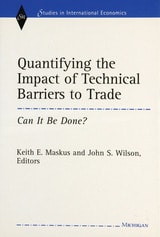
Quantifying the Impact of Technical Barriers to Trade
Can It Be Done?Keith E. Maskus and John S. Wilson, Editors
University of Michigan Press, 2001
This book provides an up-to-date discussion of economic issues involved in analyzing regulations of product quality and performance in international trade. Among the issues addressed in this collection are restrictions on genetically modified foods and pesticide use and compatibility standards for computers. While such regulations may serve important goals, they may also interfere with international trade flow by raising the costs of compliance. This is of special concern to developing countries, which have found it difficult to meet the increasingly exacting regulations imposed by the United States and Europe. Keith E. Maskus and John S. Wilson gather prominent international trade specialists to ask whether the impacts of such regulations may be quantified systematically in order to inform the international policy debate. The essays included here cover all fronts of the debate over regulatory issues and trade conflicts. The discussion ranges from a review of how trade conflicts emerge and how they are managed by the international trading system to a technical analysis of the potential impact of European restraints on trade in genetically modified products to an examination of methods for estimating the costs of compliance with environmental regulations. Considerable attention is paid to whether the emergence and enforcement of stronger standards among developed economies could result in diminished trade opportunities for developing countries. At the same time, the possibility that standards could expand market access through resolving consumer information problems is analyzed. This book will appeal to international economists, international relations specialists, and individuals concerned about appropriate regulation of safety and health issues in the global economy. Keith E. Maskus is Professor of Economics, University of Colorado, Boulder. John S. Wilson is Lead Economist, Development Economics Research Group, The World Bank.
[more]
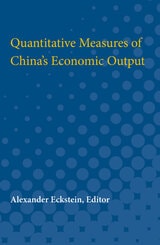
Quantitative Measures of China's Economic Output
Alexander Eckstein, Editor
University of Michigan Press, 1980
The papers in this volume were among those presented at a Conference on the Quantitative Measures of China's Economic Output, held in January, 1975, at the Brookings Institution in Washington, D.C. The conference was sponsored by the Subcommittee on Research on the Chinese Economy of the Joint Committee on Contemporary China of the Social Science Research Council and the American Council of Learned Societies. Alexander Eckstein, from the University of Michigan, had been asked by the subcommittee to organize a meeting to bring together academics and government professionals carrying out research on China's economy to discuss common problems encountered in their research. Given the limited quantity and poor quality of basic economic data for China since 1949, Eckstein decided to organize the conference on the theme of reconciling quantitative estimates of China's economic output. Participants included some twenty academics from the United States, the United Kingdom, and India and fifteen professionals from government or quasi-public research institutions. The success of the conference led to urgings by the subcommittee and many other scholars that Eckstein edit several of the papers for publication.The revisions by the individual authors of the four essays included in this volume and the supervision and coordination of their efforts by Eckstein were time-consuming tasks. The authors worked closely with him in these efforts, and his detailed critiques and suggestions were planned as a separate volume. His contribution to the final version of the essays in this volume is very significant, but Eckstein suffered a fatal heart attack in December, 1976, before the revised draft of the fourth essay was completed and before he had begun to write the introductory essay. He was widely recognized as the dean of American scholars of the economy of China, and his death was a tragic loss for all students of China.Following Eckstein's death, Robert F. Dernberger of the Universit
[more]
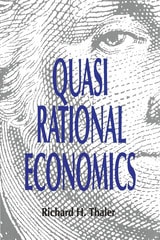
Quasi Rational Economics
Richard H. Thaler
Russell Sage Foundation, 1991
Standard economics theory is built on the assumption that human beings act rationally in their own self interest. But if rationality is such a reliable factor, why do economic models so often fail to predict market behavior accurately? According to Richard Thaler, the shortcomings of the standard approach arise from its failure to take into account systematic mental biases that color all human judgments and decisions.
[more]

Queer Economic Dissonance and Victorian Literature
Meg Dobbins
The Ohio State University Press, 2022
In nineteenth-century Britain, the word queer was associated not only with same-sex desire but also with irregular forms of financial association and trust. Queer Economic Dissonance and Victorian Literature centers this forgotten facet of queer by recovering an alternative economic narrative of the Victorian period: one of economic excess, waste, debt, and downward mobility. Drawing on insights from intersectional queer theory and economic literary criticism, as well as astute readings of works by Charles Dickens, Charlotte Brontë, Mary Seacole, George Eliot, and Oscar Wilde, Meg Dobbins argues that eccentric economic figures like Black entrepreneurs, childless widows, and working-class benefactors represent sites of queerness––forms of economic desire, identity, strategy, or relation that become sites of friction within the developing social and institutional norms of nineteenth-century capitalism. Dobbins argues that Victorian authors document the everyday economic struggles of those cast aside, left behind, and fundamentally transfigured by modern capitalism. Rather than rejecting capitalist ideology, these authors queer socioeconomic norms, shedding light on the provocative ways Victorians made capitalism livable, and even pleasurable. In this way, Queer Economic Dissonance rearticulates the link between erotic and economic forms of dissonance in capitalist society.
[more]
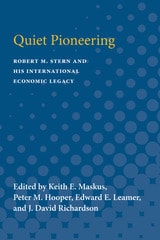
Quiet Pioneering
Robert M. Stern and His International Economic LegacyEdited by Keith E. Maskus, Peter M. Hooper, Edward E. Leamer and J. David Richardson
University of Michigan Press, 1998
New scholarly research in important aspects of international economics is brought together in this volume. The unifying theme is that each chapter is devoted to a fresh analysis of a problem in international economics that had earlier received cogent and prescient attention by Professor Robert Stern of the University of Michigan, one of the major figures in international economic research in the second half of the twentieth century. Each chapter examines a significant issue in international trade or finance, including determinants of comparative advantage, the effects of trade restrictions and the importance of trade liberalization, aspects of international trade institutions, and monetary policy in integrated markets. Three broad areas of international economic analysis are explored. The first part of the volume is devoted to new and sophisticated empirical analyses of important policy questions, such as technical change in trade models, how nontariff barriers are established, and how patent protection affects trade flows. The second part analyzes key areas involving international trade negotiations, including the usefulness of binding tariff commitments, regionalism versus bilateralism in trade liberalization, and strategic competition among international firms in setting negotiating agendas. The final part considers important questions in labor costs, asset pricing, and monetary union in international markets. Professional international economists will find much worth reading in the volume. It also is relevant to those who study international relations and international organizations; political scientists; and government policy analysts. Keith E. Maskus is Professor of Economics, University of Colorado, Boulder. Peter M. Hooper is Assistant Director, Division of International Finance, Board of Governors of the Federal Reserve System. Edward E. Leamer is Professor of Economics and Management, University of California, Los Angeles. J. David Richardson is Professor of Economics, Syracuse University.
[more]
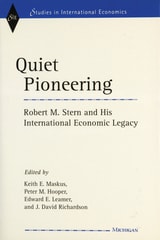
Quiet Pioneering
Robert M. Stern and His International Economic LegacyKeith E. Maskus, Peter M. Hooper, Edward E. Leamer, and J. David Richardson, Editors
University of Michigan Press, 1997
New scholarly research in important aspects of international economics is brought together in this volume. The unifying theme is that each chapter is devoted to a fresh analysis of a problem in international economics that had earlier received cogent and prescient attention by Professor Robert Stern of the University of Michigan, one of the major figures in international economic research in the second half of the twentieth century. Each chapter examines a significant issue in international trade or finance, including determinants of comparative advantage, the effects of trade restrictions and the importance of trade liberalization, aspects of international trade institutions, and monetary policy in integrated markets. Three broad areas of international economic analysis are explored. The first part of the volume is devoted to new and sophisticated empirical analyses of important policy questions, such as technical change in trade models, how nontariff barriers are established, and how patent protection affects trade flows. The second part analyzes key areas involving international trade negotiations, including the usefulness of binding tariff commitments, regionalism versus bilateralism in trade liberalization, and strategic competition among international firms in setting negotiating agendas. The final part considers important questions in labor costs, asset pricing, and monetary union in international markets. Professional international economists will find much worth reading in the volume. It also is relevant to those who study international relations and international organizations; political scientists; and government policy analysts. Keith E. Maskus is Professor of Economics, University of Colorado, Boulder. Peter M. Hooper is Assistant Director, Division of International Finance, Board of Governors of the Federal Reserve System. Edward E. Leamer is Professor of Economics and Management, University of California, Los Angeles. J. David Richardson is Professor of Economics, Syracuse University.
[more]