662 books match the query 'China' and 5 start with q
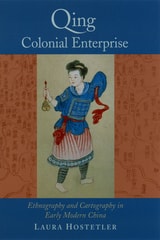
cover of Qing Colonial Enterprise: Ethnography and Cartography in Early Modern China

Qing Colonial Enterprise

Ethnography and Cartography in Early Modern China

Laura Hostetler

University of Chicago Press, 2001

In Qing Colonial Enterprise, Laura Hostetler shows how Qing China (1636-1911) used cartography and ethnography to pursue its imperial ambitions. She argues that far from being on the periphery of developments in the early modern period, Qing China both participated in and helped shape the new emphasis on empirical scientific knowledge that was simultaneously transforming Europe—and its colonial empires—at the time.

Although mapping in China is almost as old as Chinese civilization itself, the Qing insistence on accurate, to-scale maps of their territory was a new response to the difficulties of administering a vast and growing empire. Likewise, direct observation became increasingly important to Qing ethnographic writings, such as the illustrated manuscripts known as "Miao albums" (from which twenty color paintings are reproduced in this book). These were intended to educate Qing officials about various non-Han peoples so that they could govern these groups more effectively.Hostetler's groundbreaking account will interest anyone studying the history of the early modern period and colonialism.
[more]
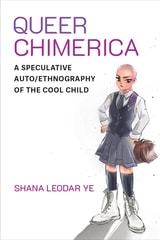
cover of Queer Chimerica: A Speculative Auto/Ethnography of the Cool Child

Queer Chimerica

A Speculative Auto/Ethnography of the Cool Child

Shana Ye

University of Michigan Press, 2024

Blending archival work, ethnography, and cultural analysis with memoir, graphic arts, and science fiction, Queer Chimerica unpacks the ways in which the transnational circulation of queer culture, politics, and institutions are structured through the antagonist interdependence of China and the United States. By examining the intersecting timelines of the rise of queer theory and the rise of China in the late Cold War era, Shana Ye explores the relationship between the discourse of queer fluidity and capital’s demands for labor flexibility. 

Drawing on rare archival material and oral historical accounts of queer life from the 1950s to the late 2010s, the author shows how these accounts make sense of the variegated landscapes of desires, transformations, and conundrums in postsocialist China. The author illustrates party cadres in the Cultural Revolution, tongzhi activism mediated by the explosive politics of Tiananmen upheaval, HIV/AIDS community outreach workers, feminist artists and digital activists, leftist queer theorists, and fictional bio-engineers, layering these vivid depictions to reveal the poetic messiness of queer world-making. Queer Chimerica offers insight into the governmentality of LGBT rights, the rules of legibility and recognition, the geo- and bio-politics of identity, and the class-ridden appropriation of queer history and community. Thus understanding the production of queerness unveils the uneven distributions of capital, knowledge, affect, and opportunity that reproduce queer precarity and agency.  
 

[more]
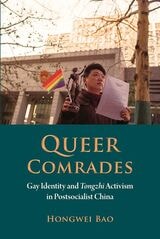
cover of Queer Comrades: Gay Identity and Tongzhi Activism in Postcolonial China

Queer Comrades

Gay Identity and Tongzhi Activism in Postcolonial China

Hongwei Bao

National University of Singapore Press, 2018
A quantum leap in scholarship on queer China, offering keen insights on the PRC’s socialist legacy. This very timely, well-written and insightful exploration of gay identity and queer activism in the People’s Republic of China today is more than a study of ‘queer China’ through the lens of male homosexuality; it also examines identity, power and governmentality in contemporary China, as shaped by China’s historical conditions and contemporary situations. The book offers in-depth analysis of recent queer history and contemporary cultural texts plus a queer Marxist analysis of sexual identity and social movements in contemporary China, where ideological negotiations between socialism and neoliberalism are constantly played out in the formation of public cultures and intimate spheres. In doing so, it critically assesses the role of Marxism and China’s socialist legacies in shaping sexual identity, queer popular culture and political activism. Although the first of its kind from a cultural studies perspective, this interdisciplinary study speaks to scholars working in disparate fields including anthropology, sociology, media studies, film studies, political theory, and Asian Studies.
[more]
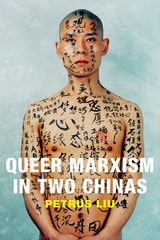
cover of Queer Marxism in Two Chinas

Queer Marxism in Two Chinas

Petrus Liu

Duke University Press, 2015
In Queer Marxism in Two Chinas Petrus Liu rethinks the relationship between Marxism and queer cultures in mainland China and Taiwan. Whereas many scholars assume the emergence of queer cultures in China signals the end of Marxism and demonstrates China's political and economic evolution, Liu finds the opposite to be true. He challenges the persistence of Cold War formulations of Marxism that position it as intellectually incompatible with queer theory, and shows how queer Marxism offers a nonliberal alternative to Western models of queer emancipation. The work of queer Chinese artists and intellectuals not only provides an alternative to liberal ideologies of inclusion and diversity, but demonstrates how different conceptions of and attitudes toward queerness in China and Taiwan stem from geopolitical tensions. With Queer Marxism in Two Chinas Liu offers a revision to current understandings of what queer theory is, does, and can be.
 
[more]
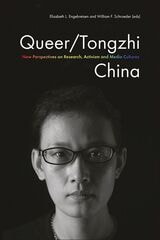
cover of Queer/Tongzhi China: New Perspectives on Research, Activism and Media Cultures

Queer/Tongzhi China

New Perspectives on Research, Activism and Media Cultures

Edited by Elisabeth L. Engebretsen and William F. Schroeder

National University of Singapore Press, 2015

This book brings together some of the most exciting, original and cutting-edge work being conducted on contemporary queer China. The volume includes original essays by some of the most prolific and central queer activists and artists in the PRC, placing their writing alongside work by emergent and established scholars from a variety of disciplines and backgrounds. The book offers unique perspectives by presenting primary accounts of the creative and multi-faceted strategies that activists and community organizers have developed in their various activities. The volume also presents rich, empirical evidence of every-day queer lives across China, offering a unique record not only of cosmopolitan community and activist perspectives but also of voices and experiences from a broad range of locations and identifications. As a whole it offers invaluable insights into sexual and gender diversity in China today. Queer/Tongzhi China thus breathes as it speaks, providing through its diverse approaches a different understanding of queer China than standard mono-ethnographies or social-scientific documentaries.
[more]