Results by title
1882 books match the query 'Criticism and interpretation' and 12 start with q

Quantum Criminals
Ramblers, Wild Gamblers, and Other Sole Survivors from the Songs of Steely DanBy Alex Pappademas and Joan LeMay
University of Texas Press, 2023
“ONE OF THE SHARPEST, FUNNIEST, AND BEST BOOKS EVER ABOUT ANY ROCK ARTIST”—Rolling Stone
“WEIRD AND WONDROUS”—New York Times
“I ADORED IT”—Michael Chabon
A literary and visual exploration of the songs of Steely Dan.
Steely Dan’s songs are exercises in fictional world-building. No one else in the classic-rock canon has conjured a more vivid cast of rogues and heroes, creeps and schmucks, lovers and dreamers and cold-blooded operators—or imbued their characters with so much humanity.
Pulling from history, lived experience, pulp fiction, the lore of the counterculture, and their own darkly comic imaginations, Donald Fagen and Walter Becker summoned protagonists who seemed like fully formed people with complicated pasts, scars they don’t talk about, delusions and desires and memories they can’t shake. From Rikki to Dr. Wu, Hoops McCann to Kid Charlemagne, Franny from NYU to the Woolly Man without a Face, every name is a locked-room mystery, beguiling listeners and earning the band an exceptionally passionate and ever-growing cult fandom.
Quantum Criminals presents the world of Steely Dan as it has never been seen, much less heard. Artist Joan LeMay has crafted lively, color-saturated images of her favorite characters from the Daniverse to accompany writer Alex Pappademas’s explorations of the famous and obscure songs that inspired each painting, in short essays full of cultural context, wild speculation, inspired dot-connecting, and the occasional conspiracy theory. All of it is refracted through the perspectives of the characters themselves, making for a musical companion unlike any other. Funny, discerning, and visually stunning, Quantum Criminals is a singular celebration of Steely Dan’s musical cosmos.
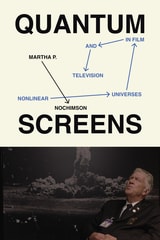
Quantum Screens
Nonlinear Universes in Film and TelevisionMartha P. Nochimson
University of Texas Press, 2026
An exploration of how nonlinear storytelling opens a post-Newtonian reality and changes both the hero’s journey and how we understand history in film and television.
Begin at the beginning and keep going until the end. That’s the cardinal rule of conventional storytelling. But ever since the modernists of the early twentieth century, popular narratives have occasionally eschewed this linear approach to temporality. It’s as though our stories, formerly unfolding in the stable, predictable universe of Newtonian physics, can now take place in multidimensional time where anything and anyone can be as incalculable as Schrödinger’s cat.
Quantum Screens is a journey through the past and present of nonlinear time in film and television. Moving beyond the early experiments of Luis Buñuel and the first nonlinear commercial films, such as 2001: A Space Odyssey, Martha Nochimson shows how risk-taking auteurs David Lynch, Damon Lindelof, and Terrence Malik have opened new horizons and a new concept of beauty in storytelling through their revelatory creations. Quantum Screens takes us deep into the audience’s experience of nonlinearity, exploring the emotional dislocations such storytelling creates, using television programs such as Twin Peaks, Westworld, and Watchmen, and films including The Tree of Life, BlacKkKlansman, and Arrival. Indeed, viewers are at the heart of a changing aesthetics of nonlinearity, Nochimson argues. Amid innovations like on-demand viewing, unlimited replay, and binge-watching, the experience of real time is more malleable than ever, and creators are responding by structuring their stories in compelling new ways.
Quare Joyce
Joseph Valente, Editor
University of Michigan Press, 2000
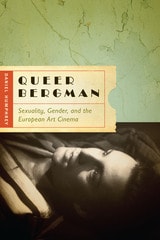
Queer Bergman
Sexuality, Gender, and the European Art CinemaBy Daniel Humphrey
University of Texas Press, 2013
One of the twentieth century’s most important filmmakers—indeed one of its most important and influential artists—Ingmar Bergman and his films have been examined from almost every possible perspective, including their remarkable portrayals of women and their searing dramatizations of gender dynamics. Curiously however, especially considering the Swedish filmmaker’s numerous and intriguing comments on the subject, no study has focused on the undeniably queer characteristics present throughout this nominally straight auteur’s body of work; indeed, they have barely been noted.
Queer Bergman makes a bold and convincing argument that Ingmar Bergman’s work can best be thought of as profoundly queer in nature. Using persuasive historical evidence, including Bergman’s own on-the-record (though stubbornly ignored) remarks alluding to his own homosexual identifications, as well as the discourse of queer theory, Daniel Humphrey brings into focus the director’s radical denunciation of heteronormative values, his savage and darkly humorous deconstructions of gender roles, and his work’s trenchant, if also deeply conflicted, attacks on homophobically constructed forms of patriarchic authority. Adding an important chapter to the current discourse on GLBT/queer historiography, Humphrey also explores the unaddressed historical connections between post–World War II American queer culture and a concurrently vibrant European art cinema, proving that particular interrelationship to be as profound as the better documented associations between gay men and Hollywood musicals, queer spectators and the horror film, lesbians and gothic fiction, and others.
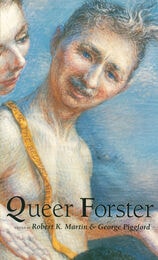
Queer Forster
Edited by Robert K. Martin and George Piggford
University of Chicago Press, 1997
Many previous critics of Forster downplayed his homosexuality or read Forster naively in terms of gay liberation. This collection situates Forster within the Bloomsbury Group and examines his relations to major figures such as Henry James, Edward Carpenter, and Virginia Woolf. Particular attention is paid to Forster's several accounts of India and their troubled relation to the British colonial enterprise. Analyzing a wide range of Forster's work, the authors examine material from Forster's undergraduate writings to stories written more than a half-century later.
A landmark book for the study of gender in literature, Queer Forster brings the terms "queer" and "gay" into conversation, opening up a dialogue on wider dimensions of theory and allowing a major revaluation of modernist inventions of sexual identity.
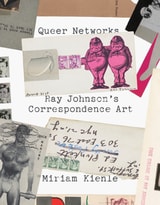
Queer Networks
Ray Johnson's Correspondence ArtMiriam Kienle
University of Minnesota Press, 2023
How the queer correspondence art of Ray Johnson disrupted art world conventions and anticipated today’s highly networked culture
Once regarded as “New York’s most famous unknown artist,” Ray Johnson was a highly visible outlier in the art world, his mail art practice reflecting the changing social relations and politics of queer communities in the 1960s. A vital contribution to the growing scholarship on this enigmatic artist, Queer Networks analyzes how Johnson’s practice sought to undermine the dominant mechanisms of the art market and gallery system in favor of unconventional social connections.
Utilizing the postal service as his primary means of producing and circulating art, Johnson cultivated an international community of friends and collaborators through which he advanced his idiosyncratic body of work. Applying both queer theory and network studies, Miriam Kienle explores how Johnson’s radical correspondence art established new modes of connectivity that fostered queer sensibilities and ran counter to the conventional methods by which artists were expected to develop their reputation.
While Johnson was significantly involved with the Pop, conceptual, and neo-Dada art movements, Queer Networks crucially underscores his resistance to traditional art historical systems of categorization and their emphasis on individual mastery. Highlighting his alternative modes of community building and playful antagonism toward art world protocols, Kienle demonstrates how Ray Johnson’s correspondence art offers new ways of envisioning togetherness in today’s highly commodified and deeply networked world.
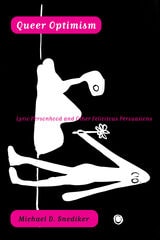
Queer Optimism
Lyric Personhood and Other Felicitous PersuasionsMichael D. Snediker
University of Minnesota Press, 2008
A new paradigm for queer theory
Michael Snediker offers a much-needed counterpoint to queer theoretical discourse, which has long privileged melancholy, self-shattering, incoherence, shame, and the death drive. Recovering the forms of positive affect that queer theory has jettisoned, Snediker insists that optimism must itself be taken beyond conventional tropes of hope and futurity and reimagined as necessary for critical engagement.
Through fresh, perceptive, and sensitive readings of the poetry of Emily Dickinson, Hart Crane, Jack Spicer, and Elizabeth Bishop, Snediker reveals that each of these poets demonstrated an interest in the durability of positive affects. Dickinson, Snediker argues, expresses joy and grace as much as pain and loss, and the myriad cryptic smiles in Hart Crane’s White Building contradict prevailing narratives of Crane’s apocryphal literary failures and eventual suicide. Snediker’s ambitious and sophisticated study, informed by thinkers such as Winnicott, Deleuze, and de Man, both supplements and challenges the work of queer theory’s leading figures, including Judith Butler, Leo Bersani, Eve Kosofsky Sedgwick, and Lee Edelman. Queer Optimism revises our understanding of queer love and affiliation, examining Spicer’s serial collusion with matinee idol Billy the Kid as well as the critically neglected force of Bishop’s epistolary and poetic reparations of the drowned figure of Hart Crane. In doing so, Snediker persuasively reconceives a theoretical field of optimism that was previously unavailable to scrupulous critical inquiry and provides a groundbreaking approach to modern American poetry and poetics.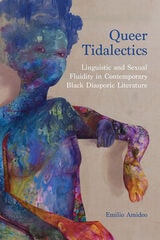
Queer Tidalectics
Linguistic and Sexual Fluidity in Contemporary Black Diasporic LiteratureEmilio Amideo
Northwestern University Press, 2021
Amideo engages and extends the work of Black queer studies, Oceanic studies, ecocriticism, phenomenology, and new materialism through the theorizations of Sara Ahmed, Omise’eke Natasha Tinsley, M. Jacqui Alexander, Édouard Glissant, José Esteban Muñoz, and Edward Kamau Brathwaite, among others. Ambitious in scope and captivating to read, Queer Tidalectics brings Caribbean writers like Glissant and Brathwaite into queer literary analysis—a major scholarly contribution.

Queering Cold War Poetry
Ethics of Vulnerability in Cuba and the United StatesEric Keenaghan
The Ohio State University Press, 2009
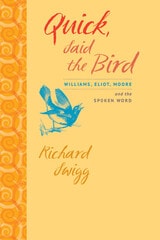
Quick, Said the Bird
Williams, Eliot, Moore, and the Spoken WordRichard Swigg
University of Iowa Press, 2012
Quince Duncan
Writing Afro-Costa Rican and Caribbean IdentityDorothy E. Mosby
University of Alabama Press, 2013
Quoting Caravaggio
Contemporary Art, Preposterous HistoryMieke Bal
University of Chicago Press, 1999
Mieke Bal’s primary object of investigation in Quoting Caravaggio is not the great seventeenth-century painter, but rather the issue of temporality in art. In order to retheorize linear notions of influence in cultural production, Bal analyzes the productive relationship between Caravaggio and a number of late-twentieth-century artists who "quote" the baroque master in their own works. These artists include Andres Serrano, Carrie Mae Weems, Ken Aptekar, David Reed, and Ana Mendieta, among others. Each chapter of Quoting Caravaggio shows particular ways in which quotation is vital to the new art but also to the source from which it is derived. Through such dialogue between present and past, Bal argues for a notion of "preposterous history" where works that appear chronologically first operate as an aftereffect caused by the images of subsequent artists.
Quoting Caravaggio is a rigorous, rewarding work: it is at once a meditation on history as creative, nonlinear process; a study of the work of Caravaggio and the Baroque; and, not least, a brilliant critical exposition of contemporary artistic representation and practice.
"[A] profoundly enlivening exercise in art criticism, in which the lens of theory magnifies rather than diminishes its object. . . . [A] remarkable book. . . . The power of Quoting Caravaggio resides in the intelligence and authority of the writer."—Roger Malbert, Times Literary Supplement