Results by title
808 books match the query 'Drama' and 2 start with q
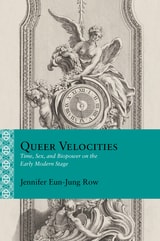
Queer Velocities
Time, Sex, and Biopower on the Early Modern StageJennifer Eun-Jung Row
Northwestern University Press, 2022
Queer Velocities: Time, Sex, and Biopower on the Early Modern Stage explores how seventeenth-century French theater represents queer desire. In this book, the first queer theoretical treatment of canonical French theater, Jennifer Eun-Jung Row proposes that these velocities, moments of unseemly haste or strategic delay, sparked new kinds of attachments, intimacies, and erotics. Rather than rely on fixed identities or analog categories, we might turn to these affectively saturated moments of temporal sensation to analyze queerness in the premodern world.
The twin innovations of precise, portable timepieces and the development of the theater as a state institution together ignited new types of embodiments, orderly and disorderly pleasures, and normative and wayward rhythms of life. Row leverages a painstakingly formalist and rhetorical analysis of tragedies by Jean Racine and Pierre Corneille to show how the staging of delay or haste can critically interrupt the normative temporalities of marriage, motherhood, mourning, or sovereignty—the quotidian rhythms and paradigms so necessary for the biopolitical management of life. Row’s approach builds on the queer turn to temporality and Elizabeth Freeman’s notion of the chronobiopolitical to wager that queerness can also be fostered by the sensations of disruptive speed and slowness. Ultimately, Row suggests that the theater not only contributed to the glitter of Louis XIV’s absolutist spectacle but also ignited new forms of knowing and feeling time, as well as new modes of loving, living, and being together.
The twin innovations of precise, portable timepieces and the development of the theater as a state institution together ignited new types of embodiments, orderly and disorderly pleasures, and normative and wayward rhythms of life. Row leverages a painstakingly formalist and rhetorical analysis of tragedies by Jean Racine and Pierre Corneille to show how the staging of delay or haste can critically interrupt the normative temporalities of marriage, motherhood, mourning, or sovereignty—the quotidian rhythms and paradigms so necessary for the biopolitical management of life. Row’s approach builds on the queer turn to temporality and Elizabeth Freeman’s notion of the chronobiopolitical to wager that queerness can also be fostered by the sensations of disruptive speed and slowness. Ultimately, Row suggests that the theater not only contributed to the glitter of Louis XIV’s absolutist spectacle but also ignited new forms of knowing and feeling time, as well as new modes of loving, living, and being together.
[more]
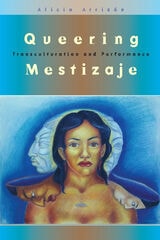
Queering Mestizaje
Transculturation and PerformanceAlicia Arrizón
University of Michigan Press, 2006
Queering Mestizaje employs theories of postcolonial cultural studies (including performance studies, queer and feminist theory) to examine the notion of mestizaje---the mixing of races, and specifically indigenous peoples, with European colonizers---and how this phenomenon manifests itself in three geographically diverse spaces: the United States, Latin America, and the Philippines. Alicia Arrizón argues that, as an imaginary site for racialized, gendered, and sexualized identities, mestizaje raises questions about historical transformation and cultural memory across Spanish postcolonial sites. Arrizón offers new, queer readings of the hybrid, the intercultural body, and the hyphenated self, building on the work of Gloria Anzaldúa, Antonio Benitez-Rojo, Walter Mignolo, and Vera Kutzinski, while challenging accepted discourses about the relationship between colonizer and colonized. Queering Mestizaje is unique in the connections it makes between the Spanish colonial legacy in the Philippines and in the Americas. An engagingly eclectic array of cultural materials---including examples from performance art, colonial literature, visual art, fashion, and consumer products---are discussed, and included in the book's twenty-nine illustrations. "Arrizón takes as her point of departure the connections and distinctions between the four keywords in the title (each with a long, specific, and convoluted history in its own right) while bringing together the Philippines, the Hispanophone Caribbean, and the United States to configure a map carved by the same blade of colonialism and imperialism. In its conjoining of queer, mestizaje, transculturation and performance, the pleasurable and enlightening variety of its textual examples, and its commitment to theorize desire from the space of queer mestizaje, her book makes a unique and accomplished contribution." ---Yvonne Yarbro-Bejarano, Stanford University Alicia Arrizón is Professor of Women's Studies at the University of California, Riverside. She is author of Latina Performance: Traversing the Stage and co-editor of Latinas on Stage: Practice and Theory. Illustration: Judith F. Baca, La Mestizaje (1991), pastel on paper. © SPARC.
[more]