Results by title
917 books match the query 'Economics' and 4 start with q
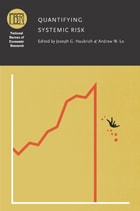
Quantifying Systemic Risk
Edited by Joseph G. Haubrich and Andrew W. Lo
University of Chicago Press, 2013
In the aftermath of the recent financial crisis, the federal government has pursued significant regulatory reforms, including proposals to measure and monitor systemic risk. However, there is much debate about how this might be accomplished quantitatively and objectively—or whether this is even possible. A key issue is determining the appropriate trade-offs between risk and reward from a policy and social welfare perspective given the potential negative impact of crises.
One of the first books to address the challenges of measuring statistical risk from a system-wide persepective, Quantifying Systemic Risk looks at the means of measuring systemic risk and explores alternative approaches. Among the topics discussed are the challenges of tying regulations to specific quantitative measures, the effects of learning and adaptation on the evolution of the market, and the distinction between the shocks that start a crisis and the mechanisms that enable it to grow.
[more]
Quasi Rational Economics
Richard H. Thaler
Russell Sage Foundation, 1991
Standard economics theory is built on the assumption that human beings act rationally in their own self interest. But if rationality is such a reliable factor, why do economic models so often fail to predict market behavior accurately? According to Richard Thaler, the shortcomings of the standard approach arise from its failure to take into account systematic mental biases that color all human judgments and decisions.
[more]
Quiet Pioneering
Robert M. Stern and His International Economic LegacyEdited by Keith E. Maskus, Peter M. Hooper, Edward E. Leamer and J. David Richardson
University of Michigan Press, 1998
New scholarly research in important aspects of international economics is brought together in this volume. The unifying theme is that each chapter is devoted to a fresh analysis of a problem in international economics that had earlier received cogent and prescient attention by Professor Robert Stern of the University of Michigan, one of the major figures in international economic research in the second half of the twentieth century. Each chapter examines a significant issue in international trade or finance, including determinants of comparative advantage, the effects of trade restrictions and the importance of trade liberalization, aspects of international trade institutions, and monetary policy in integrated markets. Three broad areas of international economic analysis are explored. The first part of the volume is devoted to new and sophisticated empirical analyses of important policy questions, such as technical change in trade models, how nontariff barriers are established, and how patent protection affects trade flows. The second part analyzes key areas involving international trade negotiations, including the usefulness of binding tariff commitments, regionalism versus bilateralism in trade liberalization, and strategic competition among international firms in setting negotiating agendas. The final part considers important questions in labor costs, asset pricing, and monetary union in international markets. Professional international economists will find much worth reading in the volume. It also is relevant to those who study international relations and international organizations; political scientists; and government policy analysts. Keith E. Maskus is Professor of Economics, University of Colorado, Boulder. Peter M. Hooper is Assistant Director, Division of International Finance, Board of Governors of the Federal Reserve System. Edward E. Leamer is Professor of Economics and Management, University of California, Los Angeles. J. David Richardson is Professor of Economics, Syracuse University.
[more]
Quiet Pioneering
Robert M. Stern and His International Economic LegacyKeith E. Maskus, Peter M. Hooper, Edward E. Leamer, and J. David Richardson, Editors
University of Michigan Press, 1997
New scholarly research in important aspects of international economics is brought together in this volume. The unifying theme is that each chapter is devoted to a fresh analysis of a problem in international economics that had earlier received cogent and prescient attention by Professor Robert Stern of the University of Michigan, one of the major figures in international economic research in the second half of the twentieth century. Each chapter examines a significant issue in international trade or finance, including determinants of comparative advantage, the effects of trade restrictions and the importance of trade liberalization, aspects of international trade institutions, and monetary policy in integrated markets. Three broad areas of international economic analysis are explored. The first part of the volume is devoted to new and sophisticated empirical analyses of important policy questions, such as technical change in trade models, how nontariff barriers are established, and how patent protection affects trade flows. The second part analyzes key areas involving international trade negotiations, including the usefulness of binding tariff commitments, regionalism versus bilateralism in trade liberalization, and strategic competition among international firms in setting negotiating agendas. The final part considers important questions in labor costs, asset pricing, and monetary union in international markets. Professional international economists will find much worth reading in the volume. It also is relevant to those who study international relations and international organizations; political scientists; and government policy analysts. Keith E. Maskus is Professor of Economics, University of Colorado, Boulder. Peter M. Hooper is Assistant Director, Division of International Finance, Board of Governors of the Federal Reserve System. Edward E. Leamer is Professor of Economics and Management, University of California, Los Angeles. J. David Richardson is Professor of Economics, Syracuse University.
[more]