Results by title
1049 books match the query 'English, Irish, Scottish, Welsh' and 5 start with q
Quare Joyce
Joseph Valente, Editor
University of Michigan Press, 2000
Much of the most influential work on Joyce over the last decade has been devoted to the study of gender representation, performance, privilege, and anxiety. Among other results, this work has made the heterosexual imperative visible as an arbitrary ideological limit. Now, in Quare Joyce, some of the most prominent scholars of Joyce address themselves directly to questions of homoerotic desire in Joyce's work, drawing on and furthering queer theory in a dazzling set of essays. Beyond simply locating another layer of cultural import in Joyce's endlessly rich oeuvre, this project reconstructs a whole other creative and critical history for his writing. The twelve essays, organized in pairs under the headings "Intersexualities," "Rethinking the Closet," "Homophobia and Misogyny," "Homocolonial Relations," "Joyce's Lesbian Other," and "Recent Controversies," explore the range of Joyce's work, from "An Encounter" through Finnegans Wake, and take on three related tasks: to redress the compulsory heterosexuality that has traditionally hampered even the most sophisticated and progressive scholarship on Joyce; to import a queer theory perspective; and to take up the manifold question of homosexuality as it pertains to the always slippery articulation of Joyce's life and work. Quare Joyce will directly interest not only Joyceans, modernists, and students of Irish literature, but also scholars in the fields of postcolonial and queer theory, gay and cultural studies.
[more]
Queer Economic Dissonance and Victorian Literature
Meg Dobbins
The Ohio State University Press, 2022
In nineteenth-century Britain, the word queer was associated not only with same-sex desire but also with irregular forms of financial association and trust. Queer Economic Dissonance and Victorian Literature centers this forgotten facet of queer by recovering an alternative economic narrative of the Victorian period: one of economic excess, waste, debt, and downward mobility. Drawing on insights from intersectional queer theory and economic literary criticism, as well as astute readings of works by Charles Dickens, Charlotte Brontë, Mary Seacole, George Eliot, and Oscar Wilde, Meg Dobbins argues that eccentric economic figures like Black entrepreneurs, childless widows, and working-class benefactors represent sites of queerness––forms of economic desire, identity, strategy, or relation that become sites of friction within the developing social and institutional norms of nineteenth-century capitalism. Dobbins argues that Victorian authors document the everyday economic struggles of those cast aside, left behind, and fundamentally transfigured by modern capitalism. Rather than rejecting capitalist ideology, these authors queer socioeconomic norms, shedding light on the provocative ways Victorians made capitalism livable, and even pleasurable. In this way, Queer Economic Dissonance rearticulates the link between erotic and economic forms of dissonance in capitalist society.
[more]
Queer Forster
Edited by Robert K. Martin and George Piggford
University of Chicago Press, 1997
This groundbreaking volume presents a radical revision of gay criticism and focuses on E. M. Forster's place in the emerging field of queer studies.
Many previous critics of Forster downplayed his homosexuality or read Forster naively in terms of gay liberation. This collection situates Forster within the Bloomsbury Group and examines his relations to major figures such as Henry James, Edward Carpenter, and Virginia Woolf. Particular attention is paid to Forster's several accounts of India and their troubled relation to the British colonial enterprise. Analyzing a wide range of Forster's work, the authors examine material from Forster's undergraduate writings to stories written more than a half-century later.
A landmark book for the study of gender in literature, Queer Forster brings the terms "queer" and "gay" into conversation, opening up a dialogue on wider dimensions of theory and allowing a major revaluation of modernist inventions of sexual identity.
[more]
Quest for Kim
In Search of Kipling's Great GamePeter Hopkirk
University of Michigan Press, 1999
This book is for all those who love Kim, the masterpiece of Indian life in which Kipling immortalized the Great Game, the centuries-old power struggle between Russia and Great Britain in the depths of Central Asia. Fascinated since childhood by this strange tale of an orphan boy's recruitment into the Indian secret service, Peter Hopkirk here explores the many mysteries surrounding Kipling's great novel.
"This is a fascinating, brilliantly written book, as interesting in its description of the author's journeys as it is in its investigation of the reality that lies behind 'the finest novel in the English language with an Indian theme,'" as Kim has been described by Nirad Chaudhuri." --T. J. Binyon, Times Literary Supplement
"In an original combination of autobiography, travel writing, and literary detective work, Hopkirk manages accessibly to tell the story of Kim and his own obsession with it. Hopkirk illustrates how creatively and thoroughly the reading of a work of fiction can shape a whole life's experience." -- John R. Bradley, Independent on Sunday
". . . a reminder of just how absorbing was the world Kipling knew, and how fabulous was his transformation of it into literature." --Richard Bernstein, New York Times
Peter Hopkirk has traveled widely over many years in the regions where his books are set--Central Asia, Russia, China, India, Pakistan, and the Middle East. His nearly twenty years with The Times included work as an Asian affairs specialist. His previous books include The Great Game, Foreign Devils on the Silk Road, Trespassers on the Roof of the World, Setting the East Ablaze, and Our Secret Service East of Constantinople. His works have been translated into twelve languages.
[more]
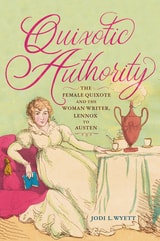
Quixotic Authority
The Female Quixote and the Woman Writer, Lennox to AustenJodi L. Wyett
University of Delaware Press, 2026
Quixotic Authority reveals how deeply absorbed reading was inextricable from and essential to British women's professional writing and cultural commentary from the mid-eighteenth to the mid-nineteenth century. The trope of quixotism, what we might today call "fangirling," had distinctly gendered implications, as the female quixote was almost exclusively associated with uncritical, overly absorptive novel reading, and often portrayed as a self-centered, deluded, ill-educated home-wrecker who must be reformed or punished. But what do we make of the fact that women wrote most of the depictions of female quixotes in novels of this period? Jodi Wyett shows that authors such as Charlotte Lennox and Jane Austen wrote quixote narratives to assert their own professional cachet as well as validate the passion and intelligence of women novel readers. Harnessing the power of the genre, they debunked proscriptive contemporary discourse denigrating both women and the novel. This book redefines the female quixote as a fierce fangirl both modeled in fiction and embodied by her creators.
[more]