Results by title
3745 books match the query 'Europe' and 11 start with q
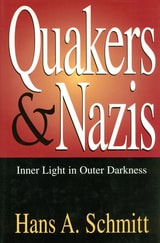
Quakers and Nazis
Inner Light in Outer DarknessHans A. Schmitt
University of Missouri Press, 1997
Why the title Quakers and Nazis, not Quakers against Nazis? Was not hostility part of the interaction between the two groups? On the contrary, Hans A. Schmitt's compelling story describes American, British, and German Quakers' attempts to mitigate the suffering among not only victims of Nazism but Nazi sympathizers in Austria and Lithuania as well.
With numerous poignant illustrations of the pressure and social cost involved in being a Quaker from 1933 to 1945, Quakers and Nazis: Inner Light in Outer Darkness reveals a facet of Nazi Germany that is entirely unknown to most people. The book focuses on the heroic acts foreign and German Quakers performed under the Nazi regime, offering fully documented and original information regarding the Quakers' commitment to nonviolence and the relief of the victims.
Schmitt's narrative reveals the stress and tension of the situation. How should a Quaker behave in a meeting for worship with a policeman present? Spies did not stop Friends in worship services from openly criticizing Hitler and Göring, but Nazis did inflict torment on Friends. Yet Friends did not, could not, respond in like manner. Olga Halle was one Friend who worked to get people, mostly Jews, out of Germany until America entered the war. When emigration was outlawed, twenty-eight were stranded. Years later her distress was still so deep that even on her deathbed she recited their names.
Schmitt reminds us that virtually all the Berlin Quakers secreted Jews throughout the war. He shows how these brave Quakers opposed the Nazis even after they lost their jobs and had been harassed by the Gestapo. Risking their lives, the Friends persisted in their efforts to alleviate suffering.
At a time when the scholarly world is divided as to whether all Germans knew and approved of the Final Solution, this book makes a valuable contribution to the discussion. Quakers—despite their small numbers—played, and continue to play, an important role in twentieth-century humanitarian relief. Quakers and Nazis: Inner Light in Outer Darkness, a study of how Friends performed under the extreme pressure of a totalitarian regime, will add significantly to our general understanding of Quaker and German history.

Queen Anne's War
The Second Contest for North America, 1702–1713Michael G. Laramie
Westholme Publishing, 2027
Told from the halls of power in North America and Europe, and through the eyes of the men and women who found themselves embroiled in this brutal realignment of colonial interests, Queen Anne’s War recreates the world of early North American expansion at the ground level, providing riveting accounts of the battles across settlements and wilderness as well as the motives, conditions, triumphs, and failures of the Europeans and their respective Native American allies. Based on extensive primary source research and command of English, French, and Spanish sources, the narrative not only describes the economic and geopolitical ramifications of the war that reshaped North America, but intriguingly reveals the sense of independence emerging in the colonies, from Puritan New England to plantation South Carolina, at the close of the war.

Queen Elizabeth's Book of Oxford
Edited by Louise Durning
Bodleian Library Publishing, 2006
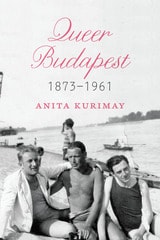
Queer Budapest, 1873–1961
Anita Kurimay
University of Chicago Press, 2020
Kurimay explores how and why a series of illiberal Hungarian regimes came to regulate but also tolerate and protect queer life. She also explains how the precarious coexistence between the illiberal state and queer community ended abruptly at the close of World War II. A stunning reappraisal of sexuality’s political implications, Queer Budapest recuperates queer communities as an integral part of Hungary’s—and Europe’s—modern incarnation.

Queer Cinema in Europe
Edited by Robin Griffiths
Intellect Books, 2008
Queer Encounters with Communist Power
Non-Heterosexual Lives and the State in Czechoslovakia, 1948-1989Vera Sokolová
Karolinum Press, 2019
Contrary to expectations, the book reveals that despite the Czechoslovak Communist regime’s brutality in many areas of life, the state did not carry out a hateful or seditious campaign against homosexual and non-heterosexual people. Rather, the official state sexology offices functioned from the late 1970s onward as essentially the first gay clubs in socialist Czechoslovakia. Interweaving the memories of non-heterosexual Czech women born between 1929 and 1952, Věra Sokolová’s study both enriches and challenges existing scholarship on lesbian and gay history during this era, promising to radically change the way we view gender, sexuality, and everyday life during East European socialism.
Queer Iberia
Sexualities, Cultures, and Crossings from the Middle Ages to the RenaissanceJosiah Blackmore and Gregory S. Hutcheson, eds.
Duke University Press, 1999
To show how sexual otherness is most evident at points of cultural conflict, the contributors use a variety of methodologies and perspectives and consider source materials that originated in Castilian, Latin, Arabic, Catalan, and Galician-Portuguese. Covering topics from the martydom of Pelagius to the exploits of the transgendered Catalina de Erauso, this volume is the first to provide a comprehensive historical examination of the relations among race, gender, sexuality, nation-building, colonialism, and imperial expansion in medieval and early modern Iberia. Some essays consider archival evidence of sexual otherness or evaluate the use of “deviance” as a marker for cultural and racial difference, while others explore both male and female homoeroticism as literary-aesthetic discourse or attempt to open up canonical texts to alternative readings.
Positing a queerness intrinsic to Iberia’s historical process and cultural identity, Queer Iberia will challenge the field of Iberian studies while appealing to scholars of medieval, cultural, Hispanic, gender, and gay and lesbian studies.
Contributors. Josiah Blackmore, Linde M. Brocato, Catherine Brown, Israel Burshatin, Daniel Eisenberg, E. Michael Gerli, Roberto J. González-Casanovas, Gregory S. Hutcheson, Mark D. Jordan, Sara Lipton, Benjamin Liu, Mary Elizabeth Perry, Michael Solomon, Louise O. Vasvári, Barbara Weissberger
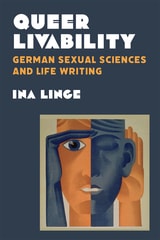
Queer Livability
German Sexual Sciences and Life WritingIna Linge
University of Michigan Press, 2023
Finalist: Waterloo Centre for German Studies Book Prize | December 10, 2024
This book brings together an exciting new archive of queer and trans voices from the history of sexual sciences in the German-speaking world. A new language to express possibilities of gender and sexuality emerged at the turn of the twentieth century, from Sigmund Freud’s theories of homosexuality in Vienna to Magnus Hirschfeld’s “third sex” in Berlin. Together, they provided a language of sex and sexuality that is still recognizable today. Queer Livability: German Sexual Sciences and Life Writing shows that individual voices of trans and queer writers had a significant impact on the production of knowledge about gender and sexuality during this time and introduces lesser known texts to a new readership. It shows the remarkable power of queer life writing in imagining and creating the possibilities of a livable life in the face of restrictive legal, medical, and social frameworks.
Queer Livability: German Sexual Sciences and Life Writing will be of interest to anyone who wants to learn more about LGBTQ+ history and literature. It also provides a fascinating insight into the historical roots for our thinking about gender and sexuality today. The book will be of relevance to an academic readership of students and faculty in German studies, literary studies, European history, and the interdisciplinary fields of gender and sexuality studies, medical humanities, and the history of sexuality.
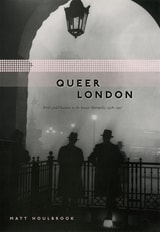
Queer London
Perils and Pleasures in the Sexual Metropolis, 1918-1957Matt Houlbrook
University of Chicago Press, 2005
Cyril's story is Matt Houlbrook's point of entry into the queer worlds of early twentieth-century London. Drawing on previously unknown sources, from police reports and newspaper exposés to personal letters, diaries, and the first queer guidebook ever written, Houlbrook here explores the relationship between queer sexualities and modern urban culture that we take for granted today. He revisits the diverse queer lives that took hold in London's parks and streets; its restaurants, pubs, and dancehalls; and its Turkish bathhouses and hotels—as well as attempts by municipal authorities to control and crack down on those worlds. He also describes how London shaped the culture and politics of queer life—and how London was in turn shaped by the lives of queer men. Ultimately, Houlbrook unveils the complex ways in which men made sense of their desires and who they were. In so doing, he mounts a sustained challenge to conventional understandings of the city as a place of sexual liberation and a unified queer culture.
A history remarkable in its complexity yet intimate in its portraiture, Queer London is a landmark work that redefines queer urban life in England and beyond.
Winner of History Today’s Book of the Year Award, 2006
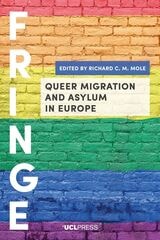
Queer Migration and Asylum in Europe
Edited by Richard C. M. Mole
University College London, 2021
Europe is a popular destination for LGBTQ people seeking to escape discrimination and persecution. Yet, while European institutions have done much to promote the legal equality of sexual minorities and a number of states pride themselves on their acceptance of sexual diversity, the image of European tolerance is often quite different from the reality faced by LGBTQ migrants and asylum seekers. Queer Migration and Asylum in Europe brings together scholars from politics, sociology, urban studies, anthropology, and law to analyze how and why queer individuals migrate to Europe, as well as the legal, social, and political frameworks they are forced to navigate in the destination societies. The subjects covered include LGBTQ Latino migrants in queer and diasporic spaces in London; the diasporic consciousness of queer Polish, Russian, and Brazilian migrants in Berlin; the role of the Council of Europe in shaping legal and policy frameworks relating to queer migration and asylum; the challenges facing bisexual asylum seekers; queer asylum and homonationalism in the Netherlands; and the role of space, faith, and LGBTQ organizations in Germany, Italy, the UK, and France in supporting queer asylum seekers.
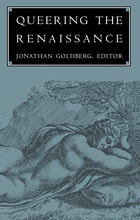
Queering the Renaissance
Jonathan Goldberg, ed.
Duke University Press, 1994
The presence of contemporary history can be felt throughout the volume, beginning with an investigation of the uses of Renaissance precedents in the 1986 U.S. Supreme Court decision Bowers v. Hardwick, to a piece on the foundations of 'our' national imaginary, and an afterword that addresses how identity politics has shaped the work of early modern historians. The volume examines canonical and noncanonical texts, including highly coded poems of the fifteenth-century Italian poet Burchiello, a tale from Marguerite de Navarre's Heptameron, and Erasmus's letters to a young male acolyte. English texts provide a central focus, including works by Spenser, Shakespeare, Bacon, Donne, Beaumont and Fletcher, Crashaw, and Dryden. Broad surveys of the complex terrains of friendship and sodomy are explored in one essay, while another offers a cross-cultural reading of the discursive sites of lesbian desire.
Contributors. Alan Bray, Marcie Frank, Carla Freccero, Jonathan Goldberg, Janet Halley, Graham Hammill, Margaret Hunt, Donald N. Mager, Jeff Masten, Elizabeth Pittenger, Richard Rambuss, Alan K. Smith, Dorothy Stephens, Forrest Tyler Stevens, Valerie Traub, Michael Warner