Results by title
93 books match the query 'Gay people' and 9 start with q
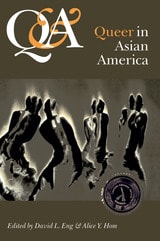
Q & A Queer And Asian
Queer & Asian In AmericaAlvin Eng
Temple University Press, 1998
Q & A approaches matters of identity from a variety of points of view and academic disciplines in order to explore the multiple crossings of race and ethnicity with sexuality and gender. Drawing together the work of visual artists, fiction writers, community organizers, scholars, and participants in roundtable discussions, the collection gathers an array of voices and experiences that represent the emerging communities of a queer Asian America. Collectively, these contributors contend that Asian American studies needs to be more attentive to issues of sexuality and that queer studies needs to be more attentive to other aspects of difference, especially race and ethnicity. Vigorously rejecting the notion that a symmetrical relationship between race and homosexuality would weaken lesbian/gay and queer movements, the editors refuse to "believe that a desirably queer world is one in which we remain perpetual aliens -- queer houseguests -- in a queer nation."
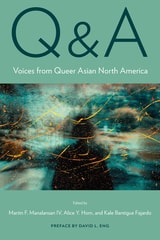
Q&A
Voices from Queer Asian North AmericaEdited by Martin F. Manalansan IV, Alice Y. Hom, and Kale Bantigue Fajardo
Temple University Press, 2021
First published in 1998, Q & A: Queer in Asian America, edited by David L. Eng and Alice Y. Hom, became a canonical work in Asian American studies and queer studies. This new edition of Q & A is neither a sequel nor an update, but an entirely new work borne out of the progressive political and cultural advances of the queer experiences of Asian North American communities.
The artists, activists, community organizers, creative writers, poets, scholars, and visual artists that contribute to this exciting new volume make visible the complicated intertwining of sexuality with race, class, gender, and ethnicity. Sections address activism, radicalism, and social justice; transformations in the meaning of Asian-ness and queerness in various mass media issues of queerness in relation to settler colonialism and diaspora; and issues of bodies, health, disability, gender transitions, death, healing, and resilience.
The visual art, autobiographical writings, poetry, scholarly essays, meditations, and analyses of histories and popular culture in the new Q & Agesture to enduring everyday racial-gender-sexual experiences of mis-recognition, micro-aggressions, loss, and trauma when racialized Asian bodies are questioned, pathologized, marginalized, or violated. This anthology seeks to expand the idea of Asian and American in LGBTQ studies.
Contributors: Marsha Aizumi, Kimberly Alidio, Paul Michael (Mike) Leonardo Atienza, Long T. Bui, John Paul (JP) Catungal, Ching-In Chen, Jih-Fei Cheng, Kim Compoc, Sony Coráñez Bolton, D’Lo, Patti Duncan, Chris A. Eng, May Farrales, Joyce Gabiola, C. Winter Han, Douglas S. Ishii, traci kato-kiriyama, Jennifer Lynn Kelly, Mimi Khúc, Anthony Yooshin Kim, Việt Lê, Danni Lin, Glenn D. Magpantay, Leslie Mah, Casey Mecija, Maiana Minahal, Sung Won Park, Thea Quiray Tagle, Emily Raymundo, Vanita Reddy, Eric Estuar Reyes, Margaret Rhee, Thomas Xavier Sarmiento, Pahole Sookkasikon, Amy Sueyoshi, Karen Tongson, Kim Tran, Kay Ulanday Barrett, Reid Uratani, Eric C. Wat, Sasha Wijeyeratne, Syd Yang, Xine Yao, and the editors
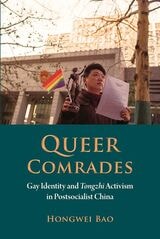
Queer Comrades
Gay Identity and Tongzhi Activism in Postcolonial ChinaHongwei Bao
National University of Singapore Press, 2018
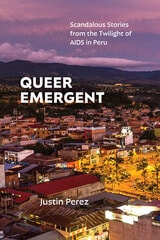
Queer Emergent
Scandalous Stories from the Twilight of AIDS in PeruJustin Perez
Duke University Press, 2025
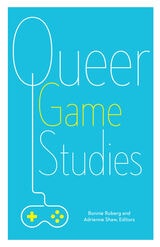
Queer Game Studies
Bonnie Ruberg
University of Minnesota Press, 2017
Video games have developed into a rich, growing field at many top universities, but they have rarely been considered from a queer perspective. Immersion in new worlds, video games seem to offer the perfect opportunity to explore the alterity that queer culture longs for, but often sexism and discrimination in gamer culture steal the spotlight. Queer Game Studies provides a welcome corrective, revealing the capacious albeit underappreciated communities that are making, playing, and studying queer games.
These in-depth, diverse, and accessible essays use queerness to challenge the ideas that have dominated gaming discussions. Demonstrating the centrality of LGBTQ issues to the gamer world, they establish an alternative lens for examining this increasingly important culture. Queer Game Studies covers important subjects such as the representation of queer bodies, the casual misogyny prevalent in video games, the need for greater diversity in gamer culture, and reading popular games like Bayonetta, Mass Effect, and Metal Gear Solid from a queer perspective.
Perfect for both everyday readers and instructors looking to add diversity to their courses, Queer Game Studies is the ideal introduction to the vast and vibrant realm of queer gaming.
Contributors: Leigh Alexander; Gregory L. Bagnall, U of Rhode Island; Hanna Brady; Mattie Brice; Derek Burrill, U of California, Riverside; Edmond Y. Chang, U of Oregon; Naomi M. Clark; Katherine Cross, CUNY; Kim d’Amazing, Royal Melbourne Institute of Technology; Aubrey Gabel, U of California, Berkeley; Christopher Goetz, U of Iowa; Jack Halberstam, U of Southern California; Todd Harper, U of Baltimore; Larissa Hjorth, Royal Melbourne Institute of Technology; Chelsea Howe; Jesper Juul, Royal Danish Academy of Fine Arts; merritt kopas; Colleen Macklin, Parsons School of Design; Amanda Phillips, Georgetown U; Gabriela T. Richard, Pennsylvania State U; Toni Rocca; Sarah Schoemann, Georgia Institute of Technology; Kathryn Bond Stockton, U of Utah; Zoya Street, U of Lancaster; Peter Wonica; Robert Yang, Parsons School of Design; Jordan Youngblood, Eastern Connecticut State U.
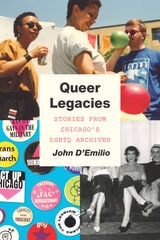
Queer Legacies
Stories from Chicago’s LGBTQ ArchivesJohn D'Emilio
University of Chicago Press, 2020
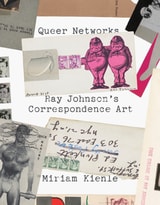
Queer Networks
Ray Johnson's Correspondence ArtMiriam Kienle
University of Minnesota Press, 2023
How the queer correspondence art of Ray Johnson disrupted art world conventions and anticipated today’s highly networked culture
Once regarded as “New York’s most famous unknown artist,” Ray Johnson was a highly visible outlier in the art world, his mail art practice reflecting the changing social relations and politics of queer communities in the 1960s. A vital contribution to the growing scholarship on this enigmatic artist, Queer Networks analyzes how Johnson’s practice sought to undermine the dominant mechanisms of the art market and gallery system in favor of unconventional social connections.
Utilizing the postal service as his primary means of producing and circulating art, Johnson cultivated an international community of friends and collaborators through which he advanced his idiosyncratic body of work. Applying both queer theory and network studies, Miriam Kienle explores how Johnson’s radical correspondence art established new modes of connectivity that fostered queer sensibilities and ran counter to the conventional methods by which artists were expected to develop their reputation.
While Johnson was significantly involved with the Pop, conceptual, and neo-Dada art movements, Queer Networks crucially underscores his resistance to traditional art historical systems of categorization and their emphasis on individual mastery. Highlighting his alternative modes of community building and playful antagonism toward art world protocols, Kienle demonstrates how Ray Johnson’s correspondence art offers new ways of envisioning togetherness in today’s highly commodified and deeply networked world.
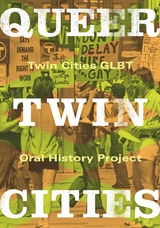
Queer Twin Cities
University of Minnesota Press, 2010
A pioneering look at the queer history, politics, and spaces of the Twin Cities
The Twin Cities is home to one of the largest and most vital GLBT populations in the nation—and one of the highest percentages of gay residents in the country. Drawn from the pioneering work of the Twin Cities GLBT Oral History Project—a collective organization of students, scholars, and activists devoted to documenting and interpreting the lives of GLBT people in Minneapolis and St. Paul—Queer Twin Cities is a uniquely critical collection of essays on Minnesota’s vibrant queer communities, past and present.
A rich blend of oral history, archival research, and ethnography, Queer Twin Cities uses sexuality to chart connections between people’s lives in Minnesota. Topics range from turn-of-the-century Minneapolis amid moral reform—including the highly publicized William Williams murder trial and efforts to police Bridge Square, aka ‘skid row’—to northern Minnesota and the importance of male companionship among lumber workers, and to postwar life, when the increased visibility of queer life went hand in hand with increased regulation, repression, and violence. Other essays present a portrait of early queer spaces in the Twin Cities, such as Kirmser’s Bar, the Viking Room, and the Persian Palms, and the proliferation of establishments like the Dugout and the 19 Bar. Exploring the activism of GLBT Two-Spirit indigenous people, the antipornography movements of the 1980s, and the role of gay men in the gentrification of Minneapolis neighborhoods, this volume brings the history of queer life and politics in the Twin Cities into fascinating focus.Engaging and revelatory, Queer Twin Cities offers a critical analysis of local history and community and fills a glaring omission in the culture and history of Minnesota, looking not only to a remarkable past but to our collective future.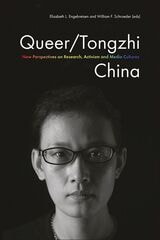
Queer/Tongzhi China
New Perspectives on Research, Activism and Media CulturesEdited by Elisabeth L. Engebretsen and William F. Schroeder
National University of Singapore Press, 2015