Results by title
2646 books match the query 'History & Criticism' and 13 start with q
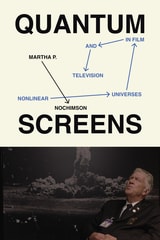
Quantum Screens
Nonlinear Universes in Film and TelevisionMartha P. Nochimson
University of Texas Press, 2026
An exploration of how nonlinear storytelling opens a post-Newtonian reality and changes both the hero’s journey and how we understand history in film and television.
Begin at the beginning and keep going until the end. That’s the cardinal rule of conventional storytelling. But ever since the modernists of the early twentieth century, popular narratives have occasionally eschewed this linear approach to temporality. It’s as though our stories, formerly unfolding in the stable, predictable universe of Newtonian physics, can now take place in multidimensional time where anything and anyone can be as incalculable as Schrödinger’s cat.
Quantum Screens is a journey through the past and present of nonlinear time in film and television. Moving beyond the early experiments of Luis Buñuel and the first nonlinear commercial films, such as 2001: A Space Odyssey, Martha Nochimson shows how risk-taking auteurs David Lynch, Damon Lindelof, and Terrence Malik have opened new horizons and a new concept of beauty in storytelling through their revelatory creations. Quantum Screens takes us deep into the audience’s experience of nonlinearity, exploring the emotional dislocations such storytelling creates, using television programs such as Twin Peaks, Westworld, and Watchmen, and films including The Tree of Life, BlacKkKlansman, and Arrival. Indeed, viewers are at the heart of a changing aesthetics of nonlinearity, Nochimson argues. Amid innovations like on-demand viewing, unlimited replay, and binge-watching, the experience of real time is more malleable than ever, and creators are responding by structuring their stories in compelling new ways.
Queer African Cinemas
Lindsey B. Green-Simms
Duke University Press, 2022
Queer Bergman
Sexuality, Gender, and the European Art CinemaBy Daniel Humphrey
University of Texas Press, 2013
One of the twentieth century’s most important filmmakers—indeed one of its most important and influential artists—Ingmar Bergman and his films have been examined from almost every possible perspective, including their remarkable portrayals of women and their searing dramatizations of gender dynamics. Curiously however, especially considering the Swedish filmmaker’s numerous and intriguing comments on the subject, no study has focused on the undeniably queer characteristics present throughout this nominally straight auteur’s body of work; indeed, they have barely been noted.
Queer Bergman makes a bold and convincing argument that Ingmar Bergman’s work can best be thought of as profoundly queer in nature. Using persuasive historical evidence, including Bergman’s own on-the-record (though stubbornly ignored) remarks alluding to his own homosexual identifications, as well as the discourse of queer theory, Daniel Humphrey brings into focus the director’s radical denunciation of heteronormative values, his savage and darkly humorous deconstructions of gender roles, and his work’s trenchant, if also deeply conflicted, attacks on homophobically constructed forms of patriarchic authority. Adding an important chapter to the current discourse on GLBT/queer historiography, Humphrey also explores the unaddressed historical connections between post–World War II American queer culture and a concurrently vibrant European art cinema, proving that particular interrelationship to be as profound as the better documented associations between gay men and Hollywood musicals, queer spectators and the horror film, lesbians and gothic fiction, and others.

Queer Cinema in Europe
Edited by Robin Griffiths
Intellect Books, 2008
Queer Cinema in the World
Karl Schoonover and Rosalind Galt
Duke University Press, 2016
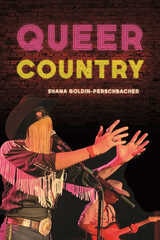
Queer Country
Shana Goldin-Perschbacher
University of Illinois Press, 2022
- A Variety Best Music Book of 2022
- A No Depression Most Memorable Music Book of 2022
- A Library Journal Best Arts and Humanities Book of 2022
- A Pitchfork Best Music Book of 2022
- A Boot Best Music Book of 2022
- A Ticketmaster Best Music Book of 2022
- A Happy Magazine Best Music Book of 2022
- Woody Guthrie First Book Award winner
- Awarded a Certificate of Merit in the 2023 ARSC Awards for Excellence in Historical Recorded Sound Research in the category Best Historical Research in Country, Folk, Roots, or World Music.
Though frequently ignored by the music mainstream, queer and transgender country and Americana artists have made essential contributions as musicians, performers, songwriters, and producers. Queer Country blends ethnographic research with analysis and history to provide the first in-depth study of these artists and their work. Shana Goldin-Perschbacher delves into the careers of well-known lesbian artists like k.d. lang and Amy Ray and examines the unlikely success of singer-songwriter Patrick Haggerty, who found fame forty years after releasing the first out gay country album. She also focuses on later figures like nonbinary transgender musician Rae Spoon and renowned drag queen country artist Trixie Mattel; and on recent breakthrough artists like Orville Peck, Amythyst Kiah, and chart-topping Grammy-winning phenomenon Lil Nas X. Many of these musicians place gender and sexuality front and center even as it complicates their careers. But their ongoing efforts have widened the circle of country/Americana by cultivating new audiences eager to connect with the artists’ expansive music and personal identities.
Detailed and one-of-a-kind, Queer Country reinterprets country and Americana music through the lives and work of artists forced to the margins of the genre's history.
Queer Episodes in Music and Modern Identity
Edited by Sophie Fuller and Lloyd Whitesell
University of Illinois Press, 2001
Exploring the relationship between queer sexuality and music in the late nineteenth and early twentieth century
Queer Episodes in Music and Modern Identity approaches modern sexuality by way of music. Through the hidden or lost stories of composers, scholars, patrons, performers, audiences, repertoires, venues, and specific works, this intriguing volume explores points of intersection between music and queerness in Europe and the United States in the years 1870 to 1950--a period when dramatic changes in musical expression and in the expression of individual sexual identity played similar roles in washing away the certainties of the past. Pursuing the shadowy, obscured tracks of queerness, contributors unravel connections among dissident identities and concrete aspects of musical style, gestures, and personae.
Contributors are Byron Adams, Philip Brett, Malcolm Hamrick Brown, Sophie Fuller, Mitchell Morris, Jann Pasler, Ivan Raykoff, Fiona Richards, Eva Rieger, Gillian Rodger, Sherrie Tucker, and Lloyd Whitesell.
Queer Indigenous Cinemas
Sovereign Genders from Seven DirectionsGabriel S. Estrada
University of Arizona Press, 2026
The seven Indigenous directions—east, south, west, north, down, up, and center—provide a map of understanding gender in media history.
In Queer Indigenous Cinemas, scholar Gabriel S. Estrada offers an analysis of queer Indigenous media from the Americas, the Pacific, and the Caribbean. This groundbreaking work uses Indigenous directional space and sovereign mapping methods to uncover the emotional, spiritual, and cultural dimensions of queer Indigenous lives. The book’s seven chapters—each one of the directions—look closely at media such as cinema and streaming videos that draw on Indigenous concepts from diverse nations such as Diné, Caxcan, Kanaka Maoli, and Nehiyawak. Estrada discusses how the cinema brings into focus the ways that many Indigenous genders do not conform with the male/female binary, genders and sexualities that may or may not overlap with contemporary constructions of gay, lesbian, bisexual, transgender, intersex, and two-spirit (LGBTQI2+) identities.
Highlighting the struggles and resistances of two-spirit peoples, Estrada’s analysis engages with films that represent the diverse and sovereign identities of queer Indigenous peoples. Estrada provides a framework for understanding how queer Indigenous media producers confront colonial trauma and reclaims space for the spiritual and bodily sovereignty of LGBTQI2+ peoples.
Queer Issues in Contemporary Latin American Cinema
By David William Foster
University of Texas Press, 2003
Viewing contemporary Latin American films through the lens of queer studies reveals that many filmmakers are exploring issues of gender identity and sexual difference, as well as the homophobia that attempts to defeat any challenge to the heterosexual norms of patriarchal culture. In this study of queer issues in Latin American cinema, David William Foster offers highly perceptive queer readings of fourteen key films to demonstrate how these cultural products promote the principles of an antiheterosexist stance while they simultaneously disclose how homophobia enforces the norms of heterosexuality.
Foster examines each film in terms of the ideology of its narrative discourse, whether homoerotic desire or a critique of patriarchal heterosexism and its implications for Latin American social life and human rights. His analyses underscore the difficulties involved in constructing a coherent and convincing treatment of the complex issues involved in critiquing the patriarchy from perspectives associated with queer studies. The book will be essential reading for everyone working in queer studies and film studies.
The films discussed in this book are:
- De eso no se habla (I Don't Want to Talk about It)
- El lugar sin límites (The Place without Limits)
- Aqueles dois (Those Two)
- Convivencia (Living Together)
- Conducta impropia (Improper Conduct)
- The Disappearance of García Lorca
- La Virgen de los Sicarios (Our Lady of the Assassins)
- Doña Herlinda y su hijo (Doña Herlinda and Her Son)
- No se lo digas a nadie (Don't Tell Anyone)
- En el paraíso no existe el dolor (There Is No Suffering in Paradise)
- A intrusa (The Interloper)
- Plata quemada (Burnt Money)
- Afrodita (Aphrodite)
- Fresa y chocolate (Strawberry and Chocolate)
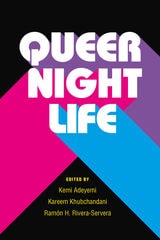
Queer Nightlife
Kemi Adeyemi, Kareem Khubchandani, Ramón H. Rivera-Servera, Editors
University of Michigan Press, 2021
The mass shooting at a queer Latin Night in Orlando in July 2016 sparked a public conversation about access to pleasure and selfhood within conditions of colonization, violence, and negation. Queer Nightlife joins this conversation by centering queer and trans people of color who apprehend the risky medium of the night to explore, know, and stage their bodies, genders, and sexualities in the face of systemic and social negation. The book focuses on house parties, nightclubs, and bars that offer improvisatory conditions and possibilities for “stranger intimacies,” and that privilege music, dance, and sexual/gender expressions. Queer Nightlife extends the breadth of research on “everynight life” through twenty-five essays and interviews by leading scholars and artists. The book’s four sections move temporally from preparing for the night (how do DJs source their sounds, what does it take to travel there, who promotes nightlife, what do people wear?); to the socialities of nightclubs (how are social dance practices introduced and taught, how is the price for sex negotiated, what styles do people adopt to feel and present as desirable?); to the staging and spectacle of the night (how do drag artists confound and celebrate gender, how are spaces designed to create the sensation of spectacularity, whose bodies become a spectacle already?); and finally, how the night continues beyond the club and after sunrise (what kinds of intimacies and gestures remain, how do we go back to the club after Orlando?).
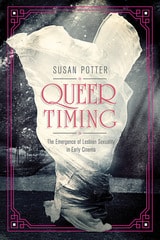
Queer Timing
The Emergence of Lesbian Sexuality in Early CinemaSusan Potter
University of Illinois Press, 2019
John Leo and Dana Heller Award for Best Single Work, Anthology, Multi-Authored or Edited Book in LGBTQ Studies, Popular Culture Association (PCA), 2020
In Queer Timing, Susan Potter offers a counter-history that reorients accepted views of lesbian representation and spectatorship in early cinema. Potter sees the emergence of lesbian figures as only the most visible but belated outcome of multiple sexuality effects. Early cinema reconfigured older erotic modalities, articulated new--though incoherent--sexual categories, and generated novel forms of queer feeling and affiliation.
Potter draws on queer theory, silent film historiography, feminist film analysis, and archival research to provide an original and innovative analysis. Taking a conceptually oriented approach, she articulates the processes of filmic representation and spectatorship that reshaped, marginalized, or suppressed women's same-sex desires and identities. As she pursues a sense of "timing," Potter stages scenes of the erotic and intellectual encounters shared by historical spectators, on-screen figures, and present-day scholars. The result is a daring revision of feminist and queer perspectives that foregrounds the centrality of women's same-sex desire to cinematic discourses of both homo- and heterosexuality.
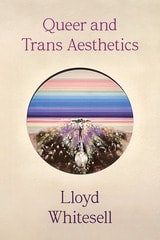
Queer and Trans Aesthetics
Lloyd Whitesell
University of Michigan Press, 2026
If a creative individual identifies as queer or trans, does that fact belong solely to the realm of biography, or does it pertain to their artistic achievement? In Queer and Trans Aesthetics, Lloyd Whitesell discusses literature, visual culture, audio-visual media, music, and performance from the 19th to the 21st century. Through this analysis, Whitesell develops a systematic framework to enrich our understanding of LGBTQ aesthetics and cultural production. He traces the history of queer aesthetic inquiry, develops a justification for a synthetic approach, identifies a fund of expressive strategies motivated by queer subjectivity, and highlights how such strategies create affinity across differences of gender, race, local context, and artistic media.
Rooted in a gender-inclusive theory of queer/trans subjectivity, the book draws on testimony from people of diverse backgrounds, genders, and races. Whitesell engages with debates in the existing scholarly literature while making connections between a wide range of artists: some from mainstream canons, some established subcultural figures, and others only now emerging as notable contributors to queer culture. The book explores five expressive archetypes or poses which have had profound significance in queer art traditions: the Monster, the Victim, the Trickster, the Dandy, and the Dreamer. Each offers a repertoire of creative responses to social oppression and configures queer subjective experience in a unique way. With its unique systematic approach, Queer and Trans Aesthetics enhances our knowledge of queer aesthetic traditions across genres and time.
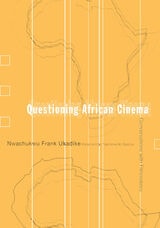
Questioning African Cinema
Conversations With FilmmakersNwachukwu Frank Ukadike
University of Minnesota Press, 2002
The most comprehensive account available of filmmaking in Africa today
Diverse in their art, paradoxically more celebrated abroad than they are at home, African filmmakers eke out their visions against a backdrop of complex historical, social, economic, and political practices. The richness of their accomplishments emerges with compelling clarity in this book, in which African filmmakers speak candidly about their work.
Featuring interviews with key personalities from twelve nations, Questioning African Cinema provides the most extensive, comprehensive account ever given of the origins, practice, and implications of filmmaking in Africa. Speaking with pioneers Med Hondo, Souleymane Cissé, and Kwaw Ansah; renowned feature filmmakers Djibril Mambéty, Haile Gerima, and Safi Faye; and award-winning younger filmmakers Idrissa Ouedraogo, Cheick Oumar Sissoko, and Jean-Pierre Bekolo, N. Frank Ukadike identifies trends and individual practices even as he surveys the evolution of African cinema and addresses the politics and problems of seeing Africa through an African lens. Situating the unique achievement of each filmmaker within the geographic, historical, social, and political context of African cinema, he also explores questions about acting, distribution and exhibition, history, theory and criticism, video-based television production, and television’s relationship to independent film.