Results by title
163 books match the query 'Homosexuality' and 20 start with q
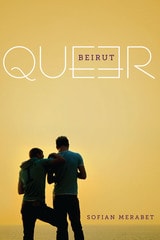
Queer Beirut
By Sofian Merabet
University of Texas Press, 2014
Gender and sexual identity formation is an ongoing anthropological conversation in both Middle Eastern studies and urban studies, but the story of gay and lesbian identity in the Middle East is only just beginning to be told. Queer Beirut is the first ethnographic study of queer lives in the Arab Middle East. Drawing on anthropology, urban studies, gender studies, queer studies, and sociocultural theory, Sofian Merabet’s compelling ethnography suggests a critical theory of gender and religious identity formations that will disrupt conventional anthropological premises about the contingent role that society and particular urban spaces have in facilitating the emergence of various subcultures within the city.
From 1995 to 2014, Merabet made a series of ethnographic journeys to Lebanon, during which he interviewed numerous gay men in Beirut. Through their life stories, Merabet crafts moving ethnographic narratives and explores how Lebanese gays inhabit and perform their gender as they formulate their sense of identity. He also examines the notion of “queer space” in Beirut and the role that this city, its class and sectarian structure, its colonial history, and religion have played in these people’s discovery and exploration of their sexualities. In using Beirut as a microcosm for the complexities of homosexual relationships in contemporary Lebanon, Queer Beirut provides a critical standpoint from which to deepen our understandings of gender rights and citizenship in the structuring of social inequality within the larger context of the Middle East.
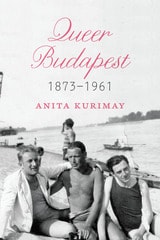
Queer Budapest, 1873–1961
Anita Kurimay
University of Chicago Press, 2020
Kurimay explores how and why a series of illiberal Hungarian regimes came to regulate but also tolerate and protect queer life. She also explains how the precarious coexistence between the illiberal state and queer community ended abruptly at the close of World War II. A stunning reappraisal of sexuality’s political implications, Queer Budapest recuperates queer communities as an integral part of Hungary’s—and Europe’s—modern incarnation.
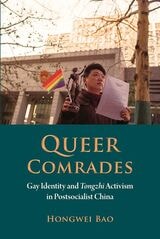
Queer Comrades
Gay Identity and Tongzhi Activism in Postcolonial ChinaHongwei Bao
National University of Singapore Press, 2018
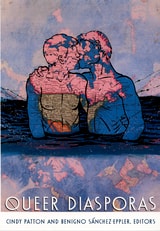
Queer Diasporas
Cindy Patton and Benigno Sánchez-Eppler, editors
Duke University Press, 2000
Incorporating literary analysis, ethnographic research, and theories of diaspora, migration, and transnationalism, the essays in this volume address an impressive range of topics, from the divergent medical and epidemiological understandings of the AIDS pandemic to 1950s lesbian pulp fiction. While one chapter focuses on the appropriation of religious ceremony by gay Filipino immigrants in New York City, another investigates the implicit connection between Jewishness and homosexuality in the work of Freud. The gendering of domestic roles in food preparation and consumption in Japanese society gives way to a discussion of Cuban and Jamaican homoeroticism as seen in the works of Reinaldo Arenas and Claude McKay. Chilean author D’Halmar’s orientalization of Spain as queer space and the hybrid nature of queer ‘zine culture in Quebec are the subject of others. The collection concludes with a monologue by “Walid,” a young gay Arab living in the occupied territory, whose sexual and national identities change according to his sexual and social needs.
Illuminating the complex nature of queerness in the postmodern world, Queer Diasporas contributes to the advancement of gay and lesbian studies. It will be important to those working in cultural, literary, and postcolonial studies.
Contributors. Michele Aina Barale, Daniel Boyarin, Sandra Buckley, Rhonda Cobham, Amir Sumaka’i Fink, Marcie Frank, Martin F. Manalansan IV, Sylvia Molloy, Cindy Patton, Jacob Press, Jennifer Robertson, Benigno Sánchez-Eppler
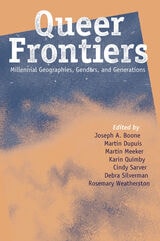
Queer Frontiers
Millennial Geographies, Genders, and GenerationsEdited by Joseph A. Boone, et.al.
University of Wisconsin Press, 2000
From the history of gay and lesbian studies to the emergence of video bars, from an interview with playwright Cherrie Moraga to a photo record of 1950s gay Los Angeles, these original essays tackle the past, present, and future of queer sexuality from all directions. Queer Frontiers brings together the most vital and energetic voices around; whether promising young scholar or veteran of gay activism, each contributor is helping to move the debate into uncharted territory.
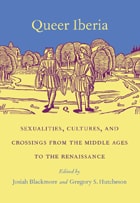
Queer Iberia
Sexualities, Cultures, and Crossings from the Middle Ages to the RenaissanceJosiah Blackmore and Gregory S. Hutcheson, eds.
Duke University Press, 1999
To show how sexual otherness is most evident at points of cultural conflict, the contributors use a variety of methodologies and perspectives and consider source materials that originated in Castilian, Latin, Arabic, Catalan, and Galician-Portuguese. Covering topics from the martydom of Pelagius to the exploits of the transgendered Catalina de Erauso, this volume is the first to provide a comprehensive historical examination of the relations among race, gender, sexuality, nation-building, colonialism, and imperial expansion in medieval and early modern Iberia. Some essays consider archival evidence of sexual otherness or evaluate the use of “deviance” as a marker for cultural and racial difference, while others explore both male and female homoeroticism as literary-aesthetic discourse or attempt to open up canonical texts to alternative readings.
Positing a queerness intrinsic to Iberia’s historical process and cultural identity, Queer Iberia will challenge the field of Iberian studies while appealing to scholars of medieval, cultural, Hispanic, gender, and gay and lesbian studies.
Contributors. Josiah Blackmore, Linde M. Brocato, Catherine Brown, Israel Burshatin, Daniel Eisenberg, E. Michael Gerli, Roberto J. González-Casanovas, Gregory S. Hutcheson, Mark D. Jordan, Sara Lipton, Benjamin Liu, Mary Elizabeth Perry, Michael Solomon, Louise O. Vasvári, Barbara Weissberger

Queer Korea
Todd A. Henry, editor
Duke University Press, 2020
Contributors. Pei Jean Chen, John (Song Pae) Cho, Chung-kang Kim, Todd A. Henry, Merose Hwang, Ruin, Layoung Shin, Shin-ae Ha, John Whittier Treat
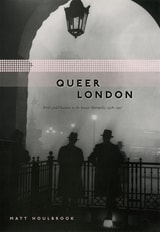
Queer London
Perils and Pleasures in the Sexual Metropolis, 1918-1957Matt Houlbrook
University of Chicago Press, 2005
Cyril's story is Matt Houlbrook's point of entry into the queer worlds of early twentieth-century London. Drawing on previously unknown sources, from police reports and newspaper exposés to personal letters, diaries, and the first queer guidebook ever written, Houlbrook here explores the relationship between queer sexualities and modern urban culture that we take for granted today. He revisits the diverse queer lives that took hold in London's parks and streets; its restaurants, pubs, and dancehalls; and its Turkish bathhouses and hotels—as well as attempts by municipal authorities to control and crack down on those worlds. He also describes how London shaped the culture and politics of queer life—and how London was in turn shaped by the lives of queer men. Ultimately, Houlbrook unveils the complex ways in which men made sense of their desires and who they were. In so doing, he mounts a sustained challenge to conventional understandings of the city as a place of sexual liberation and a unified queer culture.
A history remarkable in its complexity yet intimate in its portraiture, Queer London is a landmark work that redefines queer urban life in England and beyond.
Winner of History Today’s Book of the Year Award, 2006

Queer Lovers and Hateful Others
Regenerating Violent Times and PlacesJin Haritaworn
Pluto Press, 2015
At the centre of this book is the concept of 'queer regeneration.' Haritaworn sees the queer lover as a transitional object which allows the present-day neoliberal regime to make punishment and neglect appear as signs of care and love for diversity. Alongside this shift, in the wake of older moral panics over crime, violence, patriarchy, integration, and segregation, the new Other, that is, the homophobic migrant appears. To understand this transition, Queer Lovers and Hateful Others looks at the environments in which queer bodies have become worthy of protection, and the everyday erasures that shape life in the inner city, and how queer activists actively seek out and dispel the myths of sites of nostalgia for the 'invented traditions' of women-and-gay-friendliness.
Haritaworn guides the reader through a rich archive of media, arts, policy, and activism, including posters, newspaper reports, hate crime action plans, urban projects, psychological studies, demonstrations, kiss-ins, political speeches, and films. In the process, queer lovers, drag kings, criminalised youth, homosexuals persecuted under National Socialism, and other figures of degeneracy and regeneration appear on a shared plane, where new ways of sharing space become imaginable.

Queer Marxism in Two Chinas
Petrus Liu
Duke University Press, 2015
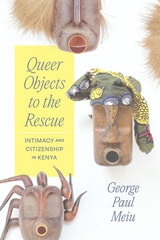
Queer Objects to the Rescue
Intimacy and Citizenship in KenyaGeorge Paul Meiu
University of Chicago Press, 2023
Campaigns calling on police and citizens to purge their countries of homosexuality have taken hold across the world. But the “homosexual threat” they claim to be addressing is not always easy to identify. To make that threat visible, leaders, media, and civil society groups have deployed certain objects as signifiers of queerness. In Kenya, for example, bead necklaces, plastics, and even diapers have come to represent the danger posed by homosexual behavior to an essentially “virile” construction of national masculinity.
In Queer Objects tothe Rescue, George Paul Meiu explores objects that have played an important and surprising role in both state-led and popular attempts to rid Kenya of various imagined threats to intimate life. Meiu shows that their use in the political imaginary has been crucial to representing the homosexual body as a societal threat and as a target of outrage, violence, and exclusion, while also crystallizing anxieties over wider political and economic instability. To effectively understand and critique homophobia, Meiu suggests, we must take these objects seriously and recognize them as potential sources for new forms of citizenship, intimacy, resistance, and belonging.
Queer Phenomenology
Orientations, Objects, OthersSara Ahmed
Duke University Press, 2006
Ahmed proposes that a queer phenomenology might investigate not only how the concept of orientation is informed by phenomenology but also the orientation of phenomenology itself. Thus she reflects on the significance of the objects that appear—and those that do not—as signs of orientation in classic phenomenological texts such as Husserl’s Ideas. In developing a queer model of orientations, she combines readings of phenomenological texts—by Husserl, Heidegger, Merleau-Ponty, and Fanon—with insights drawn from queer studies, feminist theory, critical race theory, Marxism, and psychoanalysis. Queer Phenomenology points queer theory in bold new directions.
Queer Social Philosophy
CRITICAL READINGS FROM KANT TO ADORNORandall Halle
University of Illinois Press, 2004

Queer Subjects in Modern Japanese Literature
Male Love, Intimacy, and Erotics, 1886–2014Stephen D. Miller, Editor
University of Michigan Press, 2022
Queer Subjects in Modern Japanese Literature: Male Love, Erotics, and Intimacy, 1886–2014 is an anthology of translated Japanese literature about men behaving lovingly, erotically, and intimately with other men. Covering more than 125 years of modern and contemporary Japanese history, this book aims to introduce a diverse array of authors to an English-speaking audience and provide further context for their works. While no anthology can comprehensively represent queer Japanese literature, these selections nonetheless expand our understanding of queerness in Japanese culture.
Queer in Russia
A Story of Sex, Self, and the OtherLaurie Essig
Duke University Press, 1999
While male homosexual acts were criminalized in Russia before 1993, women attracted to women were policed by the medical community, who saw them less as criminals than as diseased persons potentially cured by drug therapy or transsexual surgery. After describing accounts of pre-perestroika persecution, Essig examines the more recent state of sexual identities in Russia. Although the fall of communism brought new freedom to Russian queers, there are still no signs of a mass movement forming around the issue, and few identify themselves as lesbians or gay men, even when they are involved in same-sex relations. Essig does reveal, however, vibrant manifestations of gay life found at the local level—in restaurants, discos, clubs, and cruising strips, in newspapers, journals, literature, and the theater. Concluding with a powerful exploration of the surprising affinities between some of Russia’s most prominent nationalists and its queers, Queer in Russia fills a gap in both Russian and cultural studies.

Queer/Early/Modern
Carla Freccero
Duke University Press, 2006
Combining feminist theory, queer theory, psychoanalysis, deconstruction, and literary criticism, Freccero takes up a series of theoretical and historical issues related to debates in queer theory, feminist theory, the history of sexuality, and early modern studies. She juxtaposes readings of early and late modern texts, discussing the lyric poetry of Petrarch, Louise Labé, and Melissa Ethridge; David Halperin’s take on Michel Foucault via Apuleius’s The Golden Ass and Boccaccio’s Decameron; and France’s domestic partner legislation in connection with Marguerite de Navarre’s Heptameron. Turning to French cleric Jean de Léry’s account, published in 1578, of having witnessed cannibalism and religious rituals in Brazil some twenty years earlier and to the twentieth-century Brandon Teena case, Freccero draws on Jacques Derrida’s concept of spectrality to propose both an ethics and a mode of interpretation that acknowledges and is inspired by the haunting of the present by the past.
Queering Black Atlantic Religions
Transcorporeality in Candomblé, Santería, and VodouRoberto Strongman
Duke University Press, 2019
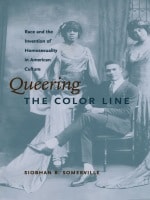
Queering the Color Line
Race and the Invention of Homosexuality in American CultureSiobhan B. Somerville
Duke University Press, 2000
At about the same time that the 1896 Supreme Court Plessy v. Ferguson decision hardened the racialized boundary between black and white, prominent trials were drawing the public’s attention to emerging categories of sexual identity. Somerville argues that these concurrent developments were not merely parallel but in fact inextricably interrelated and that the discourses of racial and sexual “deviance” were used to reinforce each other’s terms. She provides original readings of such texts as Havelock Ellis’s late nineteenth-century work on “sexual inversion,” the 1914 film A Florida Enchantment, the novels of Pauline E. Hopkins, James Weldon Johnson’s Autobiography of an Ex-Coloured Man, and Jean Toomer’s fiction and autobiographical writings, including Cane. Through her analyses of these texts and her archival research, Somerville contributes to the growing body of scholarship that focuses on discovering the intersections of gender, race, and sexuality.
Queering the Color Line will have broad appeal across disciplines including African American studies, gay and lesbian studies, literary criticism, cultural studies, cinema studies, and gender studies.
Queering the Renaissance
Jonathan Goldberg, ed.
Duke University Press, 1994
The presence of contemporary history can be felt throughout the volume, beginning with an investigation of the uses of Renaissance precedents in the 1986 U.S. Supreme Court decision Bowers v. Hardwick, to a piece on the foundations of 'our' national imaginary, and an afterword that addresses how identity politics has shaped the work of early modern historians. The volume examines canonical and noncanonical texts, including highly coded poems of the fifteenth-century Italian poet Burchiello, a tale from Marguerite de Navarre's Heptameron, and Erasmus's letters to a young male acolyte. English texts provide a central focus, including works by Spenser, Shakespeare, Bacon, Donne, Beaumont and Fletcher, Crashaw, and Dryden. Broad surveys of the complex terrains of friendship and sodomy are explored in one essay, while another offers a cross-cultural reading of the discursive sites of lesbian desire.
Contributors. Alan Bray, Marcie Frank, Carla Freccero, Jonathan Goldberg, Janet Halley, Graham Hammill, Margaret Hunt, Donald N. Mager, Jeff Masten, Elizabeth Pittenger, Richard Rambuss, Alan K. Smith, Dorothy Stephens, Forrest Tyler Stevens, Valerie Traub, Michael Warner
Queering the Underworld
Slumming, Literature, and the Undoing of Lesbian and Gay HistoryScott Herring
University of Chicago Press, 2007
In this major rethinking of American literature and culture, Scott Herring explores how a key group of authors manipulated this genre to paradoxically evade the confines of sexual identification. Queering the Underworld examines a range of writers, from Jane Addams and Willa Cather to Carl Van Vechten and Djuna Barnes, revealing how they fulfilled the conventions of slumming literature but undermined its goals, and in the process, queered the genre itself. Their work frustrated the reader’s desire for sexual knowledge, restored the inscrutability of sexual identity, and cast doubt on the value of a homosexual subculture made visible and therefore subject to official control.
Herring is persuasive and polemical in connecting these writers to ongoing debates about lesbian and gay history and politics, and Queering the Underworld will be widely read by students and scholars of literature, history, and sexuality.