Results by title
486 books match the query 'LGBTQ+' and 20 start with q
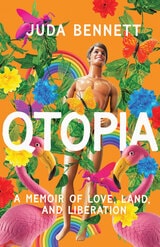
Qtopia
A Memoir of Love, Land, and LiberationJuda Bennett
University of Wisconsin Press, 2026
In the 1970s, while communes bloomed like wildflowers across the land, most had no room for queer members. The so-called counterculture still clung to heterosexual norms, even as it preached freedom from traditional gender roles and the nuclear family. Juda Bennett’s engrossing memoir follows his escape from suburbia into the back-to-the-land movement—and chronicles the efforts it took for him to “drop back in” to mainstream society and the ways in which he and his compatriots continued to honor their communal vision.
After enduring the hollow promises of “progressive” communes, Bennett finally found what he didn’t know he was looking for at Lavender Hill, a rural queer commune of visionaries carving out a life beyond heteronormativity, beyond capitalism, beyond shame. They didn’t just survive; they built something messy, luminous, and defiantly alive. And when the commune began to unravel, they didn’t vanish. They evolved. Qtopia is a story of chosen family and radical transformation. It is a reminder that queer utopia isn’t behind us—it’s still out there on the horizon, singing its song of joy, defiance, and fabulousness.

Queer Between the Covers
Histories of Queer Publishing and Publishing Queer VoicesEdited by Leila Kassir and Richard Espley
University of London Press, 2021
Queer Between the Covers presents a history of radical queer publishing and literature from 1880 to the modern day. Chronicling the gay struggle for acceptance and liberation, the book demonstrates how the fight for representation was often waged between the covers of books in a world where spaces for queer expression were taboo. The chapters provide an array of voices and histories from the famous, Derek Jarman and Oscar Wilde, to the lesser known and underappreciated, such as John Wieners and Valerie Taylor. It includes firsthand accounts of seminal moments in queer history, including the birth of Hazard Press and the Defend Gay’s the Word Bookshop campaign in the 1980s.
Queer Between the Covers demonstrates the importance of the book and how the queer community could be brought together through shared literature. The works discussed show the imaginative and radical ways in which queer texts have fought against censorship and repression and could be used as a political tool for organization and production. This study follows key moments in queer literary history, from the powerful community wide demonstrations for Gay’s the Word during their battle with the British government, to the mapping of Chicago’s queer spaces within Valerie Taylor’s pulp novels, or the anonymous but likely shared authorship of the nineteenth century queer text Teleny. Queer publishing also often involved fascinating creative tactics for beating the censor, from the act of self-publishing to anonymous authorship as part of a so-called “cloaked resistance.” Collage and repurposing found images and texts were key practices for many queer publishers and authors, from Derek Jarman to the artworks created by the Hazard Press.
This is a fascinating and topical book on publishing history for those interested in how queer people throughout modernity have used literature as an important forum for self-expression and self-actualization when spaces and sites for queer expression were outlawed.
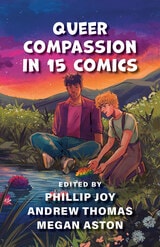
Queer Compassion in 15 Comics
Edited by Phillip Joy, Andrew Thomas, and Megan Aston
Lever Press, 2024
These comics are created by queer artists for queer audiences and with the intent for queer self-expression and representation. Social science researchers spoke to diverse members of LGBTQ+ communities to explore their beliefs about and experiences of compassion. Fifteen queer comics were commissioned to illustrate those stories, making the process of creating each comic a unique collaboration between researchers and artists, blending data exploring the meanings of compassion for queer folks with the creativity, passion, and understanding of a queer comic artist.
These stories reflect not only the harsh realities that many queer people face but they also uplift queer voices, illustrate strength, and capture queer resolve to make life more compassionate. Queer people, living in a cis-heteronormative world, often face experiences of marginalization, discrimination, stigma, trauma, and invisibility in everyday life. Queer Compassion shows that its titular emotion can be the bridge that brings understanding and creates community connections — a bridge that is particularly needed at this time.
Queer Contiguities of Nigerian Literature
Kerry Manzo
Michigan State University Press, 2026
Queer Economic Dissonance and Victorian Literature
Meg Dobbins
The Ohio State University Press, 2022

Queer Forster
Edited by Robert K. Martin and George Piggford
University of Chicago Press, 1997
Many previous critics of Forster downplayed his homosexuality or read Forster naively in terms of gay liberation. This collection situates Forster within the Bloomsbury Group and examines his relations to major figures such as Henry James, Edward Carpenter, and Virginia Woolf. Particular attention is paid to Forster's several accounts of India and their troubled relation to the British colonial enterprise. Analyzing a wide range of Forster's work, the authors examine material from Forster's undergraduate writings to stories written more than a half-century later.
A landmark book for the study of gender in literature, Queer Forster brings the terms "queer" and "gay" into conversation, opening up a dialogue on wider dimensions of theory and allowing a major revaluation of modernist inventions of sexual identity.

Queer Gothic
George E. Haggerty
University of Illinois Press, 2000

Queer Nations
Marginal Sexualities in the MaghrebJarrod Hayes
University of Chicago Press, 2000
In this incisive postcolonial study, Jarrod Hayes uses literary analysis to examine how Francophone novelists from the Maghreb engaged in a diametric nation-building project. Their works imagined a diverse nation peopled by those who were excluded by the dominant political discourses, especially those who did not conform to traditional sexual norms. By incorporating representations of marginal sexualities, sexual dissidence, and gender insubordination, Maghrebian novelists imagined an anticolonial struggle that would result in sexual liberation and envisioned nations that could be defined and developed inclusively.

Queer Optimism
Lyric Personhood and Other Felicitous PersuasionsMichael D. Snediker
University of Minnesota Press, 2008
A new paradigm for queer theory
Michael Snediker offers a much-needed counterpoint to queer theoretical discourse, which has long privileged melancholy, self-shattering, incoherence, shame, and the death drive. Recovering the forms of positive affect that queer theory has jettisoned, Snediker insists that optimism must itself be taken beyond conventional tropes of hope and futurity and reimagined as necessary for critical engagement.
Through fresh, perceptive, and sensitive readings of the poetry of Emily Dickinson, Hart Crane, Jack Spicer, and Elizabeth Bishop, Snediker reveals that each of these poets demonstrated an interest in the durability of positive affects. Dickinson, Snediker argues, expresses joy and grace as much as pain and loss, and the myriad cryptic smiles in Hart Crane’s White Building contradict prevailing narratives of Crane’s apocryphal literary failures and eventual suicide. Snediker’s ambitious and sophisticated study, informed by thinkers such as Winnicott, Deleuze, and de Man, both supplements and challenges the work of queer theory’s leading figures, including Judith Butler, Leo Bersani, Eve Kosofsky Sedgwick, and Lee Edelman. Queer Optimism revises our understanding of queer love and affiliation, examining Spicer’s serial collusion with matinee idol Billy the Kid as well as the critically neglected force of Bishop’s epistolary and poetic reparations of the drowned figure of Hart Crane. In doing so, Snediker persuasively reconceives a theoretical field of optimism that was previously unavailable to scrupulous critical inquiry and provides a groundbreaking approach to modern American poetry and poetics.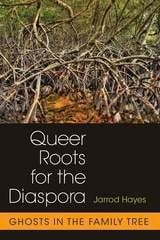
Queer Roots for the Diaspora
Ghosts in the Family TreeJarrod Hayes
University of Michigan Press, 2016
The central argument of Queer Roots for the Diaspora is that, in spite of these debates, ultimately the desire for roots contains the “roots” of its own deconstruction. The book considers alternative root narratives that acknowledge the impossibility of returning to origins with any certainty; welcome sexual diversity; acknowledge their own fictionality; reveal that even a single collective identity can be rooted in multiple ways; and create family trees haunted by the queer others patrilineal genealogy seems to marginalize.
The roots narratives explored in this book simultaneously assert and question rooted identities within a number of diasporas—African, Jewish, and Armenian. By looking at these together, one can discern between the local specificities of any single diaspora and the commonalities inherent in diaspora as a global phenomenon. This comparatist, interdisciplinary study will interest scholars in a diversity of fields, including diaspora studies, postcolonial studies, LGBTQ studies, French and Francophone studies, American studies, comparative literature, and literary theory.

Queer Roots for the Diaspora
Ghosts in the Family TreeJarrod Hayes
University of Michigan Press, 2016
The central argument of Queer Roots for the Diaspora is that, in spite of these debates, ultimately the desire for roots contains the “roots” of its own deconstruction. The book considers alternative root narratives that acknowledge the impossibility of returning to origins with any certainty; welcome sexual diversity; acknowledge their own fictionality; reveal that even a single collective identity can be rooted in multiple ways; and create family trees haunted by the queer others patrilineal genealogy seems to marginalize.
The roots narratives explored in this book simultaneously assert and question rooted identities within a number of diasporas—African, Jewish, and Armenian. By looking at these together, one can discern between the local specificities of any single diaspora and the commonalities inherent in diaspora as a global phenomenon. This comparatist, interdisciplinary study will interest scholars in a diversity of fields, including diaspora studies, postcolonial studies, LGBTQ studies, French and Francophone studies, American studies, comparative literature, and literary theory.

Queer Subjects in Modern Japanese Literature
Male Love, Intimacy, and Erotics, 1886–2014Stephen D. Miller, Editor
University of Michigan Press, 2022
Queer Subjects in Modern Japanese Literature: Male Love, Erotics, and Intimacy, 1886–2014 is an anthology of translated Japanese literature about men behaving lovingly, erotically, and intimately with other men. Covering more than 125 years of modern and contemporary Japanese history, this book aims to introduce a diverse array of authors to an English-speaking audience and provide further context for their works. While no anthology can comprehensively represent queer Japanese literature, these selections nonetheless expand our understanding of queerness in Japanese culture.
Queer Tidalectics
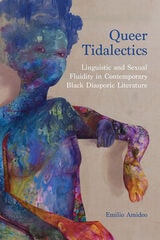
Linguistic and Sexual Fluidity in Contemporary Black Diasporic LiteratureEmilio Amideo
Northwestern University Press, 2021
Amideo engages and extends the work of Black queer studies, Oceanic studies, ecocriticism, phenomenology, and new materialism through the theorizations of Sara Ahmed, Omise’eke Natasha Tinsley, M. Jacqui Alexander, Édouard Glissant, José Esteban Muñoz, and Edward Kamau Brathwaite, among others. Ambitious in scope and captivating to read, Queer Tidalectics brings Caribbean writers like Glissant and Brathwaite into queer literary analysis—a major scholarly contribution.

Queer about Comics
Darieck Scott and Ramzi Fawaz, special issue editors
Duke University Press, 2018
Contributors examine the relationships among reader, creator, and community across a range of comics production, including mainstream superhero comics, independent LGBTQ comics, and avant-garde and experimental feminist narratives. They also address queer forms of identification elicited by the classic X-Men character Rogue, the lesbian grassroots publishing networks that helped shape Alison Bechdel’s oeuvre, and the production of black queer fantasy in the Black Panther comic book series, among other topics.
Contributors andré carrington, Anthony Michael D’Agostino, Ramzi Fawaz, Margaret Galvan, Yetta Howard, Joshua Abraham Kopin, Kate McCullough, Darieck Scott, Jessica Q. Stark, Shelley Streeby, Rebecca Wanzo

Queer and Trans Aesthetics
Lloyd Whitesell
University of Michigan Press, 2026
If a creative individual identifies as queer or trans, does that fact belong solely to the realm of biography, or does it pertain to their artistic achievement? In Queer and Trans Aesthetics, Lloyd Whitesell discusses literature, visual culture, audio-visual media, music, and performance from the 19th to the 21st century. Through this analysis, Whitesell develops a systematic framework to enrich our understanding of LGBTQ aesthetics and cultural production. He traces the history of queer aesthetic inquiry, develops a justification for a synthetic approach, identifies a fund of expressive strategies motivated by queer subjectivity, and highlights how such strategies create affinity across differences of gender, race, local context, and artistic media.
Rooted in a gender-inclusive theory of queer/trans subjectivity, the book draws on testimony from people of diverse backgrounds, genders, and races. Whitesell engages with debates in the existing scholarly literature while making connections between a wide range of artists: some from mainstream canons, some established subcultural figures, and others only now emerging as notable contributors to queer culture. The book explores five expressive archetypes or poses which have had profound significance in queer art traditions: the Monster, the Victim, the Trickster, the Dandy, and the Dreamer. Each offers a repertoire of creative responses to social oppression and configures queer subjective experience in a unique way. With its unique systematic approach, Queer and Trans Aesthetics enhances our knowledge of queer aesthetic traditions across genres and time.
Queer under Siege
How Global Repression Works and How We ResistBaris Cayli Messina
Temple University Press, 2027
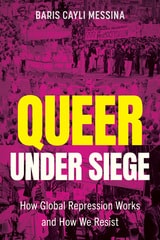
Queer Under Siege reveals that collective repression is not only a global system, but also a moral process that shapes how people tolerate (and even justify) exclusion and oppression. Baris Cayli Messina probes the question of what kind of society sustains its morality by expelling those who are already most vulnerable? and interrogates why societies continually generate the conditions that produce repression, requiring the unyielding struggle of queer people to survive.
Cayli Messina draws on archives, court records, suicide letters, and activist testimony from the around the world to develop a conceptual framework to trace this process through three interlocking forms and mechanisms: moral eviction, which defines moral repression; punitive hypervisibility, which animates political repression; and sanctioned oblivion, which consolidates epistemic repression.
Queer Under Siege shows that the criminalization of queer life is not a misfire, but an intentional and systematic action that makes disparate societies perceive social order as safe. Arguing that survival is a political act across borders and generations, Cayli Messina traces effective methods of queer activism.

Queering Cold War Poetry
Ethics of Vulnerability in Cuba and the United StatesEric Keenaghan
The Ohio State University Press, 2009
Queering the Renaissance
Jonathan Goldberg, ed.
Duke University Press, 1994
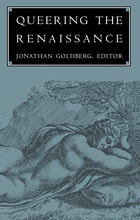
The presence of contemporary history can be felt throughout the volume, beginning with an investigation of the uses of Renaissance precedents in the 1986 U.S. Supreme Court decision Bowers v. Hardwick, to a piece on the foundations of 'our' national imaginary, and an afterword that addresses how identity politics has shaped the work of early modern historians. The volume examines canonical and noncanonical texts, including highly coded poems of the fifteenth-century Italian poet Burchiello, a tale from Marguerite de Navarre's Heptameron, and Erasmus's letters to a young male acolyte. English texts provide a central focus, including works by Spenser, Shakespeare, Bacon, Donne, Beaumont and Fletcher, Crashaw, and Dryden. Broad surveys of the complex terrains of friendship and sodomy are explored in one essay, while another offers a cross-cultural reading of the discursive sites of lesbian desire.
Contributors. Alan Bray, Marcie Frank, Carla Freccero, Jonathan Goldberg, Janet Halley, Graham Hammill, Margaret Hunt, Donald N. Mager, Jeff Masten, Elizabeth Pittenger, Richard Rambuss, Alan K. Smith, Dorothy Stephens, Forrest Tyler Stevens, Valerie Traub, Michael Warner
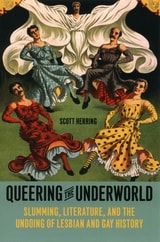
Queering the Underworld
Slumming, Literature, and the Undoing of Lesbian and Gay HistoryScott Herring
University of Chicago Press, 2007
In this major rethinking of American literature and culture, Scott Herring explores how a key group of authors manipulated this genre to paradoxically evade the confines of sexual identification. Queering the Underworld examines a range of writers, from Jane Addams and Willa Cather to Carl Van Vechten and Djuna Barnes, revealing how they fulfilled the conventions of slumming literature but undermined its goals, and in the process, queered the genre itself. Their work frustrated the reader’s desire for sexual knowledge, restored the inscrutability of sexual identity, and cast doubt on the value of a homosexual subculture made visible and therefore subject to official control.
Herring is persuasive and polemical in connecting these writers to ongoing debates about lesbian and gay history and politics, and Queering the Underworld will be widely read by students and scholars of literature, history, and sexuality.
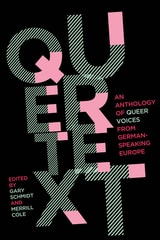
Quertext
An Anthology of Queer Voices from German-Speaking EuropeEdited by Gary Schmidt and Merrill Cole
University of Wisconsin Press, 2021
These outstanding texts exemplify the glittering variety of styles, themes, settings, and subjects addressed by openly queer authors who write in German today. They explore identity, sexuality, history, fantasy, loss, and discovery. Their authors, narrators, and characters explore gender nonconformity and living queer everywhere from city centers to rural communities. They are gay, lesbian, bisexual, trans, and nonbinary. They are exiles, immigrants, and travelers through time and space.
Witty, titillating, and a delight to read, Quertext opens up new worlds of experience for readers interested in queer life beyond the Anglophone world.
Featuring work by Jürgen Bauer • Ella Blix • Claudia Breitsprecher • Lovis Cassaris • Gunther Geltinger • Joachim Helfer • Odile Kennel • Friedrich Kröhnke • Anja Kümmel • Marko Martin • Hans Pleschinski • Christoph Poschenrieder • Peter Rehberg • Michael Roes • Sasha Marianna Salzmann • Angela Steidele • Antje Rávik Strubel • Alain Claude Sulzer • Antje Wagner • J. Walther • Tania Witte • Yusuf Yeşilöz