Results by title
1993 books match the query 'Latin America' and 5 start with q

Queen for a Day
Transformistas, Beauty Queens, and the Performance of Femininity in VenezuelaMarcia Ochoa
Duke University Press, 2014
Beauty pageants play an outsized role in Venezuela. The country has won more international beauty contests than any other. The femininity performed by Venezuelan women in high-profile, widely viewed pageants defines a kind of national femininity. Ochoa argues that as transformistas and misses work to achieve the bodies, clothing and makeup styles, and postures and gestures of this national femininity, they come to embody Venezuelan modernity.

Queer Issues in Contemporary Latin American Cinema
By David William Foster
University of Texas Press, 2003
Viewing contemporary Latin American films through the lens of queer studies reveals that many filmmakers are exploring issues of gender identity and sexual difference, as well as the homophobia that attempts to defeat any challenge to the heterosexual norms of patriarchal culture. In this study of queer issues in Latin American cinema, David William Foster offers highly perceptive queer readings of fourteen key films to demonstrate how these cultural products promote the principles of an antiheterosexist stance while they simultaneously disclose how homophobia enforces the norms of heterosexuality.
Foster examines each film in terms of the ideology of its narrative discourse, whether homoerotic desire or a critique of patriarchal heterosexism and its implications for Latin American social life and human rights. His analyses underscore the difficulties involved in constructing a coherent and convincing treatment of the complex issues involved in critiquing the patriarchy from perspectives associated with queer studies. The book will be essential reading for everyone working in queer studies and film studies.
The films discussed in this book are:
- De eso no se habla (I Don't Want to Talk about It)
- El lugar sin límites (The Place without Limits)
- Aqueles dois (Those Two)
- Convivencia (Living Together)
- Conducta impropia (Improper Conduct)
- The Disappearance of García Lorca
- La Virgen de los Sicarios (Our Lady of the Assassins)
- Doña Herlinda y su hijo (Doña Herlinda and Her Son)
- No se lo digas a nadie (Don't Tell Anyone)
- En el paraíso no existe el dolor (There Is No Suffering in Paradise)
- A intrusa (The Interloper)
- Plata quemada (Burnt Money)
- Afrodita (Aphrodite)
- Fresa y chocolate (Strawberry and Chocolate)

Queer Migrations
Sexuality, U.S. Citizenship, and Border CrossingsEithne Luibheid
University of Minnesota Press, 2005
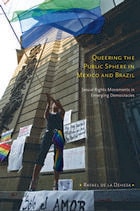
Queering the Public Sphere in Mexico and Brazil
Sexual Rights Movements in Emerging DemocraciesRafael de la Dehesa
Duke University Press, 2010
De la Dehesa studied the archives of activists, social-movement organizations, political parties, religious institutions, legislatures, and state agencies, and he interviewed hundreds of individuals, not only LGBT activists, but also feminists, AIDS and human-rights activists, party militants, journalists, academics, and state officials. He marshals his prodigious research to reveal the interplay between evolving representative institutions and LGBT activists’ entry into the political public sphere in Latin America, offering a critical analysis of the possibilities opened by emerging democratic arrangements, as well as their limitations. At the same time, exploring activists’ engagement with the international arena, he offers new insights into the diffusion and expression of transnational norms inscribing sexual rights within a broader project of liberal modernity. Queering the Public Sphere in Mexico and Brazil is a landmark examination of LGBT political mobilization.
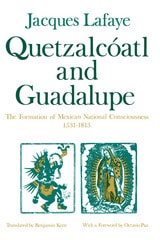
Quetzalcoatl and Guadalupe
The Formation of Mexican National Consciousness, 1531-1813Jacques Lafaye
University of Chicago Press, 1987