Results by title
154 books match the query 'Lesbian Studies' and 13 start with q

Queer Activism in India
A Story in the Anthropology of EthicsNaisargi Dave
Duke University Press, 2012
Dave argues that activism is an ethical practice comprised of critique, invention, and relational practice. Her analysis investigates the relationship between the ethics of activism and the existing social norms and conditions from which activism emerges. Through her study of different networks and institutions, Dave documents how activism oscillates between the potential for new social arrangements and the questions that arise once the activists' goals have been accomplished. Dave's book addresses a relevant and timely phenomenon and makes an important contribution to the anthropology of queer communities, social movements, affect, and ethics.

Queer Bonds, Volume 17
Joshua Joanou Weiner
Duke University Press, 0
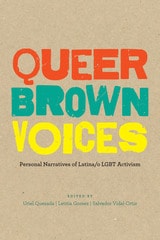
Queer Brown Voices
Personal Narratives of Latina/o LGBT ActivismEdited by Uriel Quesada, Letitia Gomez, and Salvador Vidal-Ortiz
University of Texas Press, 2015
In the last three decades of the twentieth century, LGBT Latinas/os faced several forms of discrimination. The greater Latino community did not often accept sexual minorities, and the mainstream LGBT movement expected everyone, regardless of their ethnic and racial background, to adhere to a specific set of priorities so as to accommodate a “unified” agenda. To disrupt the cycle of sexism, racism, and homophobia that they experienced, LGBT Latinas/os organized themselves on local, state, and national levels, forming communities in which they could fight for equal rights while simultaneously staying true to both their ethnic and sexual identities. Yet histories of LGBT activism in the 1970s, 1980s, and 1990s often reduce the role that Latinas/os played, resulting in misinformation, or ignore their work entirely, erasing them from history.
Queer Brown Voices is the first book published to counter this trend, documenting the efforts of some of these LGBT Latina/o activists. Comprising essays and oral history interviews that present the experiences of fourteen activists across the United States and in Puerto Rico, the book offers a new perspective on the history of LGBT mobilization and activism. The activists discuss subjects that shed light not only on the organizations they helped to create and operate, but also on their broad-ranging experiences of being racialized and discriminated against, fighting for access to health care during the HIV/AIDS epidemic, and struggling for awareness.
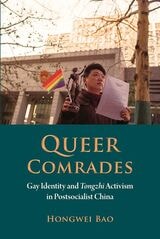
Queer Comrades
Gay Identity and Tongzhi Activism in Postcolonial ChinaHongwei Bao
National University of Singapore Press, 2018

Queer Diasporas
Cindy Patton and Benigno Sánchez-Eppler, editors
Duke University Press, 2000
Incorporating literary analysis, ethnographic research, and theories of diaspora, migration, and transnationalism, the essays in this volume address an impressive range of topics, from the divergent medical and epidemiological understandings of the AIDS pandemic to 1950s lesbian pulp fiction. While one chapter focuses on the appropriation of religious ceremony by gay Filipino immigrants in New York City, another investigates the implicit connection between Jewishness and homosexuality in the work of Freud. The gendering of domestic roles in food preparation and consumption in Japanese society gives way to a discussion of Cuban and Jamaican homoeroticism as seen in the works of Reinaldo Arenas and Claude McKay. Chilean author D’Halmar’s orientalization of Spain as queer space and the hybrid nature of queer ‘zine culture in Quebec are the subject of others. The collection concludes with a monologue by “Walid,” a young gay Arab living in the occupied territory, whose sexual and national identities change according to his sexual and social needs.
Illuminating the complex nature of queerness in the postmodern world, Queer Diasporas contributes to the advancement of gay and lesbian studies. It will be important to those working in cultural, literary, and postcolonial studies.
Contributors. Michele Aina Barale, Daniel Boyarin, Sandra Buckley, Rhonda Cobham, Amir Sumaka’i Fink, Marcie Frank, Martin F. Manalansan IV, Sylvia Molloy, Cindy Patton, Jacob Press, Jennifer Robertson, Benigno Sánchez-Eppler

Queer Joy in Theory and Practice
EssaysJJ Wright
Rutgers University Press, 2027
Queer Joy in Theory and Practice: Essays on Resistance, Thriving, and Liberation centers queer joy as a radical method of resistance and world-building in the face of rising homophobia, transphobia, and systemic violence. Rather than framing queer and trans lives solely through trauma, this groundbreaking collection explores how joy functions as a site of possibility, solidarity, and social change. This book bridges theory, research, and practice to examine queer joy across classrooms, communities, art, public spaces, and activism. With chapters on education, abolitionist politics, drag, parenting, street art, and festivals, this timely and interdisciplinary volume illuminates joy as a transformative force—one that refuses despair and instead imagines liberatory, life-affirming futures for queer and trans communities worldwide.

Queer Kinship and Family Change in Taiwan
Brainer, Amy
Rutgers University Press, 2019
Interweaving the narratives of multiple family members, including parents and siblings of her queer and trans informants, Amy Brainer analyzes the strategies that families use to navigate their internal differences. In Queer Kinship and Family Change in Taiwan, Brainer looks across generational cohorts for clues about how larger social, cultural, and political shifts have materialized in people’s everyday lives. Her findings bring light to new parenting and family discourses and enduring inequalities that shape the experiences of queer and heterosexual kin alike.
Brainer’s research takes her from political marches and support group meetings to family dinner tables in cities and small towns across Taiwan. She speaks with parents and siblings who vary in whether and to what extent they have made peace with having a queer or transgender family member, and queer and trans people who vary in what they hope for and expect from their families of origin. Across these diverse life stories, Brainer uses a feminist materialist framework to illuminate struggles for personal and sexual autonomy in the intimate context of family and home.
Queer Timing
The Emergence of Lesbian Sexuality in Early CinemaSusan Potter
University of Illinois Press, 2019
John Leo and Dana Heller Award for Best Single Work, Anthology, Multi-Authored or Edited Book in LGBTQ Studies, Popular Culture Association (PCA), 2020
In Queer Timing, Susan Potter offers a counter-history that reorients accepted views of lesbian representation and spectatorship in early cinema. Potter sees the emergence of lesbian figures as only the most visible but belated outcome of multiple sexuality effects. Early cinema reconfigured older erotic modalities, articulated new--though incoherent--sexual categories, and generated novel forms of queer feeling and affiliation.
Potter draws on queer theory, silent film historiography, feminist film analysis, and archival research to provide an original and innovative analysis. Taking a conceptually oriented approach, she articulates the processes of filmic representation and spectatorship that reshaped, marginalized, or suppressed women's same-sex desires and identities. As she pursues a sense of "timing," Potter stages scenes of the erotic and intellectual encounters shared by historical spectators, on-screen figures, and present-day scholars. The result is a daring revision of feminist and queer perspectives that foregrounds the centrality of women's same-sex desire to cinematic discourses of both homo- and heterosexuality.

Queer in Russia
A Story of Sex, Self, and the OtherLaurie Essig
Duke University Press, 1999
While male homosexual acts were criminalized in Russia before 1993, women attracted to women were policed by the medical community, who saw them less as criminals than as diseased persons potentially cured by drug therapy or transsexual surgery. After describing accounts of pre-perestroika persecution, Essig examines the more recent state of sexual identities in Russia. Although the fall of communism brought new freedom to Russian queers, there are still no signs of a mass movement forming around the issue, and few identify themselves as lesbians or gay men, even when they are involved in same-sex relations. Essig does reveal, however, vibrant manifestations of gay life found at the local level—in restaurants, discos, clubs, and cruising strips, in newspapers, journals, literature, and the theater. Concluding with a powerful exploration of the surprising affinities between some of Russia’s most prominent nationalists and its queers, Queer in Russia fills a gap in both Russian and cultural studies.
Queer/Tongzhi China
New Perspectives on Research, Activism and Media CulturesEdited by Elisabeth L. Engebretsen and William F. Schroeder
National University of Singapore Press, 2015
Queering Gay and Lesbian Studies
Thomas Piontek
University of Illinois Press, 2005
In this pioneering new study, Thomas Piontek provides a critical analysis of the development of gay and lesbian studies alongside the development of queer theory, the disputes between them, and criticism of their activities from both in and outside of the gay academic community. Examining disputes about transgendering, gay male promiscuity, popular culture, gay history, political activism, and non-normative sexual practices, Piontek argues that it is vital to queer gay and lesbian studies--opening this emerging discipline to queer critical interventions without, however, further institutionalizing queer theory.
Queering Reproduction
Achieving Pregnancy in the Age of TechnoscienceLaura Mamo
Duke University Press, 2007
Mamo provides an overview of a shift within some lesbian communities from low-tech methods of self-insemination to a reliance on outside medical intervention and fertility treatments. Reflecting on the issues facing lesbians who become parents through assisted reproductive technologies, Mamo explores questions about the legal rights of co-parents, concerns about the genetic risks of choosing an anonymous sperm donor, and the ways decisions to become parents affect sexual and political identities. In doing so, she investigates how lesbians navigate the medical system with its requisite range of fertility treatments, diagnostic categories, and treatment trajectories. Combining moving narratives and insightful analysis, Queering Reproduction reveals how medical technology reconfigures social formations, individual subjectivity, and notions of kinship.
Queering the Renaissance
Jonathan Goldberg, ed.
Duke University Press, 1994
The presence of contemporary history can be felt throughout the volume, beginning with an investigation of the uses of Renaissance precedents in the 1986 U.S. Supreme Court decision Bowers v. Hardwick, to a piece on the foundations of 'our' national imaginary, and an afterword that addresses how identity politics has shaped the work of early modern historians. The volume examines canonical and noncanonical texts, including highly coded poems of the fifteenth-century Italian poet Burchiello, a tale from Marguerite de Navarre's Heptameron, and Erasmus's letters to a young male acolyte. English texts provide a central focus, including works by Spenser, Shakespeare, Bacon, Donne, Beaumont and Fletcher, Crashaw, and Dryden. Broad surveys of the complex terrains of friendship and sodomy are explored in one essay, while another offers a cross-cultural reading of the discursive sites of lesbian desire.
Contributors. Alan Bray, Marcie Frank, Carla Freccero, Jonathan Goldberg, Janet Halley, Graham Hammill, Margaret Hunt, Donald N. Mager, Jeff Masten, Elizabeth Pittenger, Richard Rambuss, Alan K. Smith, Dorothy Stephens, Forrest Tyler Stevens, Valerie Traub, Michael Warner