Results by title
1445 books match the query 'Life Sciences' and 5 start with q
QRB vol 95 num 3
The University of Chicago Press
University of Chicago Press Journals, 2020
This is volume 95 issue 3 of The Quarterly Review of Biology. The Quarterly Review of Biology (QRB) has presented insightful historical, philosophical, and technical treatments of important biological topics since 1926. As the premier review journal in biology, the QRB publishes outstanding review articles of generous length that are guided by an expansive, inclusive, and often humanistic understanding of biology. Beyond the core biological sciences, the QRB is also an important review journal for scholars in related areas, including policy studies and the history and philosophy of science. A comprehensive section of reviews on new biological books provides educators and researchers with information on the latest publications in the life sciences.
[more]
Quantifying Life
A Symbiosis of Computation, Mathematics, and BiologyDmitry A. Kondrashov
University of Chicago Press, 2016
Since the time of Isaac Newton, physicists have used mathematics to describe the behavior of matter of all sizes, from subatomic particles to galaxies. In the past three decades, as advances in molecular biology have produced an avalanche of data, computational and mathematical techniques have also become necessary tools in the arsenal of biologists. But while quantitative approaches are now providing fundamental insights into biological systems, the college curriculum for biologists has not caught up, and most biology majors are never exposed to the computational and probabilistic mathematical approaches that dominate in biological research.
With Quantifying Life, Dmitry A. Kondrashov offers an accessible introduction to the breadth of mathematical modeling used in biology today. Assuming only a foundation in high school mathematics, Quantifying Life takes an innovative computational approach to developing mathematical skills and intuition. Through lessons illustrated with copious examples, mathematical and programming exercises, literature discussion questions, and computational projects of various degrees of difficulty, students build and analyze models based on current research papers and learn to implement them in the R programming language. This interplay of mathematical ideas, systematically developed programming skills, and a broad selection of biological research topics makes Quantifying Life an invaluable guide for seasoned life scientists and the next generation of biologists alike.
With Quantifying Life, Dmitry A. Kondrashov offers an accessible introduction to the breadth of mathematical modeling used in biology today. Assuming only a foundation in high school mathematics, Quantifying Life takes an innovative computational approach to developing mathematical skills and intuition. Through lessons illustrated with copious examples, mathematical and programming exercises, literature discussion questions, and computational projects of various degrees of difficulty, students build and analyze models based on current research papers and learn to implement them in the R programming language. This interplay of mathematical ideas, systematically developed programming skills, and a broad selection of biological research topics makes Quantifying Life an invaluable guide for seasoned life scientists and the next generation of biologists alike.
[more]
Quantitative Genetic Studies of Behavioral Evolution
Edited by Christine R. B. Boake
University of Chicago Press, 1994
Quantitative genetics—the statistical study of the inheritance of traits within a population—has become an important tool for studying the evolution of behavior in the last decade. Quantitative Genetic Studies of Behavioral Evolution examines the theory and methods of quantitative genetics and presents case studies that illustrate the many ways in which the methods can be applied.
Christine R. B. Boake brings together current theoretical and empirical studies to show how quantitative genetics can illuminate topics as diverse as sexual selection, migration, sociality, and aggressive behavior. Nearly half of the chapters focus on conceptual issues, ranging from quantitative genetic models to the complementary roles of quantitative genetic and optimality approaches in evolutionary studies. Other chapters illustrate how to use the techniques by providing surveys of research fields, such as the evolution of mating behavior, sexual selection, migration, and size-dependent behavioral variation. The balance of the volume offers case studies of territoriality in fruit flies, cannibalism in flour beetles, mate-attractive traits in crickets, locomotor behavior and physiology in the garter snake, and cold adaptation in the house mouse. Taken together, these studies document both the benefits and pitfalls of quantitative genetics.
This book shows the advanced student and scholar of behavioral evolution and genetics the many powerful uses of quantitative genetics in behavioral research.
[more]
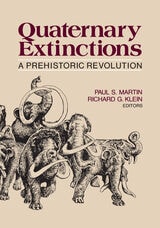
Quaternary Extinctions
A Prehistoric RevolutionEdited by Paul S. Martin and Richard G. Klein
University of Arizona Press, 1984
"What caused the extinction of so many animals at or near the end of the Pleistocene? Was it overkill by human hunters, the result of a major climatic change or was it just a part of some massive evolutionary turnover? Questions such as these have plagued scientists for over one hundred years and are still being heatedly debated today. Quaternary Extinctions presents the latest and most comprehensive examination of these questions." —Geological Magazine
"May be regarded as a kind of standard encyclopedia for Pleistocene vertebrate paleontology for years to come." —American Scientist
"Should be read by paleobiologists, biologists, wildlife managers, ecologists, archeologists, and anyone concerned about the ongoing extinction of plants and animals." —Science
"Uncommonly readable and varied for watchers of paleontology and the rise of humankind." —Scientific American
"Represents a quantum leap in our knowledge of Pleistocene and Holocene palaeobiology. . . . Many volumes on our bookshelves are destined to gather dust rather than attention. But not this one." —Nature
"Two strong impressions prevail when first looking into this epic compendium. One is the judicious balance of views that range over the whole continuum between monocausal, cultural, or environmental explanations. The second is that both the data base and theoretical sophistication of the protagonists in the debate have improved by a quantum leap since 1967." —American Anthropologist
[more]
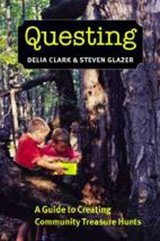
Questing
A Guide to Creating Community Treasure HuntsDelia Clark and Steven Glazer
University Press of New England, 2006
Inspired by the British pastime of "letterboxing," questing has become one of the fastest growing recreational-educational activities on this side of the Atlantic. In scores of communities, people from toddlers and teens, parents and grandparents follow maps, clues, and rhyming riddles seeking treasure boxes hidden in natural and cultural locations. In this book, two experts in community education explain how individuals and organizations can create and organize permanent quests to foster place-based education, stewardship, adventure, and fun. In the process of undertaking quests participants "celebrate and strengthen community life" by forging "lifelong connections to the distinct landscapes and cultural features of their home ground." This book is intended to offer inspiration and practical advice for parents, teachers, community group leaders, and others interested in learning about where they live and building community ties through questing. Questing draws upon the well-established success of a program in New England in which individuals, students, and organizations create clues and maps highlighting the special places and stories of their community. The book presents a rationale for place-based education and quest program goals and objectives that can easily be implemented in any community.
[more]