479 books match the query 'Methodology' and 2 start with q
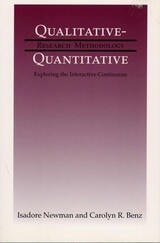
cover of Qualitative-Quantitative Research Methodology: Exploring the Interactive Continuum

Qualitative-Quantitative Research Methodology

Exploring the Interactive Continuum

Isadore Newman and Carolyn R. Benz

Southern Illinois University Press, 1998

Rejecting the artificial dichotomy between qualitative and quantitative research strategies in the social and behavioral sciences, Isadore Newman and Carolyn R. Benz argue that the two approaches are neither mutually exclusive nor interchangeable; rather, the actual relationship between the two paradigms is one of isolated events on a continuum of scientific inquiry.

Through graphic and narrative descriptions, Newman and Benz show research to be a holistic endeavor in the world of inquiry. To clarify their argument, they provide a diagram of the "qualitative-quantitative interactive continuum" showing that qualitative analysis with its feedback loops can easily modify the types of research questions asked in quantitative research and that the quantitative results and its feedback can change what will be asked qualitatively.

In their model for research—an "interactive continuum"—Newman and Benz emphasize four major points: the research question dictates the selection of research methods; consistency between question and design can lead to a method of critiquing research studies in professional journals; the interactive continuum model is built around the place of theory; and the assurance of "validity" of research is central to all studies.
[more]
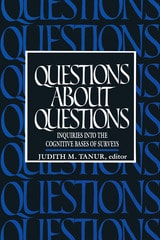
cover of Questions About Questions: Inquiries into the Cognitive Bases of Surveys

Questions About Questions

Inquiries into the Cognitive Bases of Surveys

Judith M. Tanur

Russell Sage Foundation, 1992

The social survey has become an essential tool in modern society, providing crucial measurements of social change, describing social life, and guiding government policy. But the validity of surveys is fragile and depends ultimately upon the accuracy of answers to survey questions. As our dependence on surveys grows, so too have questions about the accuracy of survey responses. Authored by a group of experts in cognitive psychology, linguistics, and survey research, Questions About Questions provides a broad review of the survey response problem. Examining the cognitive and social processes that influence the answers to questions, the book first takes up the problem of meaning and demonstrates that a respondent must share the survey researcher's intended meaning of a question if the response is to be revealing and informative. The book then turns to an examination of memory. It provides a framework for understanding the processes that can introduce errors into retrospective reports, useful guidance on when those reports are more or less trustworthy, and investigates techniques for the improvement of such reports. Questions about the rigid standardization imposed on the survey interview receive a thorough airing as the authors show how traditional survey formats violate the usual norms of conversational behavior and potentially endanger the validity of the data collected. Synthesizing the work of the Social Science Research Council's Committee on Cognition and Survey Research, Questions About Questions emphasizes the reciprocal gains to be achieved when insights and techniques from the cognitive sciences and survey research are exchanged. "these chapters provide a good sense of the range of survey problems investigated by the cognitive movement, the methods and ideas it draws upon, and the results it has yielded." —American Journal of Sociology
[more]