Results by title
1210 books match the query 'Mexico' and 7 start with q
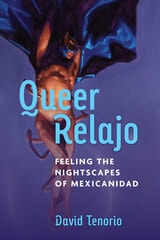
Queer Relajo
Feeling the Nightscapes of MexicanidadDavid Tenorio
University of Michigan Press, 2025
2026 Dance Studies Association de la Torre Bueno First Book Award Shortlist Finalist
In 2015, Mexico City declared itself a “gay-friendly” city and followed up with a gay tourist guide and new laws permitting changes to gender markers on legal documents, sanctioning same-sex marriage, and allowing joint adoption of children. At the same time, patterns of violence and discrimination against women, trans, and queer people have continued throughout the country. In Queer Relajo, David Tenorio argues that while Mexico City aims to bring visibility to queer sociality, the benefits of legitimizing queer space remain unclear.
Combining readings of film, digital media, and performance with drag autoethnography, Queer Relajo quite literally plays with how relajo (or playfulness) structures the spaces of queer nightlife in urban contexts by revealing how nighttime intimacy can minimize the paralyzing effects of violence and precarity in a neoliberal Mexico. Considering the political implications of when a queer/trans person is present at night, Tenorio argues that queer feelings of play are not only essential to sexual liberation, but also resist neoliberal commodification and heteronormative extraction.
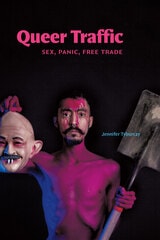
Queer Traffic
Sex, Panic, Free TradeJennifer Tyburczy
Duke University Press, 2025
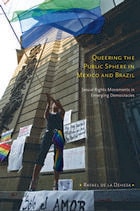
Queering the Public Sphere in Mexico and Brazil
Sexual Rights Movements in Emerging DemocraciesRafael de la Dehesa
Duke University Press, 2010
De la Dehesa studied the archives of activists, social-movement organizations, political parties, religious institutions, legislatures, and state agencies, and he interviewed hundreds of individuals, not only LGBT activists, but also feminists, AIDS and human-rights activists, party militants, journalists, academics, and state officials. He marshals his prodigious research to reveal the interplay between evolving representative institutions and LGBT activists’ entry into the political public sphere in Latin America, offering a critical analysis of the possibilities opened by emerging democratic arrangements, as well as their limitations. At the same time, exploring activists’ engagement with the international arena, he offers new insights into the diffusion and expression of transnational norms inscribing sexual rights within a broader project of liberal modernity. Queering the Public Sphere in Mexico and Brazil is a landmark examination of LGBT political mobilization.
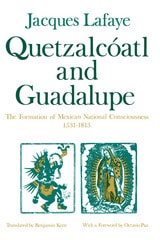
Quetzalcoatl and Guadalupe
The Formation of Mexican National Consciousness, 1531-1813Jacques Lafaye
University of Chicago Press, 1987
Quetzalcoatl and the Irony of Empire
Myths and Prophecies in the Aztec TraditionDavid Carrasco
University of Chicago Press, 1992
"This book, rich in ideas, constituting a novel approach . . . represents a stimulating and provocative contribution to Mesoamerican studies. . . . Recommended to all serious students of the New World's most advanced indigenous civilization."—H. B. Nicholson, Man
Quetzalcoatl and the Irony of Empire
Myths and Prophecies in the Aztec Tradition, Revised EditionDavíd Carrasco
University Press of Colorado, 2000
- American Anthropologist
"A must for both professional and serious non-professional students in Mesoamerica. Those who are interested in complex society and urbanism in general, as well as students of comparative religion, will find it stimulating. Most importantly, for anyone interested in the history of ideas, the book illuminates the tremendously powerful impact and role of a complex deity/mythico-historical figure in shaping one of the world's great pristine civilizations."
- Queen's Quarterly
Quintana Roo Archaeology
Edited by Justine M. Shaw and Jennifer P. Mathews
University of Arizona Press, 2005
The first volume devoted to the archaeology of Quintana Roo, this book reveals a long tradition of exploration and discovery in the region and an increasingly rich recent history of study. Covering a time span from the Formative period through the early twentieth century, it offers a sampling of recent and ongoing research by Mexican, North American, and European archaeologists. Each of the chapters helps to integrate sites within and beyond the borders of the modern state, inviting readers to consider Quintana Roo as part of an interacting Maya world whose boundaries were entirely different from today’s. In taking in the range of the region, the authors consider studies in the northern part of the state resulting from modern development around Cancún; the mid-state sites of Muyil and Yo’okop, both of which witnessed continual occupations from the Middle Preclassic through the Postclassic; and new data from such southern sites as Cerros, Lagartera, and Chichmuul. The contributions consider such subjects as ceramic controversies, settlement shifts, site planning strategies, epigraphic and iconographic materials, the impact of recent coastal development, and the interplay between ancient, historic, and modern use of the region. Many of the chapters confirm the region as a cultural corridor between Cobá and the southern lowland centers and address demographic shifts of the Terminal Classic through Postclassic periods, while others help elucidate some of Peter Harrison’s Uaymil Survey work of the 1970s.
Quintana Roo Archaeology unfolds a rich archaeological record spanning 2,500 years, depicting the depth and breadth of modern archaeological studies within the state. It is an important touchstone for Maya and Mesoamerican archaeologists, demonstrating the shifting web of connections between Quintanarooense sites and their neighbors, and confirming the need to integrate this region into a broader understanding of the ancient Maya.