Results by title
968 books match the query 'Movements' and 2 start with q
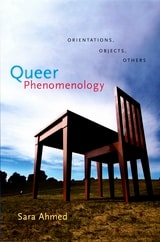
Queer Phenomenology
Orientations, Objects, OthersSara Ahmed
Duke University Press, 2006
Ahmed proposes that a queer phenomenology might investigate not only how the concept of orientation is informed by phenomenology but also the orientation of phenomenology itself. Thus she reflects on the significance of the objects that appear—and those that do not—as signs of orientation in classic phenomenological texts such as Husserl’s Ideas. In developing a queer model of orientations, she combines readings of phenomenological texts—by Husserl, Heidegger, Merleau-Ponty, and Fanon—with insights drawn from queer studies, feminist theory, critical race theory, Marxism, and psychoanalysis. Queer Phenomenology points queer theory in bold new directions.
Questions of Travel
Postmodern Discourses of DisplacementCaren Kaplan
Duke University Press, 1996
Addressing a wide range of writers, including Paul Fussell, Edward Said, James Clifford, Gilles Deleuze, Jean Baudrillard, Gayatri Spivak, Edward Soja, Doreen Massey, Chandra Mohanty, and Adrienne Rich, Kaplan demonstrates that symbols and metaphors of travel are used in ways that obscure key differences of power between nationalities, classes, races, and genders. Neither rejecting nor dismissing the powerful testimony of individual experiences of modern exile or displacement, Kaplan asks how mystified metaphors of travel might be avoided. With a focus on theory’s colonial discourses, she reveals how these metaphors continue to operate in the seemingly liberatory critical zones of poststructuralism and feminist theory. The book concludes with a critique of the politics of location as a form of essentialist identity politics and calls for new feminist geographies of place and displacement.