Results by title
120 books match the query 'Multicultural Education' and 2 start with q
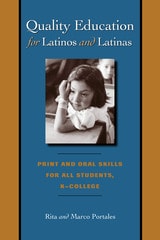
Quality Education for Latinos and Latinas
Print and Oral Skills for All Students, K–CollegeBy Rita and Marco Portales
University of Texas Press, 2005
As educators and legislators across the country debate how to improve public schools, the most vital factor often disappears from the equation—the relationship between the teacher and the student. According to veteran educators Rita and Marco Portales, this relationship is the central issue in the education of students, especially Latino/a students who often face serious barriers to school success because of the legacy of racism, insufficient English-language skills, and cultural differences with the educational establishment.
To break down these barriers and help Latino/a students acquire a quality education, the Portaleses focus attention on the teacher-student relationship and offer a proven method that teachers can use to strengthen the print and oral skills of their students. They begin by analyzing the reasons why schools too often fail to educate Latino/a students, using eloquent comments from young Latinos/as and their parents to confirm how important the teacher-student relationship is to the student's success. Then they show how all educational stakeholders—teachers, administrators, state education agencies, legislators, and parents—can work together to facilitate the teacher-student relationship and improve student education. By demonstrating how teachers can improve students' reading, critical thinking, writing, and oral communication skills across the curriculum, they argue that learning can be made more relevant for students, keeping their interest levels high while preparing them for academically competitive colleges.
Quiet Methodologies
Humility in the HumanitiesSuzanne Bost
University of Minnesota Press, 2025
Reimagining humanities scholarship with humility and inclusive attention
How might foregrounding the writings of colonized peoples transform the ways we work in the humanities? In an era dominated by loud political rhetoric, Suzanne Bost advocates for quieter modes of scholarship: intellectual humility rather than ego, collaboration and conversation rather than singular argumentation, continual reflection and revision rather than defensiveness, and a willingness to believe in different ways of being and knowing rather than adhering to academic norms. With Quiet Methodologies, she demonstrates practical decolonial scholarship and proposes alternative approaches for fostering meaningful engagement.
Turning to feminist, queer, and decolonial writings from Gloria Anzaldúa, Alexis Pauline Gumbs, Audre Lorde, and many others, Bost reflects on what we do when we work with literature, culture, and ideas. She weaves together multiple voices, methods of writing, and culturally diverse epistemologies and uses creative devices such as collage, her own original poetry, revision, lists, images, and conversation to disengage academic thought and writing from colonial theories and archives that have passed as neutral. Eschewing conventional monograph formats, her work embraces a reciprocal and heterogeneous learning process with profound ethical implications.
Part of a movement of reimagining research and education through care, Quiet Methodologies is a powerful exploration of the possibilities of criticism during crises. It encourages readers to be visionary and pragmatic, challenging current conditions and offering alternative ideas for the future of the humanities.
Retail e-book files for this title are screen-reader friendly with images accompanied by short alt text and/or extended descriptions.