Results by title
2817 books match the query 'Nature' and 4 start with q
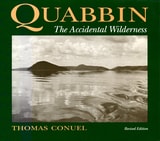
Quabbin
The Accidental WildernessThomas Conuel
University of Massachusetts Press, 1990
When one looks out on the quiet waters and forested hills of Quabbin Reservoir in west central Massachusetts, it is hard to imagine that the area was once dotted with buildings and farmlands or that it echoed with the activity of several villages and towns. Today, the daytime silence may be broken only by the cry of a hawk overhead or the slap of a plunging fish, and the evening calm, by the lonesome howl of a coyote. But in the nineteenth century, things were quite different.
In 1895, engineers for the Metropolitan Water Board began to search the state of Massachusetts for a site on which to construct a reservoir to supply water for the growing city of Boston. Sixty-five miles west of the city, in a region of high hills and running streams known as the Swift River Valley, they found what they were looking for. When Quabbin Reservoir was finally completed and filled in 1946, the engineers had created the third largest body of fresh water in New England and hand accomplished one of the larger public works projects of its time. They had also uprooted and displaced the valley's inhabitants, leveled and flooded four towns and six villages—and formed a magnificent wilderness on some 85,000 acres.
The valley that was once known for its picturesque villages and mill ponds is now, over forty years later, home to a wide array of wildlife. Coyote, bobcat, and deer flourish, and Quabbin's eagle restoration project, begun in 1982, produced the first nesting pair of bald eagles in Massachusetts in almost a century. Today, the bald eagle population at Quabbin is estimated at forty-one birds.
But this accidental wilderness is being increasingly threatened. As early as the 1950s, the sounds of power boats occasionally intruded on the peaceful silence of the waters. In more recent years, acid rain, ozone and other pollutants, the ravages of a herd of hungry deer, and demands for increased recreational use are all jeopardizing Quabbin's waters and forests.
This book tells the story of Quabbin, tracing Quabbin's history, describing its natural resources, and discussing the environmental challenges it currently faces. The original edition, issued by the Massachusetts Audubon Society in 1981, has now been expanded and updated.

Queen of the Snake Charmers
Grace Olive Wiley and Her Venomous PetsMargie Crisp
University of Texas Press, 0
The story of an unconventional, self-taught American herpetologist and handler of venomous reptiles.
Grace Olive Wiley, America’s homegrown snake charmer, believed that all snakes, venomous or not, could be tamed if treated with kindness. She made pets of everything—and not just kingsnakes and boas. Using only her bare hands, she draped king cobras over her shoulders, cuddled with rattlesnakes, and fed minnows to cottonmouths. Alligators, crocodiles, and monitor lizards came when she called them by name.
In 1923, a Minneapolis newspaper introduced Wiley to their readers as “the girl who hunts snakes for fun.” This enigmatic woman, who quickly gained a national reputation as a snake expert, was in fact a forty-year-old divorcée with no training in herpetology. She would go on to run a wildly successful live reptile exhibit at the Minneapolis Public Library Museum, be the first person to breed Western Diamond-backed Rattlesnakes in captivity, become Brookfield Zoo’s (and the nation’s) first female zoo curator, wrangle king cobras for Hollywood films, and spend the remainder of her life as a tireless advocate for all things reptilian.
Queen of the Snake Charmers brings Wiley’s remarkable life back into focus while exploring the enduring fascination with snakes and the people who handle them. Author Margie Crisp explores the myths and folklore surrounding snakes and examines new research into snake behavior and the medical uses of venom. Blending biography, science, and natural history, the book tells the story of a forgotten pioneer while offering a lively and unexpected look at our enduring relationship with one of nature’s most feared creatures.
Questioning Rebound
People and Environmental Change in the Protohistoric and Early Historic AmericasEmily Lena Jones and Jacob L. Fisher
University of Utah Press, 2022
The extent of human impact on world environments is undeniable. At scales ranging from local to global, investigations continue to demonstrate that the ecosystems to which we currently belong are structured by human behavior. Catastrophic events such as war, disaster, disease, or economic decay have, at various times throughout history, led to the human abandonment of particular environments. What happens to a human-structured environment when the manner in which people use it abruptly changes? In Questioning Rebound, authors Emily Lena Jones and Jacob L. Fisher explore the archaeological record of the Americas during the period immediately following European contact, a time when the human footprint on the land abruptly shifted. During this era of disease-driven mortality, genocide, incarceration, and forced labor of Indigenous peoples, American landscapes changed in fundamental ways, producing short-lived ecosystems that later became the basis of myths regarding the natural state of environments across the Americas.
Questioning Rebound explores the record and the causes of environmental change during the period following European contact, featuring case studies throughout the Americas. While both the record for and the apparent causes of the changes in the human footprint vary, the record of post- contact environmental change consistently reflects the impacts of past social upheaval.
Quiet Magic
Sam Cook
University of Minnesota Press, 2002
A collection of essays dedicated to the awe and solitude that can only be found in nature-now in paperback!
Step outside and marvel at the grand experience of the North-the power of a storm building on the greatest of the Great Lakes, the glory of Northern Lights in the shimmering night sky, the embracing, absolute silence of a snowhouse. Or stay inside with Quiet Magic and savor Sam Cook’s unique blend of sensitive portrayals and gentle humor.
Starting with his discovery of one of nature’s wonders-the simplicity of a stand of reeds against a wide-open sunset-and ending with a deep appreciation for the never-ending surprises of the outdoors, Sam Cook weaves a tapestry of enchanting images of the North Woods and keeps you smiling and chuckling all the way.In this long-awaited paperback edition, Sam Cook invites you to look outward to discover the North Country, and look inward to discover yourself."A special book about a special place." Jim Brandenburg, National Geographic"An uncommonly compassionate writer, Cook is arguably Minnesota’s best-loved newspaper columnist." Minnesota Monthly"The word pictures in Sam Cook’s latest literary sketch pad are poignant reminders of the depth of wonder and enjoyment that can be drawn from every experience in nature’s world." Paul Schurke, North Pole explorer