Results by title
4917 books match the query 'Philosophy' and 14 start with q

Qu'appelons-nous penser?
Jean-Luc Nancy and Daniel Tyradellis
Diaphanes, 2013
Cet échange rare et singulier traite de la précarité de toute pensée, qu’elle s’établisse dans la langue, dans l’image, dans le corps ou dans l’espace ; du nous et de la pensée partagée qui ouvre les possibilités du sens. Il dessine une pensée qui s’épuise, mais qui aime aussi, et nous redonne foi en l’existence.

Quaestiones super Secundum et Tertium De Anima Aristotelis (B. Ioannis Duns Scoti Opera Philosophica, Volume 5)
John Duns Scotus
Catholic University of America Press, 2006

Quantum Anthropologies
Life at LargeVicki Kirby
Duke University Press, 2011
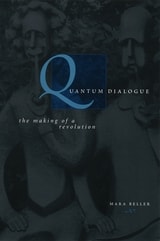
Quantum Dialogue
The Making of a RevolutionMara Beller
University of Chicago Press, 1999
Beller draws her argument from her radical new reading of the history of the quantum revolution, especially the development of the Copenhagen interpretation. One of several competing approaches, this version succeeded largely due to the rhetorical skills of Niels Bohr and his colleagues. Using extensive archival research, Beller shows how Bohr and others marketed their views, misrepresenting and dismissing their opponents as "unreasonable" and championing their own not always coherent or well-supported position as "inevitable."
Quantum Dialogue, winner of the 1999 Morris D. Forkosch Prize of the Journal of the History of Ideas, will fascinate everyone interested in how stories of "scientific revolutions" are constructed and "scientific consensus" achieved.
"[A]n intellectually stimulating piece of work, energised by a distinct point of view."—Dipankar Home, Times Higher Education Supplement
"[R]emarkable and original. . . . [Beller's] arguments are thoroughly supported and her conclusions are meticulously argued. . . . This is an important book that all who are interested in the emergence of quantum mechanics will want to read."—William Evenson, History of Physics Newsletter
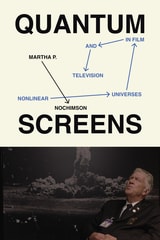
Quantum Screens
Nonlinear Universes in Film and TelevisionMartha P. Nochimson
University of Texas Press, 2026
An exploration of how nonlinear storytelling opens a post-Newtonian reality and changes both the hero’s journey and how we understand history in film and television.
Begin at the beginning and keep going until the end. That’s the cardinal rule of conventional storytelling. But ever since the modernists of the early twentieth century, popular narratives have occasionally eschewed this linear approach to temporality. It’s as though our stories, formerly unfolding in the stable, predictable universe of Newtonian physics, can now take place in multidimensional time where anything and anyone can be as incalculable as Schrödinger’s cat.
Quantum Screens is a journey through the past and present of nonlinear time in film and television. Moving beyond the early experiments of Luis Buñuel and the first nonlinear commercial films, such as 2001: A Space Odyssey, Martha Nochimson shows how risk-taking auteurs David Lynch, Damon Lindelof, and Terrence Malik have opened new horizons and a new concept of beauty in storytelling through their revelatory creations. Quantum Screens takes us deep into the audience’s experience of nonlinearity, exploring the emotional dislocations such storytelling creates, using television programs such as Twin Peaks, Westworld, and Watchmen, and films including The Tree of Life, BlacKkKlansman, and Arrival. Indeed, viewers are at the heart of a changing aesthetics of nonlinearity, Nochimson argues. Amid innovations like on-demand viewing, unlimited replay, and binge-watching, the experience of real time is more malleable than ever, and creators are responding by structuring their stories in compelling new ways.
Queer Frontiers
Millennial Geographies, Genders, and GenerationsEdited by Joseph A. Boone, et.al.
University of Wisconsin Press, 2000
From the history of gay and lesbian studies to the emergence of video bars, from an interview with playwright Cherrie Moraga to a photo record of 1950s gay Los Angeles, these original essays tackle the past, present, and future of queer sexuality from all directions. Queer Frontiers brings together the most vital and energetic voices around; whether promising young scholar or veteran of gay activism, each contributor is helping to move the debate into uncharted territory.
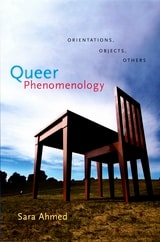
Queer Phenomenology
Orientations, Objects, OthersSara Ahmed
Duke University Press, 2006
Ahmed proposes that a queer phenomenology might investigate not only how the concept of orientation is informed by phenomenology but also the orientation of phenomenology itself. Thus she reflects on the significance of the objects that appear—and those that do not—as signs of orientation in classic phenomenological texts such as Husserl’s Ideas. In developing a queer model of orientations, she combines readings of phenomenological texts—by Husserl, Heidegger, Merleau-Ponty, and Fanon—with insights drawn from queer studies, feminist theory, critical race theory, Marxism, and psychoanalysis. Queer Phenomenology points queer theory in bold new directions.
Queer Social Philosophy
CRITICAL READINGS FROM KANT TO ADORNORandall Halle
University of Illinois Press, 2004
Queer/Early/Modern
Carla Freccero
Duke University Press, 2006
Combining feminist theory, queer theory, psychoanalysis, deconstruction, and literary criticism, Freccero takes up a series of theoretical and historical issues related to debates in queer theory, feminist theory, the history of sexuality, and early modern studies. She juxtaposes readings of early and late modern texts, discussing the lyric poetry of Petrarch, Louise Labé, and Melissa Ethridge; David Halperin’s take on Michel Foucault via Apuleius’s The Golden Ass and Boccaccio’s Decameron; and France’s domestic partner legislation in connection with Marguerite de Navarre’s Heptameron. Turning to French cleric Jean de Léry’s account, published in 1578, of having witnessed cannibalism and religious rituals in Brazil some twenty years earlier and to the twentieth-century Brandon Teena case, Freccero draws on Jacques Derrida’s concept of spectrality to propose both an ethics and a mode of interpretation that acknowledges and is inspired by the haunting of the present by the past.
Querying Consent
Beyond Permission and RefusalJordana Greenblatt, Keja Valens
Rutgers University Press, 2018
Questions of Evidence
Proof, Practice, and Persuasion across the DisciplinesEdited by James Chandler, Arnold I. Davidson, and Harry D. Harootunian
University of Chicago Press, 1994
The essays and rejoinders are by Terry Castle, Lorraine Daston, Carlo Ginzburg, Ian Hacking, Mark Kelman, R. C. Lewontin, Pierre Vidal-Naquet, Mary Poovey, Donald Preziosi, Simon Schaffer, Joan W. Scott, Eve Kosofsky Sedgwick, and Barbara Herrnstein Smith.
The critical responses are by Lauren Berlant, James Chandler, Jean Comaroff, Arnold I. Davidson, Harry D. harootunian, Elizabeth Helsinger, Thomas C. Holt, Francoise Meltzer, Robert J. Richards, Lawrence Rothfield, Joel Snyder, Cass R. Sunstein, and William Wimsatt.

Questions of Form
Logic and Analytic Proposition from Kant to CarnapJoelle ProustTranslated by Anastasios Albert Brenner
University of Minnesota Press, 1989
Questions of Form was first published in 1989. Minnesota Archive Editions uses digital technology to make long-unavailable books once again accessible, and are published unaltered from the original University of Minnesota Press editions.
In Questions on Form, Joelle Proust traces the concept of the analytic proposition from Kant's development of the notion down to its place in the work of Rudolf Carnap, a founder of logical empiricism and a key figure in contemporary analytic philosophy. Using a method known in France as topique comparative,she provides a rigorous exposition of analyticity, situating it within four major philosophical systems—those of Kant, Bolzano, Frege, and Carnap—and clearly delineating its development from one system to the next.
Proust takes as her point of departure Kant's distinction between analytic and synthetic judgments. Though she makes clear that Kant drew on Locke, Hume, and Leibniz, she argues that his notion of analyticity was innovative, not simply an elaboration of something already found in their work. She shows that the analytic proposition unexpectedly (given its modest status in Kant) came to play an important part in efforts to convert problems considered "transcendental" into questions of belonging to formal logic.
Ultimately, her comparison of their systems reveals that the concept of the analytic, however specific its rile in each, remains linked to a foundationalist strategy—in effect, to the transcendentalist questions Kant used when he reinterpreted the findings of his empiricist predecessors. Hence, this book's provocative claim: today's so-called logical empiricism owes much more to Kant's notion of science than to Hume's.
Questions of Travel
Postmodern Discourses of DisplacementCaren Kaplan
Duke University Press, 1996
Addressing a wide range of writers, including Paul Fussell, Edward Said, James Clifford, Gilles Deleuze, Jean Baudrillard, Gayatri Spivak, Edward Soja, Doreen Massey, Chandra Mohanty, and Adrienne Rich, Kaplan demonstrates that symbols and metaphors of travel are used in ways that obscure key differences of power between nationalities, classes, races, and genders. Neither rejecting nor dismissing the powerful testimony of individual experiences of modern exile or displacement, Kaplan asks how mystified metaphors of travel might be avoided. With a focus on theory’s colonial discourses, she reveals how these metaphors continue to operate in the seemingly liberatory critical zones of poststructuralism and feminist theory. The book concludes with a critique of the politics of location as a form of essentialist identity politics and calls for new feminist geographies of place and displacement.

Qu’est-ce que le sexe ?
Alenka Zupancic
Diaphanes, 2019
Alenka Zupančič soutient que la sexualité est à la limite d’un « circuit court » entre ontologie et épistémologie. La sexualité et le savoir sont structurés autour d‘une négativité fondamentale qui les unit au point de l’inconscient. L’inconscient (en tant que lien avec la sexualité) est le concept d‘un lien inhérent entre l’être et la connaissance dans leur négativité même.