Results by title
3785 books match the query 'Poetry' and 11 start with q
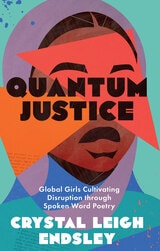
Quantum Justice
Global Girls Cultivating Disruption through Spoken Word PoetryCrystal Leigh Endsley
University of Texas Press, 2023
How girls of color from eight global communities strategize on questions of identity, social issues, and political policy through spoken word poetry.
Around the world, girls know how to perform. Grounded in her experience of “putting a mic in the margins” by facilitating workshops for girls in Ethiopia, South Africa, Tanzania, and the United States, scholar/advocate/artist Crystal Leigh Endsley highlights how girls use spoken word poetry to narrate their experiences, dreams, and strategies for surviving and thriving. By centering the process of creating and performing spoken word poetry, this book examines how girls forecast what is possible for their collective lives.
In this book, Endsley combines poetry, discourse analysis, photovoice, and more to forge the feminist theory of “quantum justice,” which forefronts girls’ relationships with their global counterparts. Using quantum justice theory, Endsley examines how these collaborative efforts produce powerful networks and ultimately map trajectories of social change at the micro level. By inviting transnational dialogue through spoken word poetry, Quantum Justice emphasizes how the imaginative energy in hip-hop culture can mobilize girls to connect and motivate each other through spoken word performance and thereby disrupt the status quo.
Quarter Notes
Improvisations and InterviewsCharles Wright
University of Michigan Press, 1995
This satisfying collection includes reminiscences and meditations on the details of memory and what it means to visit the past; the vices of titleism and the hydrosyllabic foot in poetry; a comparison of poems and journeys; appreciation of poets Donald Justice and John Crow Ransom; an attempt to define "image"; discussions of the current state of poetry; and various highlights from the Charles Wright Literary Festival.
Charles Wright's books of poetry include The World of the Ten Thousand Things and Country Music: Selected Early Poems. He received the 1993 Ruth Lilly Poetry Prize and the 1992 Award of Merit Medal from the American Academy of Arts and Letters. He is Souder Family Professor of English, University of Virginia.

Queen in Blue
Ambalila Hemsell
University of Wisconsin Press, 2020
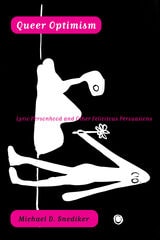
Queer Optimism
Lyric Personhood and Other Felicitous PersuasionsMichael D. Snediker
University of Minnesota Press, 2008
A new paradigm for queer theory
Michael Snediker offers a much-needed counterpoint to queer theoretical discourse, which has long privileged melancholy, self-shattering, incoherence, shame, and the death drive. Recovering the forms of positive affect that queer theory has jettisoned, Snediker insists that optimism must itself be taken beyond conventional tropes of hope and futurity and reimagined as necessary for critical engagement.
Through fresh, perceptive, and sensitive readings of the poetry of Emily Dickinson, Hart Crane, Jack Spicer, and Elizabeth Bishop, Snediker reveals that each of these poets demonstrated an interest in the durability of positive affects. Dickinson, Snediker argues, expresses joy and grace as much as pain and loss, and the myriad cryptic smiles in Hart Crane’s White Building contradict prevailing narratives of Crane’s apocryphal literary failures and eventual suicide. Snediker’s ambitious and sophisticated study, informed by thinkers such as Winnicott, Deleuze, and de Man, both supplements and challenges the work of queer theory’s leading figures, including Judith Butler, Leo Bersani, Eve Kosofsky Sedgwick, and Lee Edelman. Queer Optimism revises our understanding of queer love and affiliation, examining Spicer’s serial collusion with matinee idol Billy the Kid as well as the critically neglected force of Bishop’s epistolary and poetic reparations of the drowned figure of Hart Crane. In doing so, Snediker persuasively reconceives a theoretical field of optimism that was previously unavailable to scrupulous critical inquiry and provides a groundbreaking approach to modern American poetry and poetics.
Questions and Their Retinue
Selected Poems of Hatif JanabiHatif Janabi
University of Arkansas Press, 1996
Hatif Janabi’s poems are passionate, jolting, apocalyptic, and painful. They deal with war and death, perception and truth, drawing from his family life, his exile in Poland, the Gulf War, violence in Iraq, and his experience in the United States.
The speaker in many of Janabi’s poems moves from a confrontational stance to one of resigned desperation, and from coyness to deep longing, where, occasionally, hope surfaces. The associative processes and the often bizarre surreal imagery he employs are very effective in expressing his profound sense of political and spiritual alienation. Janabi is among a generation of Arab poets who, because of censorship, can speak only obliquely about the harsh reality of their lives. In these poems he has created symbolic landscapes that attempt to reveal the political, social, and psychological stresses with which suffering people live.
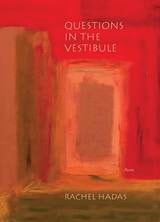
Questions in the Vestibule
PoemsRachel Hadas
Northwestern University Press, 2016
Rachel Hadas reaches the peak of her poetic prowess in Questions in the Vestibule. A deeply personal and meditative collection in three sections, Questions moves through the liminal space of solitude and the coded landscape of dreams toward the startling power of a life-changing love.
Hadas’s voice and her formal elegance, as distinctive and distinguished as ever, endow this new work with a precise and thoughtful beauty. Questions in the Vestibule takes readers into a new territory of unapologetic bliss.
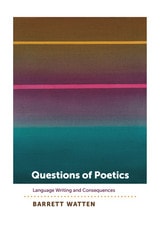
Questions of Poetics
Language Writing and ConsequencesBarrett Watten
University of Iowa Press, 2016
Each chapter is a theoretical inquiry into an aspect of poetics in an expanded sense—from the relation of experimental poetry to cultural logics of liberation and political economy, to questions of community and the politics of the avant-garde, to the cultural contexts where it is produced and intervenes. Each serves as a kind of thought experiment that theorizes and assesses the consequences of Language writing in expanded fields of meaning that include history, political theory, art history, and narrative theory. While all are grounded in a series of baseline questions of poetics, they also polemically address the currently turbulent debates on the politics of the avant-garde, especially Language writing, among emerging communities of poets.
In manifold ways, Watten masterfully demonstrates the aesthetic and political aims of Language writing, its influence on emerging literary schools, and its present aesthetic, critical, and political horizons. Questions of Poetics will be a major point of reference in continuing debates on poetry and literary history, a critical reexamination for already familiar readers and a clearly presented introduction for new ones.
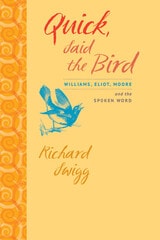
Quick, Said the Bird
Williams, Eliot, Moore, and the Spoken WordRichard Swigg
University of Iowa Press, 2012
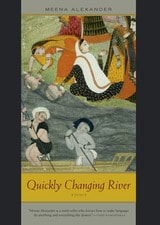
Quickly Changing River
PoemsMeena Alexander
Northwestern University Press, 2008
Recipient, 2008 Guggenheim Fellowship
With her strong voice and precise language, Meena Alexander has crafted this visceral, worldly collection of poems. The experience she brings to the reader is sensual in many senses of the word, as she invokes bright colors, sounds, smells, and feelings. Her use of vivid imagery from the natural world—birds, lilies, horses—up against that from the world of humans—oppression, slavery, and violence—ties her work to the earth even as she works a few mystical poetic transformations.
In Alexander’s world, the songs of a bird can become the voice of a girl in a café and the red juice of mulberries can be as shocking as blood. When she focuses her attention on the cloth of a girl’s sari, the material of a woman’s life, or the blood in her veins, she speaks to the particular experience of women in the world. The women are vividly present—sometimes they are hidden or veiled, juxtaposed with open gardens in full bloom. It is difficult not to come away from Quickly Changing River without a new sense of the power and frailty of being alive.

Quiet Armor
PoemsStevie Edwards
Northwestern University Press, 2023
Quiet Armor, the third full-length collection from poet Stevie Edwards, examines how capitalism and patriarchy impact romantic relationships and, more broadly, intimacy. Edwards considers the ways in which confessional performances of vulnerability can be coercive, whether popular culture encourages men to seek validation through sexual excess and aggression, and how we encourage women to be complicit in figurative and literal violence against other women.
Drawing on historical and mythological figures—including Medusa, Persephone, Shakespeare’s Lavinia, Saint Agatha, and Saint Christina—Edwards builds a fierce investigation into how rape culture has shaped the literary canon, academia, and the world at large. She brings readers into the quiet and intimate spaces we create despite trauma—or perhaps even because of it. Ultimately, Quiet Armor seeks to reclaim positive intimacy, showing us not only the desperate battles but also the healing embraces. All the while, these poems ask us: What does the end of rape culture look like? How do we get there?
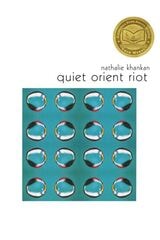
Quiet Orient Riot
Nathalie Khankan
Omnidawn, 2020
Most significantly, Quiet Orient Riot asks of itself, without release or relief: can a text seek linguistic disorientation and reorientation both? Can a text walk the tightrope from detail to detail to envision a kind of awareness that is kin to worship? Quiet Orient Riot does not shy away from a word like “worship.” Nor does it shy away from how such worship might manifest in the words of a poem, bowing to a “chirpy printed sound” in Palestine and a forest of “little justices.”
She is the winner of the 2019 Omnidawn 1st/2nd Poetry Book Contest, chosen by Dawn Lundy Martin.