Results by title
70 books match the query 'Postmodernism (Literature)' and 2 start with q
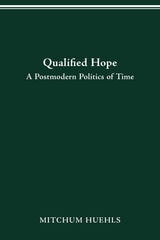
Qualified Hope
A Postmodern Politics of TimeMitchum Huehls
The Ohio State University Press, 2009
What is the political value of time, and where does that value reside? Should politics place its hope in future possibility, or does that simply defer action in the present? Can the present ground a vision of change, or is it too circumscribed by the status quo?
In Qualified Hope: A Postmodern Politics of Time, Mitchum Huehls contends that conventional treatments of time’s relationship to politics are limited by a focus on real-world experiences of time. By contrast, the innovative literary forms developed by authors in direct response to political events such as the Cold War, globalization, the emergence of identity politics, and 9/11 offer readers uniquely literary experiences of time. And it is in these literary experiences of time that Qualified Hope identifies more complicated—and thus more productive—ways to think about the time-politics relationship.
Qualified Hope challenges the conventional characterization of postmodernism as a period in which authors reject time in favor of space as the primary category for organizing experience and knowledge. And by identifying a common commitment to time at the heart of postmodern literature, Huehls suggests that the period-defining divide between multiculturalism and theory is not as stark as previously thought.
[more]
Questions of Travel
Postmodern Discourses of DisplacementCaren Kaplan
Duke University Press, 1996
Contemporary theory is replete with metaphors of travel—displacement, diaspora, borders, exile, migration, nomadism, homelessness, and tourism to name a few. In Questions of Travel, Caren Kaplan explores the various metaphoric uses of travel and displacement in literary and feminist theory, traces the political implications of this “traveling theory,” and shows how various discourses of displacement link, rather than separate, modernism and postmodernism.
Addressing a wide range of writers, including Paul Fussell, Edward Said, James Clifford, Gilles Deleuze, Jean Baudrillard, Gayatri Spivak, Edward Soja, Doreen Massey, Chandra Mohanty, and Adrienne Rich, Kaplan demonstrates that symbols and metaphors of travel are used in ways that obscure key differences of power between nationalities, classes, races, and genders. Neither rejecting nor dismissing the powerful testimony of individual experiences of modern exile or displacement, Kaplan asks how mystified metaphors of travel might be avoided. With a focus on theory’s colonial discourses, she reveals how these metaphors continue to operate in the seemingly liberatory critical zones of poststructuralism and feminist theory. The book concludes with a critique of the politics of location as a form of essentialist identity politics and calls for new feminist geographies of place and displacement.
Addressing a wide range of writers, including Paul Fussell, Edward Said, James Clifford, Gilles Deleuze, Jean Baudrillard, Gayatri Spivak, Edward Soja, Doreen Massey, Chandra Mohanty, and Adrienne Rich, Kaplan demonstrates that symbols and metaphors of travel are used in ways that obscure key differences of power between nationalities, classes, races, and genders. Neither rejecting nor dismissing the powerful testimony of individual experiences of modern exile or displacement, Kaplan asks how mystified metaphors of travel might be avoided. With a focus on theory’s colonial discourses, she reveals how these metaphors continue to operate in the seemingly liberatory critical zones of poststructuralism and feminist theory. The book concludes with a critique of the politics of location as a form of essentialist identity politics and calls for new feminist geographies of place and displacement.
[more]