1325 books match the query 'Psychology' and 9 start with q
cover of Quasi Rational Economics

Quasi Rational Economics

Richard H. Thaler

Russell Sage Foundation, 1991
Standard economics theory is built on the assumption that human beings act rationally in their own self interest. But if rationality is such a reliable factor, why do economic models so often fail to predict market behavior accurately? According to Richard Thaler, the shortcomings of the standard approach arise from its failure to take into account systematic mental biases that color all human judgments and decisions.
[more]
cover of Queer Livability: German Sexual Sciences and Life Writing

Queer Livability

German Sexual Sciences and Life Writing

Ina Linge

University of Michigan Press, 2023

Finalist: Waterloo Centre for German Studies Book Prize | December 10, 2024

This book brings together an exciting new archive of queer and trans voices from the history of sexual sciences in the German-speaking world. A new language to express possibilities of gender and sexuality emerged at the turn of the twentieth century, from Sigmund Freud’s theories of homosexuality in Vienna to Magnus Hirschfeld’s “third sex” in Berlin. Together, they provided a language of sex and sexuality that is still recognizable today. Queer Livability: German Sexual Sciences and Life Writing shows that individual voices of trans and queer writers had a significant impact on the production of knowledge about gender and sexuality during this time and introduces lesser known texts to a new readership. It shows the remarkable power of queer life writing in imagining and creating the possibilities of a livable life in the face of restrictive legal, medical, and social frameworks.

Queer Livability: German Sexual Sciences and Life Writing will be of interest to anyone who wants to learn more about LGBTQ+ history and literature. It also provides a fascinating insight into the historical roots for our thinking about gender and sexuality today. The book will be of relevance to an academic readership of students and faculty in German studies, literary studies, European history, and the interdisciplinary fields of gender and sexuality studies, medical humanities, and the history of sexuality.
[more]
cover of Queering Mesoamerican Diasporas: Remembering Xicana Indigena Ancestries

Queering Mesoamerican Diasporas

Remembering Xicana Indigena Ancestries

Susy J. Zepeda

University of Illinois Press, 2022

Acts of remembering offer a path to decolonization for Indigenous peoples forcibly dislocated from their culture, knowledge, and land. Susy J. Zepeda highlights the often overlooked yet intertwined legacies of Chicana feminisms and queer decolonial theory through the work of select queer Indígena cultural producers and thinkers. By tracing the ancestries and silences of gender-nonconforming people of color, she addresses colonial forms of epistemic violence and methods of transformation, in particular spirit research. Zepeda also uses archival materials, raised ceremonial altars, and analysis of decolonial artwork in conjunction with oral histories to explore the matriarchal roots of Chicana/x and Latina/x feminisms. As she shows, these feminisms are forms of knowledge that people can remember through Indigenous-centered visual narratives, cultural wisdom, and spirit practices.

A fascinating exploration of hidden Indígena histories and silences, Queering Mesoamerican Diasporas blends scholarship with spirit practices to reimagine the root work, dis/connection to land, and the political decolonization of Xicana/x peoples.
[more]
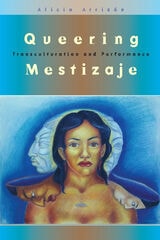
cover of Queering Mestizaje: Transculturation and Performance

Queering Mestizaje

Transculturation and Performance

Alicia Arrizón

University of Michigan Press, 2006
Queering Mestizaje employs theories of postcolonial cultural studies (including performance studies, queer and feminist theory) to examine the notion of mestizaje---the mixing of races, and specifically indigenous peoples, with European colonizers---and how this phenomenon manifests itself in three geographically diverse spaces: the United States, Latin America, and the Philippines. Alicia Arrizón argues that, as an imaginary site for racialized, gendered, and sexualized identities, mestizaje raises questions about historical transformation and cultural memory across Spanish postcolonial sites. Arrizón offers new, queer readings of the hybrid, the intercultural body, and the hyphenated self, building on the work of Gloria Anzaldúa, Antonio Benitez-Rojo, Walter Mignolo, and Vera Kutzinski, while challenging accepted discourses about the relationship between colonizer and colonized. Queering Mestizaje is unique in the connections it makes between the Spanish colonial legacy in the Philippines and in the Americas. An engagingly eclectic array of cultural materials---including examples from performance art, colonial literature, visual art, fashion, and consumer products---are discussed, and included in the book's twenty-nine illustrations. "Arrizón takes as her point of departure the connections and distinctions between the four keywords in the title (each with a long, specific, and convoluted history in its own right) while bringing together the Philippines, the Hispanophone Caribbean, and the United States to configure a map carved by the same blade of colonialism and imperialism. In its conjoining of queer, mestizaje, transculturation and performance, the pleasurable and enlightening variety of its textual examples, and its commitment to theorize desire from the space of queer mestizaje, her book makes a unique and accomplished contribution." ---Yvonne Yarbro-Bejarano, Stanford University Alicia Arrizón is Professor of Women's Studies at the University of California, Riverside. She is author of Latina Performance: Traversing the Stage and co-editor of Latinas on Stage: Practice and Theory. Illustration: Judith F. Baca, La Mestizaje (1991), pastel on paper. © SPARC.
[more]
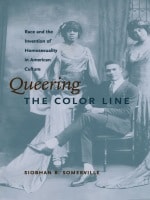
cover of Queering the Color Line: Race and the Invention of Homosexuality in American Culture

Queering the Color Line

Race and the Invention of Homosexuality in American Culture

Siobhan B. Somerville

Duke University Press, 2000

Queering the Color Line transforms previous understandings of how homosexuality was “invented” as a category of identity in the United States beginning in the late nineteenth century. Analyzing a range of sources, including sexology texts, early cinema, and African American literature, Siobhan B. Somerville argues that the emerging understanding of homosexuality depended on the context of the black/white “color line,” the dominant system of racial distinction during this period. This book thus critiques and revises tendencies to treat race and sexuality as unrelated categories of analysis, showing instead that race has historically been central to the cultural production of homosexuality.
At about the same time that the 1896 Supreme Court Plessy v. Ferguson decision hardened the racialized boundary between black and white, prominent trials were drawing the public’s attention to emerging categories of sexual identity. Somerville argues that these concurrent developments were not merely parallel but in fact inextricably interrelated and that the discourses of racial and sexual “deviance” were used to reinforce each other’s terms. She provides original readings of such texts as Havelock Ellis’s late nineteenth-century work on “sexual inversion,” the 1914 film A Florida Enchantment, the novels of Pauline E. Hopkins, James Weldon Johnson’s Autobiography of an Ex-Coloured Man, and Jean Toomer’s fiction and autobiographical writings, including Cane. Through her analyses of these texts and her archival research, Somerville contributes to the growing body of scholarship that focuses on discovering the intersections of gender, race, and sexuality.
Queering the Color Line will have broad appeal across disciplines including African American studies, gay and lesbian studies, literary criticism, cultural studies, cinema studies, and gender studies.
[more]
cover of Querying Consent: Beyond Permission and Refusal

Querying Consent

Beyond Permission and Refusal

Jordana Greenblatt, Keja Valens

Rutgers University Press, 2018
Querying Consent examines the ways in which the concept of consent is used to map and regulate sexual desire, gender relationships, global positions, technological interfaces, relationships of production and consumption, and literary and artistic interactions. From philosophy to literature, psychoanalysis to the art world, the contributors to Querying Consent address the most uncomfortable questions about consent today. Grounded in theoretical explorations of the entanglement of consent and subjectivity across a range of textual, visual, multi- and digital media, Querying Consent considers the relationships between consent and agency before moving on to trace the concept’s outcomes through a range of investigations of the mutual implication of personhood and self-ownership.
[more]
cover of Questions About Questions: Inquiries into the Cognitive Bases of Surveys

Questions About Questions

Inquiries into the Cognitive Bases of Surveys

Judith M. Tanur

Russell Sage Foundation, 1992
The social survey has become an essential tool in modern society, providing crucial measurements of social change, describing social life, and guiding government policy. But the validity of surveys is fragile and depends ultimately upon the accuracy of answers to survey questions. As our dependence on surveys grows, so too have questions about the accuracy of survey responses. Authored by a group of experts in cognitive psychology, linguistics, and survey research, Questions About Questions provides a broad review of the survey response problem. Examining the cognitive and social processes that influence the answers to questions, the book first takes up the problem of meaning and demonstrates that a respondent must share the survey researcher's intended meaning of a question if the response is to be revealing and informative. The book then turns to an examination of memory. It provides a framework for understanding the processes that can introduce errors into retrospective reports, useful guidance on when those reports are more or less trustworthy, and investigates techniques for the improvement of such reports. Questions about the rigid standardization imposed on the survey interview receive a thorough airing as the authors show how traditional survey formats violate the usual norms of conversational behavior and potentially endanger the validity of the data collected. Synthesizing the work of the Social Science Research Council's Committee on Cognition and Survey Research, Questions About Questions emphasizes the reciprocal gains to be achieved when insights and techniques from the cognitive sciences and survey research are exchanged. "these chapters provide a good sense of the range of survey problems investigated by the cognitive movement, the methods and ideas it draws upon, and the results it has yielded." —American Journal of Sociology
[more]
cover of Quoting Caravaggio: Contemporary Art, Preposterous History

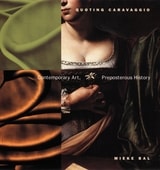
Quoting Caravaggio

Contemporary Art, Preposterous History

Mieke Bal

University of Chicago Press, 1999

As period, as style, as sensibility, the Baroque remains elusive, its definition subject to dispute. Perhaps this is so in part because baroque vision resists separation of mind and body, form and matter, line and color, image and discourse. In Quoting Caravaggio, Mieke Bal deploys this insight of entanglement as a form of art analysis, exploring its consequences for both contemporary and historical art, as well as for current conceptions of history.

Mieke Bal’s primary object of investigation in Quoting Caravaggio is not the great seventeenth-century painter, but rather the issue of temporality in art. In order to retheorize linear notions of influence in cultural production, Bal analyzes the productive relationship between Caravaggio and a number of late-twentieth-century artists who "quote" the baroque master in their own works. These artists include Andres Serrano, Carrie Mae Weems, Ken Aptekar, David Reed, and Ana Mendieta, among others. Each chapter of Quoting Caravaggio shows particular ways in which quotation is vital to the new art but also to the source from which it is derived. Through such dialogue between present and past, Bal argues for a notion of "preposterous history" where works that appear chronologically first operate as an aftereffect caused by the images of subsequent artists.

Quoting Caravaggio is a rigorous, rewarding work: it is at once a meditation on history as creative, nonlinear process; a study of the work of Caravaggio and the Baroque; and, not least, a brilliant critical exposition of contemporary artistic representation and practice.


"[A] profoundly enlivening exercise in art criticism, in which the lens of theory magnifies rather than diminishes its object. . . . [A] remarkable book. . . . The power of Quoting Caravaggio resides in the intelligence and authority of the writer."—Roger Malbert, Times Literary Supplement

[more]
cover of Qu’est-ce que le sexe ?

Qu’est-ce que le sexe ?

Alenka Zupancic

Diaphanes, 2019

La satisfaction de parler contient en soi une clé de la satisfaction sexuelle (et non ­l‘inverse) – une clé de la sexualité et de ses propres contradictions. Alenka Zupančič aborde la question de la sexualité comme un problème proprement philosophique de la psychanalyse – celle de Freud et de Lacan – et non celle des praticiens cliniciens tels que décrits par Lacan « orthopédistes de l‘inconscient ». Que se passe-t-il, comme l’affirme Lacan, si nous pouvons obtenir exactement la même satisfaction que le sexe par la parole, l’écriture, la peinture, la prière ou autres activités) ? Il ne s’agit pas d‘expliquer la satisfaction que procure la parole en indiquant son origine sexuelle, mais bien de souligner que la satisfaction de parler est elle-même sexuelle.
Alenka Zupančič soutient que la sexualité est à la limite d’un « circuit court » entre ontologie et épistémologie. La sexualité et le savoir sont structurés autour d‘une négativité fondamentale qui les unit au point de l’inconscient. L’inconscient (en tant que lien avec la sexualité) est le concept d‘un lien inhérent entre l’être et la connaissance dans leur négativité même.
[more]