1201 books match the query 'Race relations' and 4 start with q
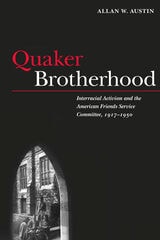
cover of Quaker Brotherhood: Interracial Activism and the American Friends Service Committee, 1917-1950

Quaker Brotherhood

Interracial Activism and the American Friends Service Committee, 1917-1950

Allan W. Austin

University of Illinois Press, 2012
 
The Religious Society of Friends and its service organization, the American Friends Service Committee (AFSC) have long been known for their peace and justice activism. The abolitionist work of Friends during the antebellum era has been well documented, and their contemporary anti-war and anti-racism work is familiar to activists around the world. Quaker Brotherhood is the first extensive study of the AFSC's interracial activism in the first half of the twentieth century, filling a major gap in scholarship on the Quakers' race relations work from the AFSC's founding in 1917 to the beginnings of the civil rights movement in the early 1950s.
 
Allan W. Austin tracks the evolution of key AFSC projects such as the Interracial Section and the American Interracial Peace Committee, which demonstrate the tentativeness of the Friends' activism in the 1920s, as well as efforts in the 1930s to make scholarly ideas and activist work more theologically relevant for Friends. Documenting the AFSC's efforts to help European and Japanese American refugees during World War II, Austin shows that by 1950, Quakers in the AFSC had honed a distinctly Friendly approach to interracial relations that combined scholarly understandings of race with their religious views.
 
In tracing the transformation of one of the most influential social activist groups in the United States over the first half of the twentieth century, Quaker Brotherhood presents Friends in a thoughtful, thorough, and even-handed manner. Austin portrays the history of the AFSC and race--highlighting the organization's boldness in some aspects and its timidity in others--as an ongoing struggle that provides a foundation for understanding how shared agency might function in an imperfect and often racist world.
 
Highlighting the complicated and sometimes controversial connections between Quakers and race during this era, Austin uncovers important aspects of the history of Friends, pacifism, feminism, American religion, immigration, ethnicity, and the early roots of multiculturalism.
[more]
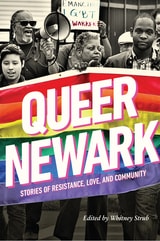
cover of Queer Newark: Stories of Resistance, Love, and Community

Queer Newark

Stories of Resistance, Love, and Community

Whitney Strub

Rutgers University Press, 2024

NJSAA Edited Works Award Winner (2024) 

Histories of gay and lesbian urban life typically focus on major metropolitan areas like San Francisco and New York, opportunity-filled destinations for LGBTQ migrants from across the country. Yet there are many other queer communities in economically depressed cities with majority Black and Hispanic populations that receive far less attention. Though just a few miles from New York, Newark is one of these cities, and its queer histories have been neglected—until now. 
 
Queer Newark charts a history in which working-class people of color are the central actors and in which violence, poverty, and homophobia could never suppress joy, resistance, love, and desire. Drawing from rare archives that range from oral histories to vice squad reports, this collection’s authors uncover the sites and people of Newark’s queer past in bars, discos, ballrooms, and churches. Exploring the intersections of class, race, gender, and sexuality, they offer fresh perspectives on the HIV/AIDS epidemic, community relations with police, Latinx immigration, and gentrification, while considering how to best tell the rich and complex stories of queer urban life. Queer Newark reveals a new side of New Jersey’s largest city while rewriting the history of LGBTQ life in America. 
 
[more]
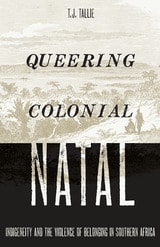
cover of Queering Colonial Natal: Indigeneity and the Violence of Belonging in Southern Africa

Queering Colonial Natal

Indigeneity and the Violence of Belonging in Southern Africa

T. J. Tallie

University of Minnesota Press, 2019

How were indigenous social practices deemed queer and aberrant by colonial forces?


In Queering Colonial Natal, T.J. Tallie travels to colonial Natalestablished by the British in 1843, today South Africa’s KwaZulu-Natal provinceto show how settler regimes “queered” indigenous practices. Defining them as threats to the normative order they sought to impose, they did so by delimiting Zulu polygamy; restricting alcohol access, clothing, and even friendship; and assigning only Europeans to government schools. 

Using queer and critical indigenous theory, this book critically assesses Natal (where settlers were to remain a minority) in the context of the global settler colonial project in the nineteenth century to yield a new and engaging synthesis. Tallie explores the settler colonial history of Natal’s white settlers and how they sought to establish laws and rules for both whites and Africans based on European mores of sexuality and gender. At the same time, colonial archives reveal that many African and Indian people challenged such civilizational claims. 

Ultimately Tallie argues that the violent collisions between Africans, Indians, and Europeans in Natal shaped the conceptions of race and gender that bolstered each group’s claim to authority. 
[more]
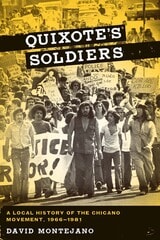
cover of Quixote's Soldiers: A Local History of the Chicano Movement, 1966–1981

Quixote's Soldiers

A Local History of the Chicano Movement, 1966–1981

By David Montejano

University of Texas Press, 2010

In the mid-1960s, San Antonio, Texas, was a segregated city governed by an entrenched Anglo social and business elite. The Mexican American barrios of the west and south sides were characterized by substandard housing and experienced seasonal flooding. Gang warfare broke out regularly. Then the striking farmworkers of South Texas marched through the city and set off a social movement that transformed the barrios and ultimately brought down the old Anglo oligarchy. In Quixote’s Soldiers, David Montejano uses a wealth of previously untapped sources, including the congressional papers of Henry B. Gonzalez, to present an intriguing and highly readable account of this turbulent period. Montejano divides the narrative into three parts. In the first part, he recounts how college student activists and politicized social workers mobilized barrio youth and mounted an aggressive challenge to both Anglo and Mexican American political elites. In the second part, Montejano looks at the dynamic evolution of the Chicano movement and the emergence of clear gender and class distinctions as women and ex-gang youth struggled to gain recognition as serious political actors. In the final part, Montejano analyzes the failures and successes of movement politics. He describes the work of second-generation movement organizations that made possible a new and more representative political order, symbolized by the election of Mayor Henry Cisneros in 1981.
[more]