Results by title
939 books match the query 'Religious aspects' and 3 start with q
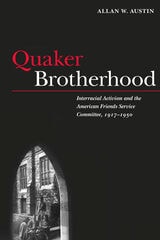
Quaker Brotherhood
Interracial Activism and the American Friends Service Committee, 1917-1950Allan W. Austin
University of Illinois Press, 2012
The Religious Society of Friends and its service organization, the American Friends Service Committee (AFSC) have long been known for their peace and justice activism. The abolitionist work of Friends during the antebellum era has been well documented, and their contemporary anti-war and anti-racism work is familiar to activists around the world. Quaker Brotherhood is the first extensive study of the AFSC's interracial activism in the first half of the twentieth century, filling a major gap in scholarship on the Quakers' race relations work from the AFSC's founding in 1917 to the beginnings of the civil rights movement in the early 1950s.
Allan W. Austin tracks the evolution of key AFSC projects such as the Interracial Section and the American Interracial Peace Committee, which demonstrate the tentativeness of the Friends' activism in the 1920s, as well as efforts in the 1930s to make scholarly ideas and activist work more theologically relevant for Friends. Documenting the AFSC's efforts to help European and Japanese American refugees during World War II, Austin shows that by 1950, Quakers in the AFSC had honed a distinctly Friendly approach to interracial relations that combined scholarly understandings of race with their religious views.
In tracing the transformation of one of the most influential social activist groups in the United States over the first half of the twentieth century, Quaker Brotherhood presents Friends in a thoughtful, thorough, and even-handed manner. Austin portrays the history of the AFSC and race--highlighting the organization's boldness in some aspects and its timidity in others--as an ongoing struggle that provides a foundation for understanding how shared agency might function in an imperfect and often racist world.
Highlighting the complicated and sometimes controversial connections between Quakers and race during this era, Austin uncovers important aspects of the history of Friends, pacifism, feminism, American religion, immigration, ethnicity, and the early roots of multiculturalism.
[more]
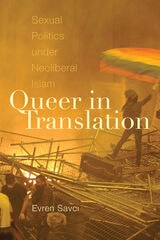
Queer in Translation
Sexual Politics under Neoliberal IslamEvren Savci
Duke University Press, 2021
In Queer in Translation, Evren Savcı analyzes the travel and translation of Western LGBT political terminology to Turkey in order to illuminate how sexual politics have unfolded under Recep Tayyip Erdoğan's AKP government. Under the AKP's neoliberal Islamic regime, Savcı shows, there has been a stark shift from a politics of multicultural inclusion to one of securitized authoritarianism. Drawing from ethnographic work with queer activist groups to understand how discourses of sexuality travel and are taken up in political discourse, Savcı traces the intersection of queerness, Islam, and neoliberal governance within new and complex regimes of morality. Savcı turns to translation as a queer methodology to think Islam and neoliberalism together and to evade the limiting binaries of traditional/modern, authentic/colonial, global/local, and East/West—thereby opening up ways of understanding the social movements and political discourse that coalesce around sexual liberation in ways that do justice to the complexities both of what circulates under the signifier Islam and of sexual political movements in Muslim-majority countries.
[more]
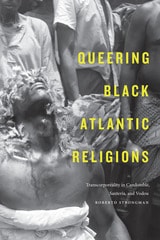
Queering Black Atlantic Religions
Transcorporeality in Candomblé, Santería, and VodouRoberto Strongman
Duke University Press, 2019
In Queering Black Atlantic Religions Roberto Strongman examines Haitian Vodou, Cuban Lucumí/Santería, and Brazilian Candomblé to demonstrate how religious rituals of trance possession allow humans to understand themselves as embodiments of the divine. In these rituals, the commingling of humans and the divine produces gender identities that are independent of biological sex. As opposed to the Cartesian view of the spirit as locked within the body, the body in Afro-diasporic religions is an open receptacle. Showing how trance possession is a primary aspect of almost all Afro-diasporic cultural production, Strongman articulates transcorporeality as a black, trans-Atlantic understanding of the human psyche, soul, and gender as multiple, removable, and external to the body.
[more]