Results by title
254 books match the query 'Sex' and 5 start with q
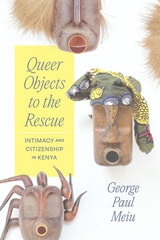
Queer Objects to the Rescue
Intimacy and Citizenship in KenyaGeorge Paul Meiu
University of Chicago Press, 2023
Examines forms of intimate citizenship that have emerged in relation to growing anti-homosexual violence in Kenya.
Campaigns calling on police and citizens to purge their countries of homosexuality have taken hold across the world. But the “homosexual threat” they claim to be addressing is not always easy to identify. To make that threat visible, leaders, media, and civil society groups have deployed certain objects as signifiers of queerness. In Kenya, for example, bead necklaces, plastics, and even diapers have come to represent the danger posed by homosexual behavior to an essentially “virile” construction of national masculinity.
In Queer Objects tothe Rescue, George Paul Meiu explores objects that have played an important and surprising role in both state-led and popular attempts to rid Kenya of various imagined threats to intimate life. Meiu shows that their use in the political imaginary has been crucial to representing the homosexual body as a societal threat and as a target of outrage, violence, and exclusion, while also crystallizing anxieties over wider political and economic instability. To effectively understand and critique homophobia, Meiu suggests, we must take these objects seriously and recognize them as potential sources for new forms of citizenship, intimacy, resistance, and belonging.
[more]
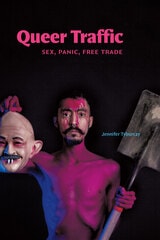
Queer Traffic
Sex, Panic, Free TradeJennifer Tyburczy
Duke University Press, 2025
In Queer Traffic, Jennifer Tyburczy traces how sexual dissidents across the Mexico-Canada-US borderlands transport the objects and experiences that nourish their sexual and social lives. She situates the North American Free Trade Agreement (NAFTA) as a pivot point in the formation of panics aimed at stamping out these outlaw sex practices. Highlighting NAFTA’s erotic investments in hetero- and homonormativity, racial capitalism, markets of dispossession, and neocolonialism, Tyburczy directly engages with art, activism, and archives to revisit the struggles of people who invented circuits of sexual exchange through four decades of violence and criminalization. In conversing with actors from bureaucrats to pornographers and in studying choreographies, social movements, and street vocabularies, she examines an array of tactics that undermine the market logics of trade law and policy. Dreaming of other forms of living that go beyond mere survival, Queer Traffic guides us through the renegade pathways that circumvent the seemingly endless reach of free-trade capitalism toward other routes to pleasure.
[more]
Queer Velocities
Time, Sex, and Biopower on the Early Modern StageJennifer Eun-Jung Row
Northwestern University Press, 2022
Queer Velocities: Time, Sex, and Biopower on the Early Modern Stage explores how seventeenth-century French theater represents queer desire. In this book, the first queer theoretical treatment of canonical French theater, Jennifer Eun-Jung Row proposes that these velocities, moments of unseemly haste or strategic delay, sparked new kinds of attachments, intimacies, and erotics. Rather than rely on fixed identities or analog categories, we might turn to these affectively saturated moments of temporal sensation to analyze queerness in the premodern world.
The twin innovations of precise, portable timepieces and the development of the theater as a state institution together ignited new types of embodiments, orderly and disorderly pleasures, and normative and wayward rhythms of life. Row leverages a painstakingly formalist and rhetorical analysis of tragedies by Jean Racine and Pierre Corneille to show how the staging of delay or haste can critically interrupt the normative temporalities of marriage, motherhood, mourning, or sovereignty—the quotidian rhythms and paradigms so necessary for the biopolitical management of life. Row’s approach builds on the queer turn to temporality and Elizabeth Freeman’s notion of the chronobiopolitical to wager that queerness can also be fostered by the sensations of disruptive speed and slowness. Ultimately, Row suggests that the theater not only contributed to the glitter of Louis XIV’s absolutist spectacle but also ignited new forms of knowing and feeling time, as well as new modes of loving, living, and being together.
The twin innovations of precise, portable timepieces and the development of the theater as a state institution together ignited new types of embodiments, orderly and disorderly pleasures, and normative and wayward rhythms of life. Row leverages a painstakingly formalist and rhetorical analysis of tragedies by Jean Racine and Pierre Corneille to show how the staging of delay or haste can critically interrupt the normative temporalities of marriage, motherhood, mourning, or sovereignty—the quotidian rhythms and paradigms so necessary for the biopolitical management of life. Row’s approach builds on the queer turn to temporality and Elizabeth Freeman’s notion of the chronobiopolitical to wager that queerness can also be fostered by the sensations of disruptive speed and slowness. Ultimately, Row suggests that the theater not only contributed to the glitter of Louis XIV’s absolutist spectacle but also ignited new forms of knowing and feeling time, as well as new modes of loving, living, and being together.
[more]
Queer in Russia
A Story of Sex, Self, and the OtherLaurie Essig
Duke University Press, 1999
In Queer in Russia Laurie Essig examines the formation of gay identity and community in the former Soviet Union. As a sociological fieldworker, she began her research during the late 1980s, before any kind of a public queer identity existed in that country. After a decade of conducting interviews, as well as observing and analyzing plays, books, pop music, and graffiti, Essig presents the first sustained study of how and why there was no Soviet gay community or even gay identity before perestroika and the degree to which this situation has—or has not—changed.
While male homosexual acts were criminalized in Russia before 1993, women attracted to women were policed by the medical community, who saw them less as criminals than as diseased persons potentially cured by drug therapy or transsexual surgery. After describing accounts of pre-perestroika persecution, Essig examines the more recent state of sexual identities in Russia. Although the fall of communism brought new freedom to Russian queers, there are still no signs of a mass movement forming around the issue, and few identify themselves as lesbians or gay men, even when they are involved in same-sex relations. Essig does reveal, however, vibrant manifestations of gay life found at the local level—in restaurants, discos, clubs, and cruising strips, in newspapers, journals, literature, and the theater. Concluding with a powerful exploration of the surprising affinities between some of Russia’s most prominent nationalists and its queers, Queer in Russia fills a gap in both Russian and cultural studies.
While male homosexual acts were criminalized in Russia before 1993, women attracted to women were policed by the medical community, who saw them less as criminals than as diseased persons potentially cured by drug therapy or transsexual surgery. After describing accounts of pre-perestroika persecution, Essig examines the more recent state of sexual identities in Russia. Although the fall of communism brought new freedom to Russian queers, there are still no signs of a mass movement forming around the issue, and few identify themselves as lesbians or gay men, even when they are involved in same-sex relations. Essig does reveal, however, vibrant manifestations of gay life found at the local level—in restaurants, discos, clubs, and cruising strips, in newspapers, journals, literature, and the theater. Concluding with a powerful exploration of the surprising affinities between some of Russia’s most prominent nationalists and its queers, Queer in Russia fills a gap in both Russian and cultural studies.
[more]
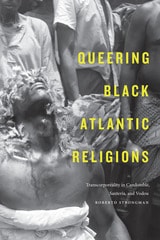
Queering Black Atlantic Religions
Transcorporeality in Candomblé, Santería, and VodouRoberto Strongman
Duke University Press, 2019
In Queering Black Atlantic Religions Roberto Strongman examines Haitian Vodou, Cuban Lucumí/Santería, and Brazilian Candomblé to demonstrate how religious rituals of trance possession allow humans to understand themselves as embodiments of the divine. In these rituals, the commingling of humans and the divine produces gender identities that are independent of biological sex. As opposed to the Cartesian view of the spirit as locked within the body, the body in Afro-diasporic religions is an open receptacle. Showing how trance possession is a primary aspect of almost all Afro-diasporic cultural production, Strongman articulates transcorporeality as a black, trans-Atlantic understanding of the human psyche, soul, and gender as multiple, removable, and external to the body.
[more]