661 books match the query 'South America' and 2 start with q

cover of Queen for a Day: Transformistas, Beauty Queens, and the Performance of Femininity in Venezuela

Queen for a Day

Transformistas, Beauty Queens, and the Performance of Femininity in Venezuela

Marcia Ochoa

Duke University Press, 2014

Queen for a Day connects the logic of Venezuelan modernity with the production of a national femininity. In this ethnography, Marcia Ochoa considers how femininities are produced, performed, and consumed in the mass-media spectacles of international beauty pageants, on the runways of the Miss Venezuela contest, on the well-traveled Caracas avenue where transgender women (transformistas) project themselves into the urban imaginary, and on the bodies of both transformistas and beauty pageant contestants (misses). Placing transformistas and misses in the same analytic frame enables Ochoa to delve deeply into complex questions of media and spectacle, gender and sexuality, race and class, and self-fashioning and identity in Venezuela.

Beauty pageants play an outsized role in Venezuela. The country has won more international beauty contests than any other. The femininity performed by Venezuelan women in high-profile, widely viewed pageants defines a kind of national femininity. Ochoa argues that as transformistas and misses work to achieve the bodies, clothing and makeup styles, and postures and gestures of this national femininity, they come to embody Venezuelan modernity.
[more]
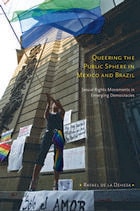
cover of Queering the Public Sphere in Mexico and Brazil: Sexual Rights Movements in Emerging Democracies

Queering the Public Sphere in Mexico and Brazil

Sexual Rights Movements in Emerging Democracies

Rafael de la Dehesa

Duke University Press, 2010

Queering the Public Sphere in Mexico and Brazil is a groundbreaking comparative analysis of the historical development and contemporary dynamics of LGBT activism in Latin America’s two largest democracies. Rafael de la Dehesa focuses on the ways that LGBT activists have engaged with the state, particularly in alliance with political parties and through government health agencies in the wake of the AIDS crisis. He examines this engagement against the backdrop of the broader political transitions to democracy, the neoliberal transformation of state–civil society relations, and the gradual consolidation of sexual rights at the international level. His comparison highlights similarities between sexual rights movements in Mexico and Brazil, including a convergence on legislative priorities such as antidiscrimination laws and the legal recognition of same-sex couples. At the same time, de la Dehesa points to notable differences in the tactics deployed by activists and the coalitions brought to bear on the state.

De la Dehesa studied the archives of activists, social-movement organizations, political parties, religious institutions, legislatures, and state agencies, and he interviewed hundreds of individuals, not only LGBT activists, but also feminists, AIDS and human-rights activists, party militants, journalists, academics, and state officials. He marshals his prodigious research to reveal the interplay between evolving representative institutions and LGBT activists’ entry into the political public sphere in Latin America, offering a critical analysis of the possibilities opened by emerging democratic arrangements, as well as their limitations. At the same time, exploring activists’ engagement with the international arena, he offers new insights into the diffusion and expression of transnational norms inscribing sexual rights within a broader project of liberal modernity. Queering the Public Sphere in Mexico and Brazil is a landmark examination of LGBT political mobilization.

[more]