Results by title
18284 books match the query 'United States' and 47 start with q
Q & A Queer And Asian
Queer & Asian In AmericaAlvin Eng
Temple University Press, 1998
Q & A approaches matters of identity from a variety of points of view and academic disciplines in order to explore the multiple crossings of race and ethnicity with sexuality and gender. Drawing together the work of visual artists, fiction writers, community organizers, scholars, and participants in roundtable discussions, the collection gathers an array of voices and experiences that represent the emerging communities of a queer Asian America. Collectively, these contributors contend that Asian American studies needs to be more attentive to issues of sexuality and that queer studies needs to be more attentive to other aspects of difference, especially race and ethnicity. Vigorously rejecting the notion that a symmetrical relationship between race and homosexuality would weaken lesbian/gay and queer movements, the editors refuse to "believe that a desirably queer world is one in which we remain perpetual aliens -- queer houseguests -- in a queer nation."
Qtopia
A Memoir of Love, Land, and LiberationJuda Bennett
University of Wisconsin Press, 2026
In the 1970s, while communes bloomed like wildflowers across the land, most had no room for queer members. The so-called counterculture still clung to heterosexual norms, even as it preached freedom from traditional gender roles and the nuclear family. Juda Bennett’s engrossing memoir follows his escape from suburbia into the back-to-the-land movement—and chronicles the efforts it took for him to “drop back in” to mainstream society and the ways in which he and his compatriots continued to honor their communal vision.
After enduring the hollow promises of “progressive” communes, Bennett finally found what he didn’t know he was looking for at Lavender Hill, a rural queer commune of visionaries carving out a life beyond heteronormativity, beyond capitalism, beyond shame. They didn’t just survive; they built something messy, luminous, and defiantly alive. And when the commune began to unravel, they didn’t vanish. They evolved. Qtopia is a story of chosen family and radical transformation. It is a reminder that queer utopia isn’t behind us—it’s still out there on the horizon, singing its song of joy, defiance, and fabulousness.
Quabbin
The Accidental WildernessThomas Conuel
University of Massachusetts Press, 1990
When one looks out on the quiet waters and forested hills of Quabbin Reservoir in west central Massachusetts, it is hard to imagine that the area was once dotted with buildings and farmlands or that it echoed with the activity of several villages and towns. Today, the daytime silence may be broken only by the cry of a hawk overhead or the slap of a plunging fish, and the evening calm, by the lonesome howl of a coyote. But in the nineteenth century, things were quite different.
In 1895, engineers for the Metropolitan Water Board began to search the state of Massachusetts for a site on which to construct a reservoir to supply water for the growing city of Boston. Sixty-five miles west of the city, in a region of high hills and running streams known as the Swift River Valley, they found what they were looking for. When Quabbin Reservoir was finally completed and filled in 1946, the engineers had created the third largest body of fresh water in New England and hand accomplished one of the larger public works projects of its time. They had also uprooted and displaced the valley's inhabitants, leveled and flooded four towns and six villages—and formed a magnificent wilderness on some 85,000 acres.
The valley that was once known for its picturesque villages and mill ponds is now, over forty years later, home to a wide array of wildlife. Coyote, bobcat, and deer flourish, and Quabbin's eagle restoration project, begun in 1982, produced the first nesting pair of bald eagles in Massachusetts in almost a century. Today, the bald eagle population at Quabbin is estimated at forty-one birds.
But this accidental wilderness is being increasingly threatened. As early as the 1950s, the sounds of power boats occasionally intruded on the peaceful silence of the waters. In more recent years, acid rain, ozone and other pollutants, the ravages of a herd of hungry deer, and demands for increased recreational use are all jeopardizing Quabbin's waters and forests.
This book tells the story of Quabbin, tracing Quabbin's history, describing its natural resources, and discussing the environmental challenges it currently faces. The original edition, issued by the Massachusetts Audubon Society in 1981, has now been expanded and updated.
Quaker Brotherhood
Interracial Activism and the American Friends Service Committee, 1917-1950Allan W. Austin
University of Illinois Press, 2012
Quakers and Abolition
Edited by Brycchan Carey and Geoffrey Plank
University of Illinois Press, 2014
This collection of fifteen insightful essays examines the complexity and diversity of Quaker antislavery attitudes across three centuries, from 1658 to 1890. Contributors from a range of disciplines, nations, and faith backgrounds show Quaker's beliefs to be far from monolithic. They often disagreed with one another and the larger antislavery movement about the morality of slaveholding and the best approach to abolition.
Not surprisingly, contributors explain, this complicated and evolving antislavery sensibility left behind an equally complicated legacy. While Quaker antislavery was a powerful contemporary influence in both the United States and Europe, present-day scholars pay little substantive attention to the subject. This volume faithfully seeks to correct that oversight, offering accessible yet provocative new insights on a key chapter of religious, political, and cultural history.
Contributors include Dee E. Andrews, Kristen Block, Brycchan Carey, Christopher Densmore, Andrew Diemer, J. William Frost, Thomas D. Hamm, Nancy A. Hewitt, Maurice Jackson, Anna Vaughan Kett, Emma Jones Lapsansky-Werner, Gary B. Nash, Geoffrey Plank, Ellen M. Ross, Marie-Jeanne Rossignol, James Emmett Ryan, and James Walvin.
Qualified Hope
A Postmodern Politics of TimeMitchum Huehls
The Ohio State University Press, 2009
Qualifying Times
Points of Change in U.S. Women's SportJaime Schultz
University of Illinois Press, 2014
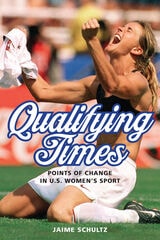
Beginning with the seemingly innocent ponytail, the subject of the Introduction, scholar Jaime Schultz challenges the reader to look at the historical and sociological significance of now-common items such as sports bras and tampons and ideas such as sex testing and competitive cheerleading. Tennis wear, tampons, and sports bras all facilitated women’s participation in physical culture, while physical educators, the aesthetic fitness movement, and Title IX encouraged women to challenge (or confront) policy, financial, and cultural obstacles.
While some of these points of change increased women's physical freedom and sporting participation, they also posed challenges. Tampons encouraged menstrual shame, sex testing (a tool never used with male athletes) perpetuated narrowly-defined cultural norms of femininity, and the late-twentieth-century aesthetic fitness movement fed into an unrealistic beauty ideal.
Ultimately, Schultz finds that U.S. women's sport has progressed significantly but ambivalently. Although participation in sports is no longer uncommon for girls and women, Schultz argues that these "points of change" have contributed to a complex matrix of gender differentiation that marks the female athletic body as different than--as less than--the male body, despite the advantages it may confer.
Quality Education for Latinos and Latinas
Print and Oral Skills for All Students, K–CollegeBy Rita and Marco Portales
University of Texas Press, 2005
As educators and legislators across the country debate how to improve public schools, the most vital factor often disappears from the equation—the relationship between the teacher and the student. According to veteran educators Rita and Marco Portales, this relationship is the central issue in the education of students, especially Latino/a students who often face serious barriers to school success because of the legacy of racism, insufficient English-language skills, and cultural differences with the educational establishment.
To break down these barriers and help Latino/a students acquire a quality education, the Portaleses focus attention on the teacher-student relationship and offer a proven method that teachers can use to strengthen the print and oral skills of their students. They begin by analyzing the reasons why schools too often fail to educate Latino/a students, using eloquent comments from young Latinos/as and their parents to confirm how important the teacher-student relationship is to the student's success. Then they show how all educational stakeholders—teachers, administrators, state education agencies, legislators, and parents—can work together to facilitate the teacher-student relationship and improve student education. By demonstrating how teachers can improve students' reading, critical thinking, writing, and oral communication skills across the curriculum, they argue that learning can be made more relevant for students, keeping their interest levels high while preparing them for academically competitive colleges.

Quantum Criminals
Ramblers, Wild Gamblers, and Other Sole Survivors from the Songs of Steely DanBy Alex Pappademas and Joan LeMay
University of Texas Press, 2023
“ONE OF THE SHARPEST, FUNNIEST, AND BEST BOOKS EVER ABOUT ANY ROCK ARTIST”—Rolling Stone
“WEIRD AND WONDROUS”—New York Times
“I ADORED IT”—Michael Chabon
A literary and visual exploration of the songs of Steely Dan.
Steely Dan’s songs are exercises in fictional world-building. No one else in the classic-rock canon has conjured a more vivid cast of rogues and heroes, creeps and schmucks, lovers and dreamers and cold-blooded operators—or imbued their characters with so much humanity.
Pulling from history, lived experience, pulp fiction, the lore of the counterculture, and their own darkly comic imaginations, Donald Fagen and Walter Becker summoned protagonists who seemed like fully formed people with complicated pasts, scars they don’t talk about, delusions and desires and memories they can’t shake. From Rikki to Dr. Wu, Hoops McCann to Kid Charlemagne, Franny from NYU to the Woolly Man without a Face, every name is a locked-room mystery, beguiling listeners and earning the band an exceptionally passionate and ever-growing cult fandom.
Quantum Criminals presents the world of Steely Dan as it has never been seen, much less heard. Artist Joan LeMay has crafted lively, color-saturated images of her favorite characters from the Daniverse to accompany writer Alex Pappademas’s explorations of the famous and obscure songs that inspired each painting, in short essays full of cultural context, wild speculation, inspired dot-connecting, and the occasional conspiracy theory. All of it is refracted through the perspectives of the characters themselves, making for a musical companion unlike any other. Funny, discerning, and visually stunning, Quantum Criminals is a singular celebration of Steely Dan’s musical cosmos.
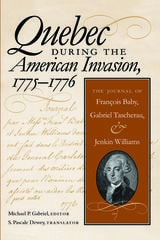
Quebec During the American Invasion, 1775-1776
The Journal of Francois Baby, Gabriel Taschereau, and Jenkin WilliamsMichael P. Gabriel
Michigan State University Press, 2005
Available for the first time in English, the 1776 journal of François Baby, Gabriel Taschereau, and Jenkin Williams provides an insight into the failure to incite rebellion in Quebec by American revolutionaries. While other sources have shown how British soldiers and civilians and the French-Canadian gentry (the seigneurs) responded to the American invasion of 1775–1776, this journal focuses on French-Canadian peasants (les habitants) who made up the vast majority of the population; in other words, the journal helps explain why Quebec did not become the "fourteenth colony."
After American forces were expelled from Quebec in early 1776, the British governor, Sir Guy Carleton, sent three trusted envoys to discover who had collaborated with the rebels from the south. They traveled to fifty-six parishes and missions in the Quebec and Trois Rivières district, discharging disloyal militia officers and replacing them with faithful subjects. They prepared a report on each parish, revealing actions taken to support the Americans or the king. Baby and his colleagues documented a wide range of responses. Some habitants enlisted with the Americans; others supplied them with food, firewood, and transportation. Some habitants refused to cooperate with the king’s soldiers. In some parishes, women were the Americans’ most zealous supporters. Overall, the Baby Journal clearly reveals that the habitants played an important, but often overlooked, role in the American invasion.

Queen Anne's War
The Second Contest for North America, 1702–1713Michael G. Laramie
Westholme Publishing, 2027
Told from the halls of power in North America and Europe, and through the eyes of the men and women who found themselves embroiled in this brutal realignment of colonial interests, Queen Anne’s War recreates the world of early North American expansion at the ground level, providing riveting accounts of the battles across settlements and wilderness as well as the motives, conditions, triumphs, and failures of the Europeans and their respective Native American allies. Based on extensive primary source research and command of English, French, and Spanish sources, the narrative not only describes the economic and geopolitical ramifications of the war that reshaped North America, but intriguingly reveals the sense of independence emerging in the colonies, from Puritan New England to plantation South Carolina, at the close of the war.
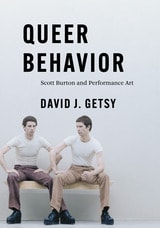
Queer Behavior
Scott Burton and Performance ArtDavid J. Getsy
University of Chicago Press, 2022
Scott Burton (1939–89) created performance art and sculpture that drew on queer experience and the sexual cultures that flourished in New York City in the 1970s. David J. Getsy argues that Burton looked to body language and queer behavior in public space—most importantly, street cruising—as foundations for rethinking the audiences and possibilities of art. This first book on the artist examines Burton’s underacknowledged contributions to performance art and how he made queer life central in them. Extending his performances about cruising, sexual signaling, and power dynamics throughout the decade, Burton also came to create functional sculptures that covertly signaled queerness by hiding in plain sight as furniture waiting to be used.
With research drawing from multiple archives and numerous interviews, Getsy charts Burton’s deep engagements with postminimalism, performance, feminism, behavioral psychology, design history, and queer culture. A restless and expansive artist, Burton transformed his commitment to gay liberation into a unique practice of performance, sculpture, and public art that aspired to be antielitist, embracing of differences, and open to all. Filled with stories of Burton’s life in New York’s art communities, Queer Behavior makes a case for Burton as one of the most significant out queer artists to emerge in the wake of the Stonewall uprising and offers rich accounts of queer art and performance art in the 1970s.
Queer Brown Voices
Personal Narratives of Latina/o LGBT ActivismEdited by Uriel Quesada, Letitia Gomez, and Salvador Vidal-Ortiz
University of Texas Press, 2015
In the last three decades of the twentieth century, LGBT Latinas/os faced several forms of discrimination. The greater Latino community did not often accept sexual minorities, and the mainstream LGBT movement expected everyone, regardless of their ethnic and racial background, to adhere to a specific set of priorities so as to accommodate a “unified” agenda. To disrupt the cycle of sexism, racism, and homophobia that they experienced, LGBT Latinas/os organized themselves on local, state, and national levels, forming communities in which they could fight for equal rights while simultaneously staying true to both their ethnic and sexual identities. Yet histories of LGBT activism in the 1970s, 1980s, and 1990s often reduce the role that Latinas/os played, resulting in misinformation, or ignore their work entirely, erasing them from history.
Queer Brown Voices is the first book published to counter this trend, documenting the efforts of some of these LGBT Latina/o activists. Comprising essays and oral history interviews that present the experiences of fourteen activists across the United States and in Puerto Rico, the book offers a new perspective on the history of LGBT mobilization and activism. The activists discuss subjects that shed light not only on the organizations they helped to create and operate, but also on their broad-ranging experiences of being racialized and discriminated against, fighting for access to health care during the HIV/AIDS epidemic, and struggling for awareness.

Queer Chimerica
A Speculative Auto/Ethnography of the Cool ChildShana Ye
University of Michigan Press, 2024
Blending archival work, ethnography, and cultural analysis with memoir, graphic arts, and science fiction, Queer Chimerica unpacks the ways in which the transnational circulation of queer culture, politics, and institutions are structured through the antagonist interdependence of China and the United States. By examining the intersecting timelines of the rise of queer theory and the rise of China in the late Cold War era, Shana Ye explores the relationship between the discourse of queer fluidity and capital’s demands for labor flexibility.
Drawing on rare archival material and oral historical accounts of queer life from the 1950s to the late 2010s, the author shows how these accounts make sense of the variegated landscapes of desires, transformations, and conundrums in postsocialist China. The author illustrates party cadres in the Cultural Revolution, tongzhi activism mediated by the explosive politics of Tiananmen upheaval, HIV/AIDS community outreach workers, feminist artists and digital activists, leftist queer theorists, and fictional bio-engineers, layering these vivid depictions to reveal the poetic messiness of queer world-making. Queer Chimerica offers insight into the governmentality of LGBT rights, the rules of legibility and recognition, the geo- and bio-politics of identity, and the class-ridden appropriation of queer history and community. Thus understanding the production of queerness unveils the uneven distributions of capital, knowledge, affect, and opportunity that reproduce queer precarity and agency.
Queer Family Values
Valerie Lehr
Temple University Press, 1999
The flaw in the fight for gay and lesbian marriage rights, argues Lehr in Queer Family Values, lies in its failure to call into question the forms of oppression -- gender, racial, and economic -- that lead society to privilege the nuclear family. Lehr calls for activists to counter conservative discourses that see the nuclear family -- what Lehr considers a socially defined institution that works to maintain, in various ways, inequalities among people -- as the only responsible and mature family alternative. She asks for an approach to family issues and individual liberty that challenges power rather than demands access to privilege. She advocates social policies that enhance the freedom of all people, not simply those gay and lesbian adults seeking to be part of the dominant vision of family in our society.
Analyzing recent works on family, gender, race, and class, Lehr shapes a theory of rights, freedom, and democracy that can liberate us from the strictures of conservative hegemony. She also provides practical examples of how activists can work for a more compassionate and caring society. She devotes a chapter, for example, to the responsibilities activists have to lesbian and gay youths, who -- unlike other children, who might find refuge from social injustice at home -- most often find in the traditional American home homophobia and isolation. Asserting that family care should be seen as a community function, Queer Family Values offers an alternative political strategy focused not on gaining rights, but on enhancing democracy and equality in private life.

Queer Gothic
George E. Haggerty
University of Illinois Press, 2000
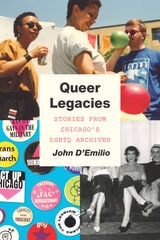
Queer Legacies
Stories from Chicago’s LGBTQ ArchivesJohn D'Emilio
University of Chicago Press, 2020
Queer Migration Politics
Activist Rhetoric and Coalitional PossibilitiesKarma Chavez
University of Illinois Press, 2013
Queer Migrations
Sexuality, U.S. Citizenship, and Border CrossingsEithne Luibheid
University of Minnesota Press, 2005
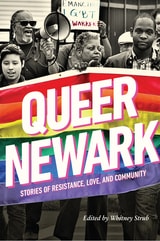
Queer Newark
Stories of Resistance, Love, and CommunityWhitney Strub
Rutgers University Press, 2024
Histories of gay and lesbian urban life typically focus on major metropolitan areas like San Francisco and New York, opportunity-filled destinations for LGBTQ migrants from across the country. Yet there are many other queer communities in economically depressed cities with majority Black and Hispanic populations that receive far less attention. Though just a few miles from New York, Newark is one of these cities, and its queer histories have been neglected—until now.
Queer Newark charts a history in which working-class people of color are the central actors and in which violence, poverty, and homophobia could never suppress joy, resistance, love, and desire. Drawing from rare archives that range from oral histories to vice squad reports, this collection’s authors uncover the sites and people of Newark’s queer past in bars, discos, ballrooms, and churches. Exploring the intersections of class, race, gender, and sexuality, they offer fresh perspectives on the HIV/AIDS epidemic, community relations with police, Latinx immigration, and gentrification, while considering how to best tell the rich and complex stories of queer urban life. Queer Newark reveals a new side of New Jersey’s largest city while rewriting the history of LGBTQ life in America.

Queer Optimism
Lyric Personhood and Other Felicitous PersuasionsMichael D. Snediker
University of Minnesota Press, 2008
A new paradigm for queer theory
Michael Snediker offers a much-needed counterpoint to queer theoretical discourse, which has long privileged melancholy, self-shattering, incoherence, shame, and the death drive. Recovering the forms of positive affect that queer theory has jettisoned, Snediker insists that optimism must itself be taken beyond conventional tropes of hope and futurity and reimagined as necessary for critical engagement.
Through fresh, perceptive, and sensitive readings of the poetry of Emily Dickinson, Hart Crane, Jack Spicer, and Elizabeth Bishop, Snediker reveals that each of these poets demonstrated an interest in the durability of positive affects. Dickinson, Snediker argues, expresses joy and grace as much as pain and loss, and the myriad cryptic smiles in Hart Crane’s White Building contradict prevailing narratives of Crane’s apocryphal literary failures and eventual suicide. Snediker’s ambitious and sophisticated study, informed by thinkers such as Winnicott, Deleuze, and de Man, both supplements and challenges the work of queer theory’s leading figures, including Judith Butler, Leo Bersani, Eve Kosofsky Sedgwick, and Lee Edelman. Queer Optimism revises our understanding of queer love and affiliation, examining Spicer’s serial collusion with matinee idol Billy the Kid as well as the critically neglected force of Bishop’s epistolary and poetic reparations of the drowned figure of Hart Crane. In doing so, Snediker persuasively reconceives a theoretical field of optimism that was previously unavailable to scrupulous critical inquiry and provides a groundbreaking approach to modern American poetry and poetics.
Queer People
Carroll and Garrett Graham. Afterword by Budd Schulberg.
Southern Illinois University Press, 1976
A brilliantly savage story, Queer People is, according to Budd Schulberg, “a racy testament to an era as totally vanished as the civilization of the Aztecs,” and if not the Hollywood novel is “at least a truly seminal work.”
Today’s readers will recognize in this long-forgotten Hollywood novel the seeds of three longer-lived ones, The Day of the Locust, What Makes Sammy Run?,and The Last Tycoon. They may also recognize Whitey, the hero of the Grahams’ novel, as a forerunner of F. Scott Fitzgerald’s Pat Hobby.
The central figure in the novel is an archetypal newspaper reporter who drifts to Hollywood. Whitey discovers the social microcosm of the studio-people, and finds himself in his element. He penetrates strange places and encounters queer people—the story conference, the three-day party, the titans and the moguls. When a murder ends his interlude he leaves Hollywood as casually as he discovered it.
Originally published in 1930 Queer People was a scandalous roman à clef, irreverent to the “industry,” and totally amoral—qualities lacking in later Hollywood fiction. Hence itis at once an important social document and an exciting original work.

Queer Ricans
Cultures and Sexualities in the DiasporaLawrence La Fountain-Stokes
University of Minnesota Press, 2009
Highlighting cultural and political resistance within Puerto Rico’s gay, lesbian, bisexual, and transgender subcultures, La Fountain-Stokes pays close attention to differences of gender, historical moment, and generation, arguing that Puerto Rican queer identity changes over time and is experienced in very different ways. He traces an arc from 1960s Puerto Rico and the writings of Luis Rafael Sánchez to New York City in the 1970s and 1980s (Manuel Ramos Otero), Philadelphia and New Jersey in the 1980s and 1990s (Luz María Umpierre and Frances Negrón-Muntaner), and Chicago (Rose Troche) and San Francisco (Erika López) in the 1990s, culminating with a discussion of Arthur Avilés and Elizabeth Marrero’s recent dance-theater work in the Bronx.
Proposing a radical new conceptualization of Puerto Rican migration, this work reveals how sexuality has shaped and defined the Puerto Rican experience in the United States.
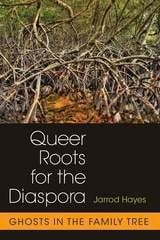
Queer Roots for the Diaspora
Ghosts in the Family TreeJarrod Hayes
University of Michigan Press, 2016
The central argument of Queer Roots for the Diaspora is that, in spite of these debates, ultimately the desire for roots contains the “roots” of its own deconstruction. The book considers alternative root narratives that acknowledge the impossibility of returning to origins with any certainty; welcome sexual diversity; acknowledge their own fictionality; reveal that even a single collective identity can be rooted in multiple ways; and create family trees haunted by the queer others patrilineal genealogy seems to marginalize.
The roots narratives explored in this book simultaneously assert and question rooted identities within a number of diasporas—African, Jewish, and Armenian. By looking at these together, one can discern between the local specificities of any single diaspora and the commonalities inherent in diaspora as a global phenomenon. This comparatist, interdisciplinary study will interest scholars in a diversity of fields, including diaspora studies, postcolonial studies, LGBTQ studies, French and Francophone studies, American studies, comparative literature, and literary theory.
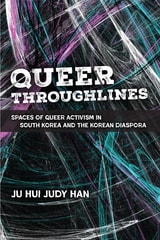
Queer Throughlines
Spaces of Queer Activism in South Korea and the Korean DiasporaJu Hui Judy Han
University of Michigan Press, 2025

Queer Traffic
Sex, Panic, Free TradeJennifer Tyburczy
Duke University Press, 2025
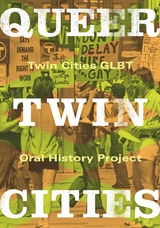
Queer Twin Cities
University of Minnesota Press, 2010
A pioneering look at the queer history, politics, and spaces of the Twin Cities
The Twin Cities is home to one of the largest and most vital GLBT populations in the nation—and one of the highest percentages of gay residents in the country. Drawn from the pioneering work of the Twin Cities GLBT Oral History Project—a collective organization of students, scholars, and activists devoted to documenting and interpreting the lives of GLBT people in Minneapolis and St. Paul—Queer Twin Cities is a uniquely critical collection of essays on Minnesota’s vibrant queer communities, past and present.
A rich blend of oral history, archival research, and ethnography, Queer Twin Cities uses sexuality to chart connections between people’s lives in Minnesota. Topics range from turn-of-the-century Minneapolis amid moral reform—including the highly publicized William Williams murder trial and efforts to police Bridge Square, aka ‘skid row’—to northern Minnesota and the importance of male companionship among lumber workers, and to postwar life, when the increased visibility of queer life went hand in hand with increased regulation, repression, and violence. Other essays present a portrait of early queer spaces in the Twin Cities, such as Kirmser’s Bar, the Viking Room, and the Persian Palms, and the proliferation of establishments like the Dugout and the 19 Bar. Exploring the activism of GLBT Two-Spirit indigenous people, the antipornography movements of the 1980s, and the role of gay men in the gentrification of Minneapolis neighborhoods, this volume brings the history of queer life and politics in the Twin Cities into fascinating focus.Engaging and revelatory, Queer Twin Cities offers a critical analysis of local history and community and fills a glaring omission in the culture and history of Minnesota, looking not only to a remarkable past but to our collective future.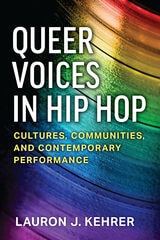
Queer Voices in Hip Hop
Cultures, Communities, and Contemporary PerformanceLauron J. Kehrer
University of Michigan Press, 2022
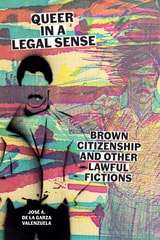
Queer in a Legal Sense
Brown Citizenship and Other Lawful FictionsJosé A. de la Garza Valenzuela
University of Texas Press, 2026
Contrasting works by queer Chicano writers against the legal landscape of sexuality and migration to interrogate the “lawful fiction” that denies queer migrants citizenship and community.
Activists for immigrants and queer people under assault by US authorities focus overwhelmingly on protections presumed to be afforded by citizenship through narratives that have rarely had a place for queer immigrants, who have consistently faced special obstacles to legal entry and citizenship that only recently are being applied more widely. Queer in a Legal Sense studies literary works by gay Chicanx writers alongside instruments of law, showing through this juxtaposition how racialized queer people have been imagined as nonviable from the standpoint of citizenship. In stories by John Rechy, Arturo Islas, Rigoberto González, Michael Nava, and Jaime Cortez, José de la Garza Valenzuela finds what has gone missing in the migrant movement’s pursuit of gendered avenues to civic participation. Further, these works illuminate the production of fictions in canons of law, like those announced by the Florida legislature’s “Purple Pamphlet” and by the US Supreme Court in Boutilier v. INS and Bowers v. Hardwick. Queer in a Legal Sense argues that, through selective ommissions and inclusions, legal fictions place queerness outside the boundaries of citizenship and powerfully undermine queer representation in pro-migrant advocacy.
Queer, Women of Color, and Critical Approaches to Feminist Mentorship and Pedagogy
Edited by Leandra H. Hernández, Stevie M. Munz, and Jessica Pauly
University of Illinois Press, 2025
The first section draws upon the contributors’ unique and situated experiences of mentorship in academia. Essays explore their past and current experiences with feminist mentorship in relationships that take many forms: faculty members with fellow faculty members; faculty members with undergraduate and graduate students; and faculty members who feel as if they have become family with their mentors and mentees. In the second section, the contributors deeply interrogate the practices of feminist mentoring by problematizing practices and offering new ways, places, and formats that make space and consider new possibilities. A conclusion reflects on the future of feminist mentorship amidst contemporary debates and concerns in higher education.
Enriching and hopeful, Queer, Women of Color, and Critical Approaches to Feminist Mentorship and Pedagogy is a much-needed challenge to traditional forms of mentorship.

Queering Cold War Poetry
Ethics of Vulnerability in Cuba and the United StatesEric Keenaghan
The Ohio State University Press, 2009

Queering Marriage
Challenging Family Formation in the United StatesKimport, Katrina
Rutgers University Press, 2013
Co-Winner of the 2015 Charles Tilly Award for Best Book of the Collective Behavior and Social Movements section from the American Sociological Association
Over four thousand gay and lesbian couples married in the city of San Francisco in 2004. The first large-scale occurrence of legal same-sex marriage, these unions galvanized a movement and reignited the debate about whether same-sex marriage, as some hope, challenges heterosexual privilege or, as others fear, preserves that privilege by assimilating queer couples.
In Queering Marriage, Katrina Kimport uses in-depth interviews with participants in the San Francisco weddings to argue that same-sex marriage cannot be understood as simply entrenching or contesting heterosexual privilege. Instead, she contends, these new legally sanctioned relationships can both reinforce as well as disrupt the association of marriage and heterosexuality.
During her deeply personal conversations with same-sex spouses, Kimport learned that the majority of respondents did characterize their marriages as an opportunity to contest heterosexual privilege. Yet, in a seeming contradiction, nearly as many also cited their desire for access to the normative benefits of matrimony, including social recognition and legal rights. Kimport’s research revealed that the pattern of ascribing meaning to marriage varied by parenthood status and, in turn, by gender. Lesbian parents were more likely to embrace normative meanings for their unions; those who are not parents were more likely to define their relationships as attempts to contest dominant understandings of marriage.
By posing the question—can queers “queer” marriage?—Kimport provides a nuanced, accessible, and theoretically grounded framework for understanding the powerful effect of heterosexual expectations on both sexual and social categories.
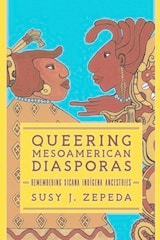
Queering Mesoamerican Diasporas
Remembering Xicana Indigena AncestriesSusy J. Zepeda
University of Illinois Press, 2022
A fascinating exploration of hidden Indígena histories and silences, Queering Mesoamerican Diasporas blends scholarship with spirit practices to reimagine the root work, dis/connection to land, and the political decolonization of Xicana/x peoples.
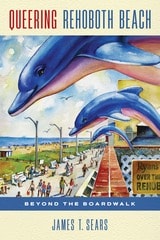
Queering Rehoboth Beach
Beyond the BoardwalkJames T. Sears
Temple University Press, 2024
Sears draws upon extensive oral history accounts, archival material, and personal narratives to chronicle “the Battle for Rehoboth,” which unfolded in the late 20th century, as conservative town leaders and homeowners opposed progressive entrepreneurs and gay activists. He recounts not just the emergence of the gay and lesbian bars, dance clubs, and organizations that drew the queer community to the region, but also the efforts of local politicians and homeowners, among other groups who fought to develop and protect the traditional identity of this beach town. Moreover, issues of race, class, and gender and sexuality informed opinions as residents and visitors struggled with the AIDS crisis and the legacy of Jim Crow.
Queering Rehoboth Beach is more than just an inspiring story about a community’s resilience and determination to establish a safe space for itself in the wake of the era of Don’t Ask, Don’t Tell. It is also a terrific beach read.

Queering Reproduction
Achieving Pregnancy in the Age of TechnoscienceLaura Mamo
Duke University Press, 2007
Mamo provides an overview of a shift within some lesbian communities from low-tech methods of self-insemination to a reliance on outside medical intervention and fertility treatments. Reflecting on the issues facing lesbians who become parents through assisted reproductive technologies, Mamo explores questions about the legal rights of co-parents, concerns about the genetic risks of choosing an anonymous sperm donor, and the ways decisions to become parents affect sexual and political identities. In doing so, she investigates how lesbians navigate the medical system with its requisite range of fertility treatments, diagnostic categories, and treatment trajectories. Combining moving narratives and insightful analysis, Queering Reproduction reveals how medical technology reconfigures social formations, individual subjectivity, and notions of kinship.
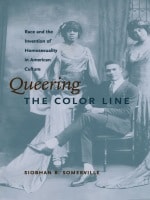
Queering the Color Line
Race and the Invention of Homosexuality in American CultureSiobhan B. Somerville
Duke University Press, 2000
At about the same time that the 1896 Supreme Court Plessy v. Ferguson decision hardened the racialized boundary between black and white, prominent trials were drawing the public’s attention to emerging categories of sexual identity. Somerville argues that these concurrent developments were not merely parallel but in fact inextricably interrelated and that the discourses of racial and sexual “deviance” were used to reinforce each other’s terms. She provides original readings of such texts as Havelock Ellis’s late nineteenth-century work on “sexual inversion,” the 1914 film A Florida Enchantment, the novels of Pauline E. Hopkins, James Weldon Johnson’s Autobiography of an Ex-Coloured Man, and Jean Toomer’s fiction and autobiographical writings, including Cane. Through her analyses of these texts and her archival research, Somerville contributes to the growing body of scholarship that focuses on discovering the intersections of gender, race, and sexuality.
Queering the Color Line will have broad appeal across disciplines including African American studies, gay and lesbian studies, literary criticism, cultural studies, cinema studies, and gender studies.
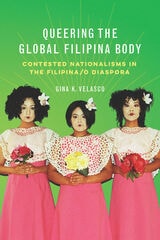
Queering the Global Filipina Body
Contested Nationalisms in the Filipina/o DiasporaGina K. Velasco
University of Illinois Press, 2020
Using a queer diasporic analysis, Velasco examines the politics of nationalism within Filipina/o American cultural production to consider an essential question: can a queer and feminist imagining of the diaspora reconcile with gendered tropes of the Philippine nation? Integrating a transnational feminist analysis of globalized gendered labor with a consideration of queer cultural politics, Velasco envisions forms of feminist and queer diasporic belonging, while simultaneously foregrounding nationalist movements as vital instruments of struggle.
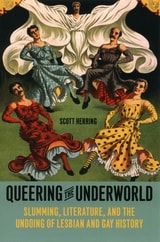
Queering the Underworld
Slumming, Literature, and the Undoing of Lesbian and Gay HistoryScott Herring
University of Chicago Press, 2007
In this major rethinking of American literature and culture, Scott Herring explores how a key group of authors manipulated this genre to paradoxically evade the confines of sexual identification. Queering the Underworld examines a range of writers, from Jane Addams and Willa Cather to Carl Van Vechten and Djuna Barnes, revealing how they fulfilled the conventions of slumming literature but undermined its goals, and in the process, queered the genre itself. Their work frustrated the reader’s desire for sexual knowledge, restored the inscrutability of sexual identity, and cast doubt on the value of a homosexual subculture made visible and therefore subject to official control.
Herring is persuasive and polemical in connecting these writers to ongoing debates about lesbian and gay history and politics, and Queering the Underworld will be widely read by students and scholars of literature, history, and sexuality.

Quick and Popular Reads for Teens
American Library Association, 2009

Quick
StoriesT. M. McNally
University of Michigan Press, 2004
The stories in Quick are complex, sometimes harsh, yet always unafraid of the dark truths many of the characters are forced to confront. Dense and layered, these miniature and compact sagas endow their often damaged characters with uncommon brilliance. Themes of love, loss, addiction, and courage roam freely throughout, and the author sets an unforgettable and palpable tone that is exceedingly spare yet faceted with views of the richness beneath the surface of everyday life.
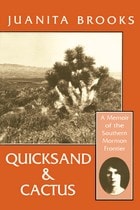
Quicksand and Cactus
Juanita Brooks
Utah State University Press, 1992
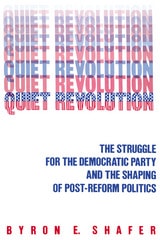
Quiet Revolution
Struggle for the Democratic Party and the Shaping of Post-Reform PoliticsByron E. Shafer
Russell Sage Foundation, 1983
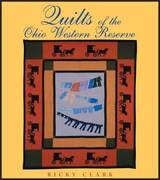
Quilts of the Ohio Western Reserve
Ricky Clark
Ohio University Press, 2005
Quilts of the Ohio Western Reserve includes early quilts brought from Connecticut to the Western Reserve in northeastern Ohio and contemporary quilts, including one by a conservative Amish woman and another inspired by Cleveland’s Rock and Roll Hall of Fame.
Ricky Clark, one of Ohio’s foremost quilt historians, has assembled exquisite examples of calamanco, “T” quilts, and borderless pieced quilts to show the influence of Connecticut aesthetics and history on the making of early quilts in this region. Rich in color, detail, and inventiveness, and often beautifully designed, the quilts of this region commemorate community history, from town fundraisers of the 1890s to a quilt designed by a Lake Erie shipbuilder. Sections of the book include quilts made during the Civil War and for postwar veterans’ organizations as well as military and presidential quilts that relate to the history of the Western Reserve.
Quilt design in Ohio has been celebrated in biennial exhibits, round-robin quilts, and most recently proudly painted on barns in rural Ohio. Quilts of the Ohio Western Reserve, lavishly illustrated with forty color photos of quilts, launches the Ohio Quilt Series. A welcome addition to Ohio’s cultural legacy, this book will interest the wider world of quilt and textile enthusiasts and historians.
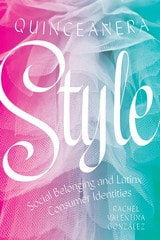
Quinceañera Style
Social Belonging and Latinx Consumer IdentitiesBy Rachel Valentina González
University of Texas Press, 2019
Winner of the Emily Toth Award for Best Single Work in Women's Studies, Popular Culture Association
Co-winner of the Elli Kongas Maranda Prize, Women's Section of the American Folklore Society (AFS)
A dynamic study of social negotiation and consumerism in the coming-of-age quinceañera celebration and the impact of normalizing spectacles of luxury.
Quinceañera celebrations, which recognize a girl’s transition to young womanhood at age fifteen, are practiced in Latinx communities throughout the Americas. But in the consumer-driven United States, the ritual has evolved from a largely religious ceremony to an elaborate party where social status takes center stage. Examining the many facets of this contemporary debut experience, Quinceañera Style reports on ethnographic fieldwork in California, Texas, the Midwest, and Mexico City to reveal a complex, compelling story. Along the way, we meet a self-identified transwoman who uses the quinceañera as an intellectual space in her activist performance art. We explore the economic empowerment of women who own barrio boutiques specializing in the quinceañera’s many accessories and made-in-China gowns. And, of course, we meet teens themselves, including a vlogger whose quince-planning tips have made her an online sensation.
Disrupting assumptions, such as the belief that Latino communities in the United States can’t desire upward mobility without abandoning ethnoracial cultural legacies, Quinceañera Style also underscores the performative nature of class and the process of constructing a self in the public, digital sphere.
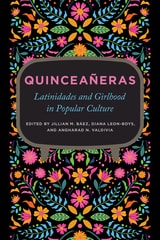
Quinceañeras
Latinidades and Girlhood in Popular CultureEdited by Jillian M. Báez, Diana Leon-Boys, and Angharad N. Valdivia
University of Illinois Press, 2026
Jillian M. Báez, Diana Leon-Boys, and Angharad N. Valdivia edit a collection that draws on the expanding field of girlhood studies to examine the increasing visibility of the event and the figure of the quinceañera herself in pop culture. The contributors focus on quinceañeras as a trope for English-language media’s treatment of Latina girlhoods and Latinx cultures but also examine how use of the quinceañera charts deepening openness and inclusivity within Latinx culture.
Timely and thought-provoking, Quinceañeras provides an interdisciplinary exploration of a celebration and its central figure within studies of Latina/o/x identity, race, class, gender, and sexuality.
Contributors: Sonya M. Alemán, Jillian M. Báez, Ariana A. Cano, Dolores Inés Casillas, Mari Castañeda, Michael Anthony DeAnda, Kelly Ferguson, Litzy Galarza, Rachel González-Martin, Jillian Hernandez, Karla Larrañaga, Diana Leon-Boys, Stephanie Melissa Pérez, Angharad N. Valdivia, and Claudia Evans-Zepeda

Quite Mad
An American Pharma MemoirSarah Fawn Montgomery
The Ohio State University Press, 2018
Blending memoir with literary journalism, Montgomery’s Quite Mad: An American Pharma Memoir examines America’s history of mental illness treatment—lobotomies to sterilization, the rest cure to Prozac—to challenge contemporary narratives about mental health. Questioning what it means to be a woman with highly stigmatized disorders, Montgomery also asks why mental illness continues to escalate in the United States despite so many “cures.” Investigating the construction of mental illness as a “female” malady, Montgomery exposes the ways current attitudes towards women and their bodies influence madness as well as the ways madness has transformed to a chronic Illness in our cultural imagination. Montgomery’s Quite Mad is one woman’s story, but it offers a beacon of hope and truth for the millions of individuals living with mental illness and issues a warning about the danger of diagnosis and the complex definition of sanity.
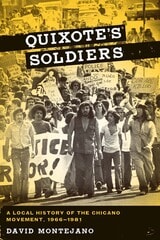
Quixote's Soldiers
A Local History of the Chicano Movement, 1966–1981By David Montejano
University of Texas Press, 2010