Results by title
2285 books match the query 'Women' and 9 start with q

Queen of the Confederacy
The Innocent Deceits of Lucy Holcombe PickensElizabeth Wittenmyer Lewis
University of North Texas Press, 2002
Queer Contiguities of Nigerian Literature
Kerry Manzo
Michigan State University Press, 2026
Queer, Women of Color, and Critical Approaches to Feminist Mentorship and Pedagogy
Edited by Leandra H. Hernández, Stevie M. Munz, and Jessica Pauly
University of Illinois Press, 2025
The first section draws upon the contributors’ unique and situated experiences of mentorship in academia. Essays explore their past and current experiences with feminist mentorship in relationships that take many forms: faculty members with fellow faculty members; faculty members with undergraduate and graduate students; and faculty members who feel as if they have become family with their mentors and mentees. In the second section, the contributors deeply interrogate the practices of feminist mentoring by problematizing practices and offering new ways, places, and formats that make space and consider new possibilities. A conclusion reflects on the future of feminist mentorship amidst contemporary debates and concerns in higher education.
Enriching and hopeful, Queer, Women of Color, and Critical Approaches to Feminist Mentorship and Pedagogy is a much-needed challenge to traditional forms of mentorship.
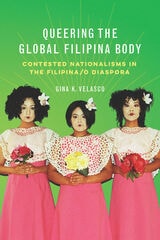
Queering the Global Filipina Body
Contested Nationalisms in the Filipina/o DiasporaGina K. Velasco
University of Illinois Press, 2020
Using a queer diasporic analysis, Velasco examines the politics of nationalism within Filipina/o American cultural production to consider an essential question: can a queer and feminist imagining of the diaspora reconcile with gendered tropes of the Philippine nation? Integrating a transnational feminist analysis of globalized gendered labor with a consideration of queer cultural politics, Velasco envisions forms of feminist and queer diasporic belonging, while simultaneously foregrounding nationalist movements as vital instruments of struggle.

Quicksand and Cactus
Juanita Brooks
Utah State University Press, 1992
Quicksand and Passing
Larsen, Nella
Rutgers University Press, 1986
"Quicksand and Passing are novels I will never forget. They open up a whole world of experience and struggle that seemed to me, when I first read them years ago, absolutely absorbing, fascinating, and indispensable." —Alice Walker
"A tantalizing mix of moral fable and sensuous colorful narrative, exploring female sexuality and racial solidarity."—Women's Studies International Forum
Rutgers' all-time bestselling book, Nella Larsen's novels Quicksand (1928) and Passing (1929) document the historical realities of Harlem in the 1920s and shed a bright light on the social world of the black bourgeoisie. The novels' greatest appeal and achievement, however, is not sociological, but psychological. As noted in the editor's comprehensive introduction, Larsen takes the theme of psychic dualism, so popular in Harlem Renaissance fiction, to a higher and more complex level, displaying a sophisticated understanding and penetrating analysis of black female psychology.
Passing is now a major motion picture written, produced, and directed by Rebecca Hall. It premiered at Sundance in 2021 and is available on Netflix.

Quiet Armor
PoemsStevie Edwards
Northwestern University Press, 2023
Quiet Armor, the third full-length collection from poet Stevie Edwards, examines how capitalism and patriarchy impact romantic relationships and, more broadly, intimacy. Edwards considers the ways in which confessional performances of vulnerability can be coercive, whether popular culture encourages men to seek validation through sexual excess and aggression, and how we encourage women to be complicit in figurative and literal violence against other women.
Drawing on historical and mythological figures—including Medusa, Persephone, Shakespeare’s Lavinia, Saint Agatha, and Saint Christina—Edwards builds a fierce investigation into how rape culture has shaped the literary canon, academia, and the world at large. She brings readers into the quiet and intimate spaces we create despite trauma—or perhaps even because of it. Ultimately, Quiet Armor seeks to reclaim positive intimacy, showing us not only the desperate battles but also the healing embraces. All the while, these poems ask us: What does the end of rape culture look like? How do we get there?

Quite Mad
An American Pharma MemoirSarah Fawn Montgomery
The Ohio State University Press, 2018
Blending memoir with literary journalism, Montgomery’s Quite Mad: An American Pharma Memoir examines America’s history of mental illness treatment—lobotomies to sterilization, the rest cure to Prozac—to challenge contemporary narratives about mental health. Questioning what it means to be a woman with highly stigmatized disorders, Montgomery also asks why mental illness continues to escalate in the United States despite so many “cures.” Investigating the construction of mental illness as a “female” malady, Montgomery exposes the ways current attitudes towards women and their bodies influence madness as well as the ways madness has transformed to a chronic Illness in our cultural imagination. Montgomery’s Quite Mad is one woman’s story, but it offers a beacon of hope and truth for the millions of individuals living with mental illness and issues a warning about the danger of diagnosis and the complex definition of sanity.
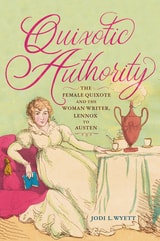
Quixotic Authority
The Female Quixote and the Woman Writer, Lennox to AustenJodi L. Wyett
University of Delaware Press, 2026